
A dashboard can show that organic traffic increased by 40% and still fail to answer the only question leadership actually cares about:
Did SEO contribute to revenue?
I have built reporting pipelines from data acquisition and transformation through to Looker Studio dashboards, KPI definitions, and business recommendations. The hardest part is rarely making the chart. It is deciding what the chart can honestly prove.
GA4 can show revenue it observed and attributed to organic search. It cannot see every search, every device, every unclicked brand exposure, every internal buying conversation, or every deal that continued inside your CRM.
That means reported organic revenue is not the same as SEO’s total commercial value.
But this does not give SEO a free pass. If you cannot connect the work to qualified leads, pipeline, customers, or revenue at all, you do not have a measurement strategy. You have an activity report.
Table of Contents
What Is SEO Revenue Reporting?
SEO revenue reporting connects organic visibility and traffic to business outcomes such as qualified leads, sales opportunities, purchases, and closed revenue. It combines search data, website analytics, CRM records, and attribution rules so decision-makers can see both the revenue directly credited to organic search and the wider pipeline SEO influenced.
A conventional SEO report normally starts with impressions, rankings, clicks, sessions, and perhaps conversions. Those metrics help me diagnose performance, but they are not all equally important.
A ranking is a leading indicator. Revenue is an outcome.
My reporting hierarchy looks like this:
- Search visibility creates qualified impressions and clicks.
- Organic visitors reach relevant commercial or educational pages.
- Some visitors complete a meaningful conversion.
- Qualified conversions become opportunities or purchases.
- Opportunities become closed revenue.
- Revenue is compared with the cost of the SEO program.
Every metric should have a place in that chain.
If clicks increase but qualified pipeline falls, the traffic may be irrelevant. If pipeline grows while GA4 sessions stay relatively flat, branded search, zero-click visibility, cross-device behavior, or attribution loss may be hiding part of the effect.
This is why I do not report one number without its surrounding mechanism.
Why Is GA4 Organic Revenue Usually Only Part Of The Story?
GA4 observes activity on tagged websites and apps. It loses visibility when users reject consent, block analytics, change devices, encounter stripped referral data, convert offline, or continue through systems that are not connected. Its organic revenue figure can therefore represent only the observable and attributable portion of SEO’s contribution.
Google explicitly acknowledges these measurement gaps. Its documentation explains that key-event modeling exists because some events cannot be directly observed due to privacy choices, technical restrictions, and cross-device behavior. Google also says it withholds modeled events when there is not enough data to model them confidently. Google Analytics: Modeled Key Events
GA4 also assigns traffic to (direct) / (none) when it does not have a clear referral source. Missing campaign information, redirects, URL shorteners, offline documents, and ad blockers can all contribute to this loss.
For SEO, the invisible portion can include:
- A buyer who finds you through an unbranded search, then returns on another device.
- A stakeholder who reads your article but passes your company name to a colleague.
- A prospect who sees your brand in Google or an AI answer without clicking.
- A lead who converts after GA4’s configured lookback window.
- A form submission that enters the CRM without its original source fields.
- A sale closed by a salesperson weeks or months after the website conversion.
- A customer who discovered you organically but later returns through a bookmark, email, or branded search.
GA4 cannot attribute a touchpoint it never observed.
But I would not publish the blanket claim that GA4 can never overreport organic revenue. Duplicate purchase events, self-referrals, incorrect channel definitions, missing paid UTMs, cross-domain errors, and attribution settings can all give organic search credit it did not earn.
My practical rule is more precise:
Once tracking and channel classification have been audited, treat observed GA4 organic revenue as a defensible minimum of directly measurable value, not a complete estimate of SEO’s total contribution.
That distinction protects credibility. We are acknowledging under-observation without declaring every invisible sale an SEO sale.
How Do You Connect SEO To Pipeline?
To connect SEO to pipeline, preserve the visitor’s original and converting source when a lead enters the CRM, associate that source with the contact and opportunity, and report the resulting qualified pipeline and closed revenue. GA4 explains website behavior; the CRM must become the source of truth for deal value and sales status.
For ecommerce, the transaction may happen on the website. For B2B and high-consideration services, the meaningful revenue event normally happens later.
A visitor becomes a form submission. The form submission becomes a contact. Sales qualifies the contact. A deal is created. The deal may close three months later.
GA4 alone does not manage that lifecycle.
I normally want the measurement chain to retain:
- Original source and medium.
- Landing page.
- Converting source and medium.
- Relevant campaign parameters.
- GA client, user, or session identifiers where the implementation and privacy rules permit them.
- Form or conversion type.
- CRM contact and company identifiers.
- Opportunity stage and value.
- Closed-won revenue.
- The dates of the first visit, conversion, opportunity creation, and close.
The biggest operational mistake is allowing the CRM’s lead-source field to be overwritten. When “organic search” becomes “email” because the contact clicked a nurture email before booking a demo, the acquisition story disappears.
I prefer separate fields for original source, converting source, and known influencing touches. Each answers a different question.
Report Sourced And Influenced Pipeline Separately
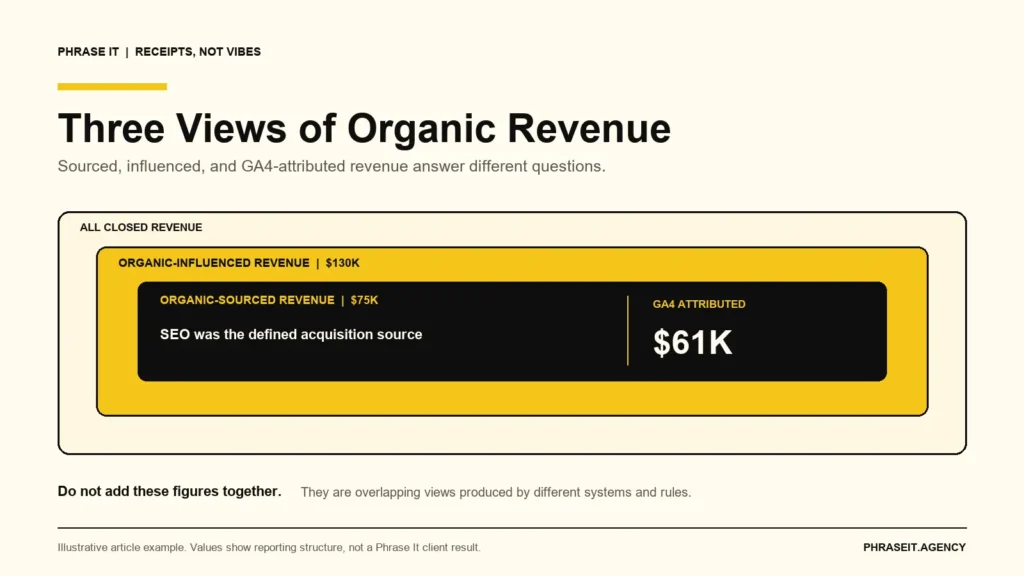
Organic-sourced pipeline includes opportunities where SEO was the defined acquisition touch, usually the first known interaction or the source attached when the contact was created.
Organic-influenced pipeline includes opportunities where an organic page or search visit appeared anywhere in the recorded path.
Do not add these figures together. Sourced pipeline is normally a subset of influenced pipeline.
For example:
- $180,000 in organic-sourced pipeline
- $310,000 in pipeline with at least one recorded organic interaction
- $75,000 in closed-won organic-sourced revenue
- $130,000 in closed-won revenue influenced by organic
This tells leadership far more than “organic conversions increased 22%.”
If your team needs senior ownership across analytics, strategy, prioritization, and implementation, that is part of what fractional SEO leadership should solve. The reporting system needs an owner, not just another dashboard.
Which Attribution Model Should You Use For SEO?
No attribution model reveals the objective truth about SEO. First-touch measures discovery, last-touch emphasizes conversion, and multi-touch distributes credit across recorded interactions. I recommend reporting at least two consistent views because each answers a different business question and every model is limited to the touchpoints your systems captured.
Google defines attribution models as rules or algorithms that assign credit to touchpoints preceding an important action. GA4 currently offers paid-and-organic data-driven attribution and last-click options for key-event reporting. Changing the model can also change the organic revenue shown in event-scoped reports.
Here is how I use the main views.
First-Touch Attribution
First-touch attribution asks: What introduced this customer to us?
It is useful for evaluating acquisition and demand creation. It often gives SEO more credit because educational and comparison searches frequently happen early.
Its weakness is obvious. It ignores the channels that nurtured and converted the buyer.
Last-Touch Attribution
Last-touch attribution asks: What interaction immediately preceded the conversion?
It helps evaluate conversion capture. It can favor branded search, email, paid retargeting, affiliates, and direct visits because these channels often appear late.
It can make early-stage SEO content look less valuable than it is.
Multi-Touch Or Data-Driven Attribution
Multi-touch attribution asks: Which recorded interactions participated in the path?
This is closer to how long buying processes work, but “multi-touch” does not mean “complete.” The model still cannot credit an unseen search impression, a blocked session, a private Slack recommendation, or a buying-committee conversation.
I normally show:
- Organic-sourced pipeline and revenue.
- Organic-influenced pipeline and revenue.
- GA4’s attributed key events and revenue.
- The attribution model and lookback window used.
- Known tracking gaps and changes.
That fifth item matters. A revenue chart without a measurement note invites false confidence.
Organic-Sourced Pipeline And Revenue
This measures deals where organic search was the defined acquisition source.
Example:
- Someone discovers the company through a non-branded Google search.
- They land on an article or service page.
- Their original source is saved as
google / organic. - They submit a form.
- The lead becomes a $30,000 opportunity.
- The opportunity closes for $25,000.
Your report records:
- $30,000 in organic-sourced pipeline
- $25,000 in organic-sourced revenue
This normally requires hidden form fields or another tracking method that carries the original source and landing page into HubSpot, Salesforce, Pipedrive, or another CRM.
Organic-Influenced Pipeline And Revenue
This measures deals where organic search appeared somewhere in the recorded buying path, even if it was not the first or final touch.
For example:
LinkedIn ad → Google organic article → email → demo request
If that contact creates a $30,000 opportunity, the deal contributes:
- $0 to organic-sourced pipeline if LinkedIn was the original source
- $30,000 to organic-influenced pipeline because organic search participated
Influenced revenue shows SEO’s supporting role in a multi-channel buying process. It should be reported separately from sourced revenue.
Do not add sourced and influenced figures together. Sourced deals are usually included within the larger influenced group.
GA4’s Attributed Key Events And Revenue
This is what GA4 assigns to organic search under its own tracking and attribution rules.
It may include:
- Purchases and purchase revenue
- Form submissions
- Demo requests
- Trial registrations
- Account signups
- Other configured key events
- Assigned values for lead-generation events
GA4 is most useful for understanding what happened on the website. Your CRM or ecommerce backend should remain the source of truth for opportunity value, actual orders, refunds, and closed revenue.
GA4 may report less than your backend because it cannot observe every user or transaction. It can also misattribute revenue when tracking is broken, events are duplicated, or channel rules are incorrect.
Attribution Model And Lookback Window
The attribution model determines which recorded channel receives credit.
For example, consider this path:
Organic search → LinkedIn ad → email → purchase
Depending on the model:
- First-touch credits organic search because it created the first recorded visit.
- Last-touch credits email because it immediately preceded the purchase.
- Data-driven attribution may divide credit among several recorded interactions.
The lookback window determines how far back the system searches for eligible interactions.
If organic search introduced a buyer 100 days before the sale but the lookback window is 90 days, that organic interaction may not receive credit. This is particularly important for B2B companies with long sales cycles.
Your report should therefore say something like:
GA4 revenue uses paid-and-organic data-driven attribution with a 90-day lookback window. CRM-sourced pipeline uses the contact’s preserved original source.
Without this note, two reports can display different organic revenue figures while both are technically following their configured rules.
Known Tracking Gaps And Changes
This is the quality-control note explaining what the numbers cannot see and what changed during the reporting period.
Examples include:
- Consent rejection prevents some sessions from being observed.
- Ad blockers interfere with analytics collection.
- Original-source fields are missing from older CRM records.
- Cross-domain tracking was corrected on June 12.
- Purchase events were duplicated before June 5.
- The attribution model changed during the quarter.
- Sales sometimes creates opportunities without associating a contact.
- Offline sales are not sent back to GA4.
- The website and CRM use different time zones.
- The typical sales cycle is longer than GA4’s lookback window.
This information does not weaken the report. It prevents false conclusions.
A concise executive summary could look like this:
| Reporting View | Result | What It Means |
|---|---|---|
| Organic-sourced pipeline | $180,000 | Opportunities acquired through organic search |
| Organic-sourced revenue | $75,000 | Closed revenue from organic-acquired contacts |
| Organic-influenced pipeline | $310,000 | Opportunities with organic in the recorded path |
| Organic-influenced revenue | $130,000 | Closed revenue with a recorded organic interaction |
| GA4 organic revenue | $61,000 | Website revenue credited to organic under GA4’s model |
| Attribution | Data-driven, 90 days | Rules GA4 used to allocate credit |
| Known gap | CRM source capture added May 1 | Earlier pipeline is less completely attributed |
The honest conclusion would be:
Organic search directly sourced $75,000 in recorded closed revenue and appeared in journeys representing $130,000 in closed revenue. GA4 attributed $61,000 to organic search under its data-driven model. Because CRM source capture began on May 1, these figures do not represent every organic interaction or deal from the period.
I’ll review your current SEO reporting setup, identify where attribution is breaking, and show you how to connect organic search with qualified leads, pipeline, and closed revenue.
Book a strategy callCan GA4 And CRM Revenue Be Reconciled?
GA4 and CRM or ecommerce-platform revenue should be reconciled, but they should not be expected to match exactly. GA4 reports observed events under its identity and attribution rules, while the backend records actual orders or deals. The useful question is whether the difference is understood, stable, and small enough for the decision being made.
For total revenue, I treat the ecommerce platform, finance system, or CRM as the commercial source of truth.
GA4 is the behavioral and attribution layer.
I investigate:
- Purchases missing from GA4.
- Duplicate purchase events.
- Incorrect or reused transaction IDs.
- Payment gateways creating self-referrals.
- Cross-domain tracking failures.
- Consent-mode behavior.
- Currency and tax differences.
- Returns, cancellations, and refunds.
- Internal or test transactions.
- CRM records with missing or overwritten sources.
- Different time zones and reporting windows.
I then calculate a coverage ratio:
Observed GA4 revenue ÷ backend revenue × 100
If the store recorded $500,000 and GA4 observed $410,000, the coverage ratio is 82%. That does not mean I multiply every channel’s revenue by 1.22. Missing transactions may not share the same channel mix as observed transactions.
The ratio is a measurement-health indicator, not an automatic correction factor.
Google also notes that attributed key-event data may continue updating for up to 12 days. I avoid presenting the most recent period as final when modeling or processing is still underway.
What Should An SEO Revenue Report Include?
An effective SEO revenue report includes business outcomes, conversion quality, leading indicators, costs, attribution assumptions, and recommended actions. Executives should see revenue and pipeline first. SEO teams can then use landing-page, query, ranking, and technical data to explain why the outcomes changed and what should happen next.
I structure the report in four layers.
1. Commercial Outcomes
For ecommerce businesses, I usually start by modeling what changes in traffic and conversion rate could mean for revenue before deciding how much ecommerce SEO investment is justified.
- Organic-sourced pipeline.
- Organic-influenced pipeline.
- Closed-won organic revenue.
- Ecommerce organic revenue.
- New customers from organic search.
- Average deal or order value.
- Organic customer acquisition cost.
- SEO return on investment.
The basic ROI formula is:
(Organic profit or attributed value − SEO cost) ÷ SEO cost × 100
Use profit where it is available. Revenue is not profit, particularly in ecommerce. For ecommerce businesses, I usually start by modeling what changes in traffic and conversion rate could mean for revenue before deciding how much SEO investment makes sense.
2. Conversion Quality
Then show:
- Qualified leads from organic search.
- Lead-to-opportunity rate.
- Opportunity-to-customer rate.
- Revenue per organic lead.
- Revenue per organic session.
- Trial-to-paid or signup-to-paid rate.
- Performance by landing page or search-intent group.
This is where an SEO report becomes strategically useful. A page that generated 50 leads and no opportunities should not outrank a page that generated five leads and two large deals merely because its conversion count is higher.
3. Leading Indicators
Revenue is delayed. I still need earlier signals to manage the work:
- Non-brand clicks and impressions.
- Visibility for commercially relevant topics.
- Organic sessions to money pages.
- Conversion rate by landing-page type.
- New ranking pages.
- Indexed and crawlable commercial pages.
- Branded-search movement.
- AI referral conversions and visibility, where measurable.
A 2025 organic-growth Omniscient Digital: Measuring Organic Growth studt found that respondents prioritized revenue, conversion rate, and pipeline, yet only 27.1% of the full sample reported pipeline and revenue growth to stakeholders. Nearly half reported traffic growth instead. The survey also found that 40.1% of Google Analytics users relied on GA alone, without another key revenue-tracking component.
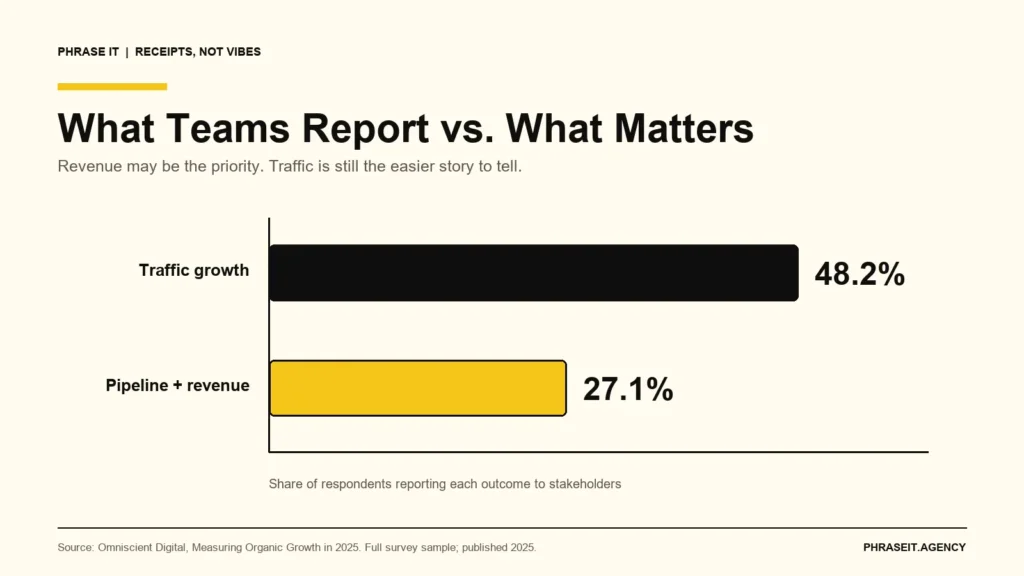
That gap is exactly why reporting expertise matters. The easy metrics are not always the decision-making metrics.
4. Decisions And Next Actions
Every report should end with decisions:
- Which landing pages deserve further investment?
- Which topics attract qualified buyers rather than incidental traffic?
- Where does organic traffic fail to convert?
- Which CRM or analytics gaps prevent reliable attribution?
- Which SEO work has the strongest commercial evidence?
- What should be stopped, fixed, expanded, or tested next?
A report is not finished when the charts load. It is finished when the team knows what to do.
How Much Revenue Should SEO Receive Credit For?
SEO should receive credit according to a documented attribution rule, not whichever model produces the largest number. Report directly sourced revenue, recorded influence, and modeled or inferred impact separately. This gives leadership a credible range while preventing assisted revenue, brand demand, and unobserved touchpoints from being presented as proven SEO revenue.
I use three evidence levels.
Observed value is directly recorded and attributed under a named rule. Examples include an organic ecommerce purchase or a closed deal whose preserved first-touch source is organic search.
Influenced value means organic search appeared in the recorded path, but other channels also participated.
Directional value includes evidence that SEO may be contributing beyond recorded clicks, such as increasing branded search, assisted conversions, high-value page engagement, AI visibility, or customer survey responses.
Directional evidence matters. It just should not be relabeled as directly attributed revenue.
This also prevents double-counting across marketing teams. If SEO, paid search, email, and social all claim 100% of influenced revenue, the combined report becomes fiction.
How Do You Report SEO When Tracking Is Incomplete?
When tracking is incomplete, report the reliable data, disclose the gap, and create a measurement improvement plan. Do not estimate unsupported revenue simply to fill the dashboard. Use qualified conversions, CRM matching, landing-page cohorts, self-reported attribution, and leading indicators until stronger revenue attribution becomes available.
I would rather show a conservative number with a clear limitation than a precise-looking number built on broken fields.
A minimum viable setup includes:
- Correct GA4 tagging and tested key events.
- Search Console connected to landing-page reporting.
- Stable source and medium definitions.
- Original-source fields captured with form submissions.
- CRM opportunity stages and values maintained.
- Ecommerce transaction IDs or CRM record IDs that prevent duplicates.
- A written attribution model and lookback period.
- A recurring GA4-to-backend reconciliation check.
For long B2B buying cycles, I also like a well-designed “How did you hear about us?” field. Self-reported attribution will not produce a perfect database, but it can reveal untracked discovery from Google, word of mouth, podcasts, communities, and AI platforms.
It is another lens, not a replacement for behavioral data.
What Questions Should Leadership Ask About SEO Revenue?
Leadership should ask how revenue was attributed, how much pipeline was sourced versus influenced, which system owns the final revenue number, and what portion of the journey remains unobserved. These questions reveal whether the report supports investment decisions or merely gives traffic metrics a financial-looking label.
The questions I want stakeholders to ask are:
- What exactly qualifies as organic-sourced revenue?
- Does this report use first-touch, last-touch, or data-driven attribution?
- Are sourced and influenced pipeline separated?
- Is revenue taken from GA4, the CRM, the store, or the finance system?
- How much backend revenue did GA4 observe?
- Are refunds and cancellations included?
- Can lead sources be overwritten inside the CRM?
- How long is the typical sales cycle?
- What happened to organic conversion quality, not just volume?
- Which pages and topics produced opportunities or customers?
- What known tracking gaps could change the interpretation?
- What decision should we make from this report?
Those are not objections to SEO. They are signs of a mature measurement process.
SEO Revenue Reporting Is A Decision System
The goal of SEO revenue reporting is not to manufacture a perfect attribution number. It is to give the business enough trustworthy evidence to make better investment decisions. That requires a chain from search visibility to conversions, pipeline, and revenue, plus an honest account of what analytics can and cannot observe.
I care deeply about rankings, clicks, technical health, and visibility because they explain what is happening.
I care more about qualified pipeline and revenue because they explain why the work matters.
The best report holds both ideas at once: SEO must be commercially accountable, and the revenue visible in GA4 is not the full boundary of SEO’s influence.
If your existing reporting stops at traffic, I can help you build the missing chain across Search Console, GA4, your CRM, and the decisions your team needs to make. Phrase It’s SEO services are structured around business outcomes, prioritization, and measurement rather than rankings for their own sake.
Frequently Asked Questions About SEO Revenue Reporting
How Do You Measure Revenue From SEO?
Measure SEO revenue by connecting organic traffic and landing-page data to purchases or CRM opportunities. Use your ecommerce platform or CRM as the source of truth for actual revenue, then apply a documented attribution model to determine whether organic search sourced, converted, or influenced the customer.
Can GA4 Track Revenue From Organic Search?
GA4 can track ecommerce revenue and key-event value attributed to organic search when tagging, consent behavior, channel definitions, and transaction events work correctly. It cannot observe every buyer interaction or downstream sale, so reconcile it with your ecommerce platform, CRM, and finance data.
Why Is GA4 Revenue Lower Than Actual Revenue?
GA4 revenue may be lower because of rejected consent, ad blockers, browser restrictions, missing tags, cross-domain problems, failed events, or transactions completed outside the website. Timing, currencies, refunds, and implementation errors can also create differences.
Can GA4 Overreport Organic Revenue?
Yes. GA4 may overreport organic revenue if purchase events fire twice, paid links lack correct UTMs, referral exclusions are wrong, or channel rules misclassify sessions. An attribution model can also give organic more credit than another model would. Audit the implementation before treating GA4 organic revenue as a conservative floor.
How Do You Connect SEO Leads To CRM Pipeline?
Capture the lead’s original source, landing page, and converting source when the form is submitted. Preserve those fields in the CRM, associate the contact with an opportunity, and report opportunity value and closed revenue by source. Do not allow the original-source field to be overwritten.
Should SEO Be Measured By First-Touch Or Last-Touch Attribution?
Use first-touch when evaluating discovery and acquisition. Use last-touch when evaluating which channel captured the conversion. For a balanced executive view, report organic-sourced and organic-influenced revenue separately and state the model used.
What SEO Metrics Matter Most To Executives?
Executives generally need organic-sourced revenue, influenced pipeline, qualified leads, new customers, customer acquisition cost, and ROI. Rankings, clicks, and technical metrics still matter, but they should explain changes in business outcomes rather than lead the executive report.
How Often Should SEO Revenue Be Reported?
Review operational indicators weekly or monthly, pipeline monthly, and closed revenue quarterly. Match the reporting window to the sales cycle. A B2B company with a six-month buying process should not judge recent SEO work using only this month’s closed deals.