
Can ChatGPT do SEO?
Yes – but not in the way the loudest AI automation posts would have you believe.
ChatGPT can help research topics, classify keywords, draft briefs, rewrite copy, analyze exported data, generate code, propose internal links, and explain technical issues. What it cannot reliably do by itself is choose the right strategy, access every piece of live SEO data, verify its own output, safely implement technical changes, or prove that its work improved organic performance.
I wanted a better answer than another list of “50 ChatGPT SEO prompts.” So I analyzed 70 eligible units from 52 public Reddit and LinkedIn URLs, including 54 firsthand accounts of people using ChatGPT for SEO.
The answer in those accounts was remarkably consistent:
ChatGPT works best inside an SEO workflow. It does not replace the workflow – or the person responsible for it.
TL;DR: Can ChatGPT Do SEO?
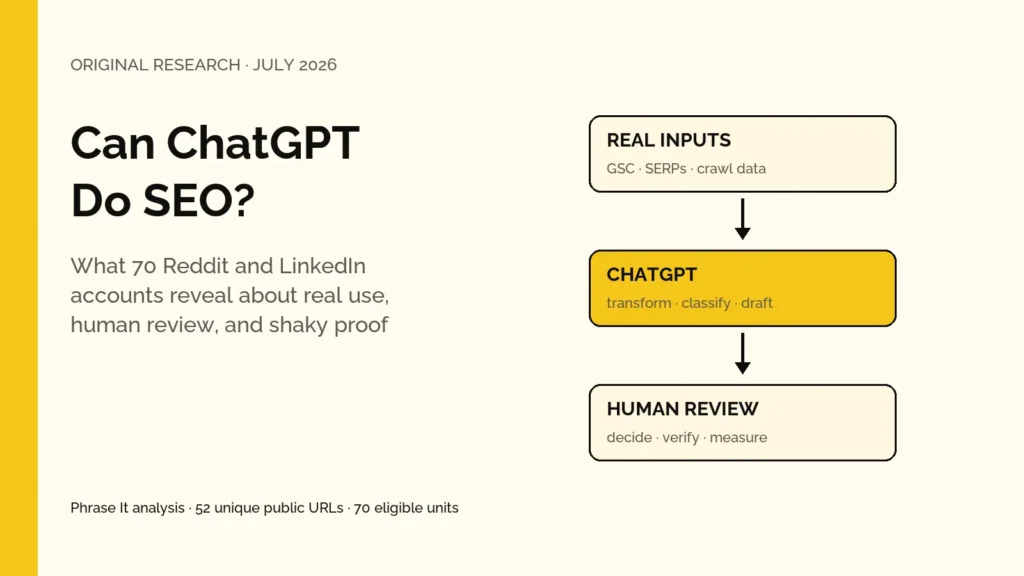
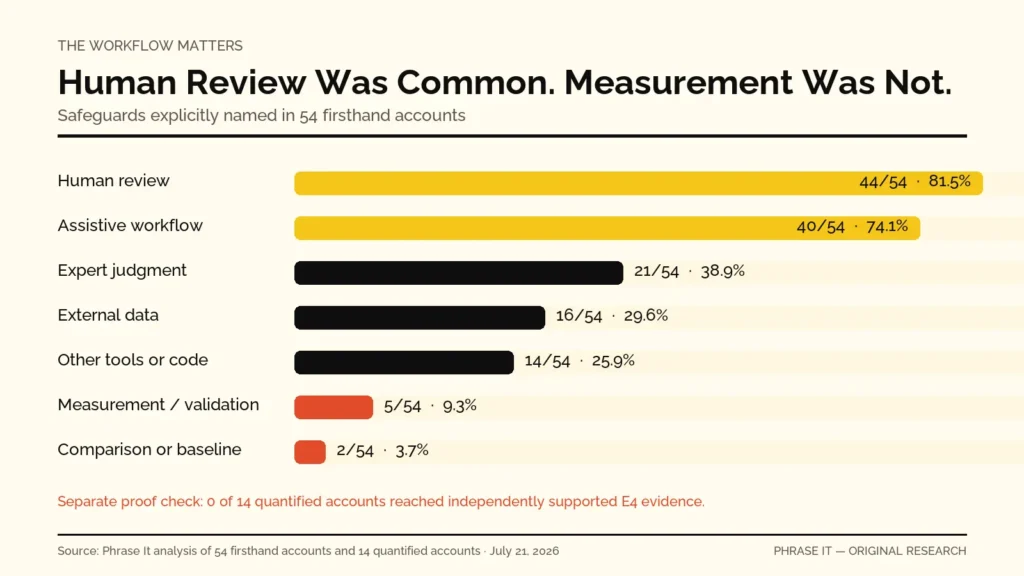
ChatGPT can perform parts of SEO, especially drafting, editing, classification, analysis, and repetitive transformation work. It cannot reliably replace keyword databases, crawling software, analytics, technical implementation, business judgment, or human quality control. In our sample, 74.1% of firsthand accounts described ChatGPT as an assistant rather than an autonomous SEO operator.
The most important findings:
- 40 of 54 firsthand accounts described an assistive workflow.
- 44 of 54 explicitly included human review.
- Content drafting was the most common use, but editing, briefs, clustering, reporting, and automation were also prominent.
- Only 5 of 54 accounts named a measurement or validation step.
- None of the 14 quantified stories reached our independently supported evidence level.
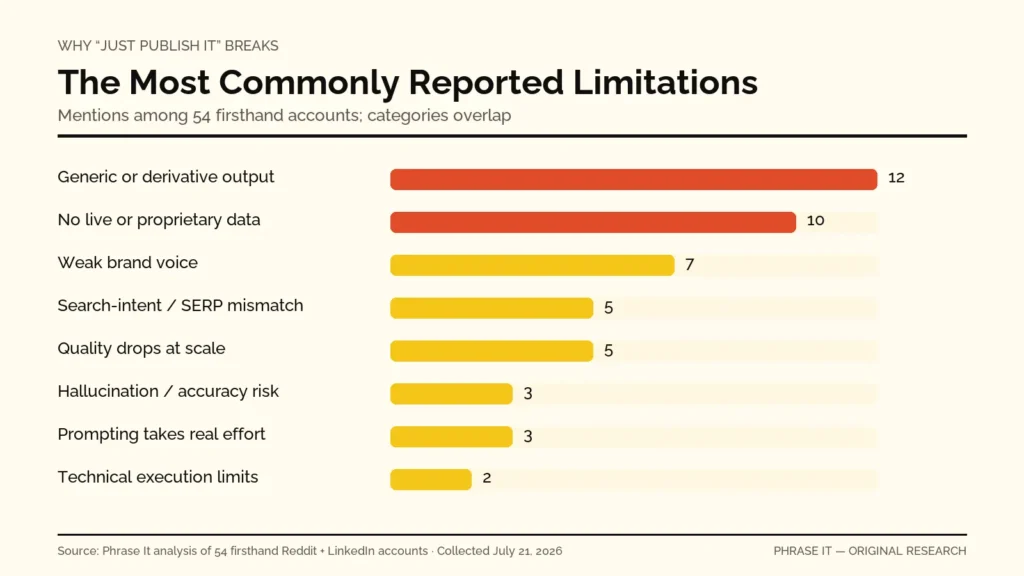
- Generic output and missing live data were the most frequently reported limitations.
- Every outcome claim connected to visible commercial interest had at least one prespecified credibility flag.
That does not mean ChatGPT is ineffective.
It means “ChatGPT helped me complete SEO work” and “ChatGPT did my SEO” are two very different claims.
Table of Contents
What Our Original Research Found
Our purposive sample covered 70 Reddit and LinkedIn units collected on July 21, 2026. Of those, 54 described firsthand use and 16 were claims or general guidance. The study was designed to distinguish practical workflows from promotional claims – not to estimate how every SEO professional uses ChatGPT.
| Finding | Result | What It Suggests |
| Assistive workflows | 40 of 54, or 74.1% | ChatGPT usually supports human-led SEO work |
| Explicit human review | 44 of 54, or 81.5% | Review is part of the normal workflow, not an optional extra |
| Content drafting | 22 of 54, or 40.7% | Drafting is common, but not the only serious use |
| Editing and QA | 19 of 54, or 35.2% | Practitioners frequently use AI after or around the first draft |
| Measurement or validation | 5 of 54, or 9.3% | Public discussions emphasize production more than proof |
| Independently supported quantified outcomes | 0 of 14 | Performance stories should be treated as unverified self-reports |
These categories overlap. One practitioner could use ChatGPT to cluster keywords, build a brief, edit a draft, and analyze the resulting Search Console data.
The sample also included more Reddit material than LinkedIn material: 50 units came from Reddit and 20 from LinkedIn. That was intentional because the research question called for firsthand community discussion, while LinkedIn was particularly useful for examining public claims tied to visible commercial interests.
How People Actually Use ChatGPT for SEO
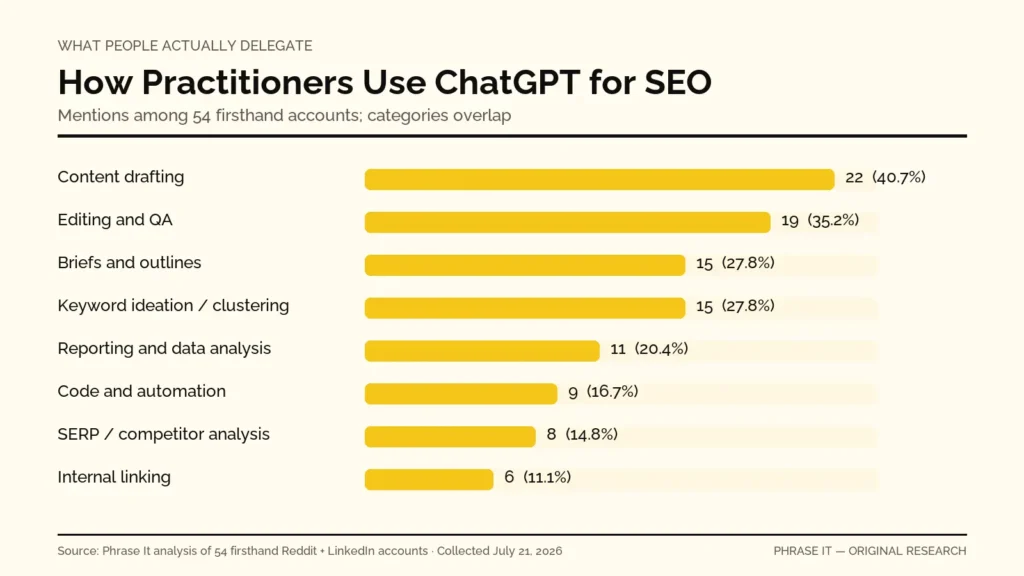
People used ChatGPT across the SEO process, but content-related and organizational tasks appeared most often. Drafting led the sample, followed by editing, briefs, keyword ideation, reporting, automation, and SERP analysis. Technical implementation appeared much less frequently and was normally paired with specialist tools or human checks.
Content Drafting
Content drafting appeared in 22 of the 54 firsthand accounts.
That does not mean 22 people were publishing untouched ChatGPT articles. Many described more controlled uses:
- Turning notes or interviews into a first draft
- Rewriting a difficult section
- Generating several introductions to compare
- Converting research into a specific format
- Creating product-description variants
- Drafting FAQs from supplied questions
- Expanding an approved outline one section at a time
This distinction matters.
Giving ChatGPT a keyword and asking for a complete article forces it to invent much of the strategy, evidence, voice, and detail. Giving it interview notes, verified sources, customer language, a SERP-informed brief, and explicit editorial rules turns it into a transformation tool.
The second workflow is far more defensible.
Editing And Quality Assurance
Editing and QA appeared in 19 accounts.
People used ChatGPT to:
- Find repetition
- Shorten overlong paragraphs
- Check whether a section answered its heading
- Compare content against a brief
- Create revision checklists
- Identify unsupported claims
- Standardize formatting
- Produce alternative titles and metadata
- Flag missing explanations or examples
I use AI this way myself. It is useful for performing a consistent first-pass review, but I do not let it decide whether the argument is commercially sound, whether an example reflects real experience, or whether a recommendation is safe to publish.
Those decisions stay human-owned.
Briefs, Outlines, And Keyword Clustering
Briefs and outlines appeared in 15 accounts. Keyword ideation or clustering also appeared in 15.
ChatGPT is good at semantic grouping. Give it a list of terms, and it can quickly identify similar phrases, entities, modifiers, and apparent intent patterns.
But semantic similarity is not the same as SEO clustering.
Two keywords that sound different may belong on one page because Google returns substantially overlapping results. Two phrases that sound similar may require separate pages because the search intent differs.
That is why I would not ask ChatGPT to invent keywords and finalize a page map in one step. I would export real data, inspect the relevant SERPs, and then use ChatGPT to help organize the evidence.
| Weak Workflow | Stronger Workflow |
| Ask ChatGPT to invent keywords and search volumes | Export keywords from GSC, Ahrefs, Semrush, or another real source |
| Group keywords by wording alone | Add SERP overlap or ranking URL data |
| Accept every proposed cluster | Review intent, business relevance, and page type |
| Create a page for every cluster | Check whether an existing page should be improved instead |
| Treat generated priorities as strategy | Add conversion potential, authority, margins, and capacity |
Reporting And Data Analysis
Reporting and analysis appeared in 11 firsthand accounts.
This is one of ChatGPT’s strongest practical applications because the model does not have to invent the data when you provide it. It can help classify rows, summarize changes, identify unusual segments, generate formulas, create charts, and turn a technical export into a stakeholder-friendly explanation.
OpenAI’s current documentation confirms that ChatGPT can analyze uploaded spreadsheets and structured files, create charts, and run Python-based calculations. It also explicitly recommends reviewing the code, assumptions, and outputs before relying on the analysis. OpenAI’s data-analysis guidance
The distinction is simple:
- “Tell me how my SEO performed” invites guesswork.
- “Analyze this Search Console export using these definitions” gives ChatGPT something concrete to calculate.
Code And Automation
Nine accounts mentioned code or automation.
Reported applications included regex, spreadsheet formulas, Apps Script, Python, schema templates, data cleanup, and repetitive metadata work.
I have built AI-assisted workflows that move SEO and AI-referral data into Sheets and reporting dashboards. The valuable part is not asking AI to “do reporting.” It is defining the source, calculation, exception handling, and output clearly enough that the automation produces something trustworthy.
Generated code still needs testing. Generated schema still needs validation. A technically plausible answer is not automatically a production-safe answer.
If your team wants useful AI-assisted SEO workflows without handing strategy to a chatbot, explore Phrase It’s fractional SEO support. I can help define the process, data, review rules, and measurements before you automate it.
The Human Review Pattern Is the Real Answer
The strongest pattern was not a particular prompt or SEO task. It was the presence of human control. Explicit human review appeared in 44 of 54 firsthand accounts, while expert judgment appeared in 21. By comparison, only five accounts explicitly named measurement or validation.
A reliable ChatGPT SEO workflow usually has three layers.
1. Give It Real Inputs
Useful inputs might include:
- Search Console queries and landing pages
- GA4 landing-page and conversion data
- A keyword export
- A crawl export
- Ranking URLs
- Product and category information
- Customer interviews
- Sales-call transcripts
- Brand and editorial rules
- Approved internal-link targets
- Current documentation or trusted sources
ChatGPT can search the public web when the relevant search or research functionality is enabled. Deep Research can also synthesize public sources, uploaded files, and connected sources into a cited report. That makes current research possible – but it does not remove the need to inspect the sources. OpenAI’s Deep Research documentation
2. Use ChatGPT To Transform The Inputs
This is where the tool earns its place.
It can:
- Classify rows
- Group similar items
- Extract themes
- Propose alternatives
- Rewrite content
- Convert formats
- Summarize findings
- Generate formulas or code
- Compare a draft against stated requirements
- Turn technical findings into plain English
These are bounded jobs. The input, expected output, and review criteria can all be described.
3. Keep Decisions And Validation Outside The Model
A person still needs to decide:
- Which keyword is commercially worthwhile
- Whether two queries share an intent
- Which page should rank
- Whether the content adds anything original
- Whether a technical recommendation is safe
- Whether an internal link helps the reader
- Whether a result is statistically or commercially meaningful
- Whether the work improved rankings, qualified traffic, leads, or revenue
That final layer is where “AI SEO automation” claims often become fuzzy.
Production is easy to demonstrate. Incremental business impact is much harder.
Why ChatGPT SEO Success Stories Need Scrutiny
The public web contains impressive claims about AI-generated traffic, rankings, content writing volume, and time savings. Some may be genuine. But a number without an inspectable baseline, clear attribution, reproducible method, or independent evidence should be treated as a self-reported outcome – not proof that ChatGPT caused the result.
Our sample included 14 quantified firsthand stories. None reached the study’s independently supported E4 evidence level.
The study also examined 14 outcome-claim units connected to visible commercial interest. All 14 carried at least one prespecified promotional-credibility flag.
That does not prove the claims were false.
It means each claim required more corroboration before it could support a confident conclusion.
Credibility Flags We Looked For
| Flag | Why It Matters |
| No comparison or baseline | We cannot tell what changed relative to normal performance |
| Attribution gap | Rankings or traffic may have changed for reasons unrelated to ChatGPT |
| Reproducibility gap | The process is too vague for someone else to test |
| Extraordinary claim | A dramatic outcome requires stronger supporting evidence |
| Lead-capture connection | The claim is also being used to sell a product or service |
| Unclear measurement period | Short-term movement may be presented as durable growth |
| Output confused with outcome | Publishing 500 pages is not the same as earning profitable traffic |
Seller status is not evidence of dishonesty. Agencies, consultants, and software companies often have real expertise.
But commercial interest raises the standard of evidence I want before accepting a dramatic result. If someone sells automated SEO production, “we generated 1,000 pages” demonstrates production capacity. It does not prove those pages were indexed, ranked, attracted the right visitors, or produced profitable customers.
What Goes Wrong When ChatGPT Is Asked To “Do SEO”
The most frequently reported limitation was generic or derivative output, followed by missing live or proprietary data. Brand voice, search-intent mismatch, and declining quality at scale also appeared repeatedly. These limitations explain why generating more material is not the same as creating a stronger organic search program.
Generic Or Derivative Output
ChatGPT predicts a plausible response from its inputs and available context.
If the input is generic, the answer will usually be generic too. It cannot spontaneously create your customer interviews, proprietary data, product knowledge, firsthand examples, or unpopular-but-earned point of view.
The fastest way to make AI content less generic is not a cleverer adjective in the prompt. It is better source material.
Missing Live Or Proprietary Data
ChatGPT cannot reliably know your current:
- Search Console performance
- Conversions and revenue
- Complete backlink profile
- Crawl state
- Indexation problems
- Competitor rankings
- Inventory and margin
- Customer objections
- Internal priorities
Some ChatGPT tools can search the web or work with connected data. But access depends on the feature, plan, permissions, source, and task.
Even when the data is available, someone must define what the data means.
Search-Intent Mismatch
A model can group phrases because they sound related. It cannot safely assume they deserve the same landing page.
SERPs reflect page type, format, freshness, location, authority, and the interpretation Google currently applies to the query. ChatGPT can help examine that evidence, but it should not silently replace it.
Weak Brand Voice
“Use a friendly but professional tone” is not a brand system.
A useful voice guide needs examples, prohibited habits, audience context, vocabulary, sentence rhythm, level of directness, and an explanation of what the brand believes.
Even then, an editor needs to remove the model’s default phrasing.
Quality Problems At Scale
Automation multiplies whatever the process contains.
If the workflow contains accurate data, controlled templates, exception handling, and human checks, automation can reduce repetitive work. If it contains vague prompts and no review, it multiplies generic claims, duplicated structures, broken links, weak pages, and technical risk.
Scale is not a quality signal.
It is a force multiplier.
Is ChatGPT-Generated Content Bad For SEO?
ChatGPT-generated content is not automatically bad for SEO. Google’s guidance focuses on accuracy, quality, relevance, originality, and value – not whether a particular tool helped create the page. However, generating many low-value pages to manipulate rankings may violate Google’s scaled-content-abuse policy.
Google’s generative AI guidance specifically says generative AI can be useful for research and structuring original content. It also warns that producing many pages without adding user value may violate its spam policies.
So the useful question is not:
“Did AI touch this article?”
Ask:
- Does the page satisfy the search intent?
- Is the information accurate and current?
- Does it contain original experience, evidence, analysis, or examples?
- Would it still deserve to exist if search traffic disappeared?
- Has someone checked every factual and technical claim?
- Does the page help the reader make a decision?
- Is it meaningfully different from the material already ranking?
- Will the business maintain it after publication?
If the answer to most of those questions is no, the problem is not simply that ChatGPT was used.
The problem is that the page has no defensible reason to rank.
A Better Way To Use ChatGPT For SEO
The safest workflow gives ChatGPT bounded transformation work while keeping strategy, factual responsibility, implementation, and measurement under human control. Start with a real business objective and verified data. Define the exact output, inspect exceptions, and measure the resulting page or change against an appropriate baseline.
Here is the workflow I recommend.
1. Start With The Business Problem
Do not begin with “What can we automate?”
Begin with a real problem:
- Important category pages are underperforming.
- The blog attracts traffic but does not support commercial pages.
- Content updates take too long.
- Search Console exports are difficult to interpret.
- Hundreds of titles or descriptions need review.
- Crawl issues need to be classified.
- Internal links do not support priority pages.
A defined problem gives the workflow a success condition.
2. Collect Trusted Inputs
Pull the applicable data from GSC, GA4, your crawler, keyword platform, CRM, CMS, product database, customer research, or approved sources.
Clean the dataset before asking ChatGPT to interpret it. Use one row per record, clear column names, and explicit definitions.
3. Define The Model’s Job Narrowly
“Improve my SEO” is not a job.
These are jobs:
- Classify queries by probable intent using the supplied definitions.
- Flag pages whose title tag is missing the primary topic.
- Summarize changes in clicks and conversions by landing-page group.
- Compare this draft with the approved brief.
- Generate five schema candidates from these verified page fields.
- Propose internal links using only this approved URL list.
4. Ask For Traceable Output
Require ChatGPT to preserve source rows, show calculations, explain uncertain classifications, and mark missing information.
Useful instructions include:
- Do not invent missing values.
- Return “needs review” when confidence is low.
- Include the source URL or row ID.
- Separate observations from recommendations.
- Explain the rule used for each classification.
- List assumptions before drawing conclusions.
5. Review High-Risk Outputs
Not every output needs the same review depth.
| Output | Minimum Review |
| Headline alternatives | Editor selects and revises |
| Keyword grouping | SEO checks SERP and intent |
| Content draft | Subject expert and editor review |
| Schema | Validate syntax and page eligibility |
| Redirect map | SEO and developer verify every target |
| Robots.txt recommendation | Technical SEO review before deployment |
| Reporting summary | Check calculations, dates, and attribution |
| Generated code | Test safely before production use |
For internal links, use a controlled URL list or internal linking anchor text generator instead of allowing the model to invent destination URLs.
6. Implement Through The Right System
ChatGPT may generate a recommendation, but your CMS, development process, analytics setup, and QA environment remain responsible for execution.
A generated redirect that never reaches the server does nothing. A schema block that fails validation does nothing. A content brief that never turns into a useful page does nothing.
7. Measure The Result
Choose the metric before implementation.
Depending on the task, that might be:
- Indexation
- Ranking distribution
- Organic clicks
- Qualified organic sessions
- Conversion rate
- Leads or revenue
- Time saved without increased error rates
- Reduced crawl waste
- Fewer broken links
- Higher editorial acceptance rate
- Faster reporting turnaround
Do not count pages produced as the main outcome unless production volume is genuinely the business objective.
If your SEO process is becoming a pile of prompts, tools, and disconnected automations, review Phrase It’s broader SEO services. The goal is not to add AI everywhere. It is to build a system that improves search performance without losing accuracy or control.
Can ChatGPT Replace An SEO Specialist?
ChatGPT cannot reliably replace an SEO specialist because SEO requires prioritization, business context, technical accountability, cross-functional coordination, original insight, and performance measurement. It can reduce repetitive work and help a skilled person analyze or produce material faster. But greater output is valuable only when someone knows what deserves to be produced.
A capable SEO specialist makes decisions between competing opportunities.
Should the company build a new commercial page or improve an existing one? Is the ranking problem caused by content, authority, intent, architecture, indexation, or the product itself? Is a traffic increase meaningful if conversions fall? Should a URL be redirected, canonicalized, consolidated, noindexed, or left alone?
ChatGPT can help reason through those questions when given strong evidence.
It should not be the only party answering them.
My preferred model is:
Human strategy → verified inputs → AI-assisted execution → human review → controlled implementation → measurement.
That is less dramatic than “replace your SEO team with one prompt.”
It is also much closer to how the practitioners in our research were getting useful work from ChatGPT.
Research Methodology And Limitations
This study analyzed a purposive sample of public Reddit and LinkedIn material, not a representative survey of every SEO practitioner. Public accounts may omit failed experiments, private review steps, or measurement details. The findings describe what appeared in the collected material and should not be treated as population-wide adoption rates.
Study Sample
| Sample Component | Count |
| Eligible coded units | 70 |
| Unique public URLs | 52 |
| Reddit units | 50 |
| LinkedIn units | 20 |
| Firsthand accounts | 54 |
| Claims or guidance units | 16 |
| Quantified firsthand accounts | 14 |
| Collection date | July 21, 2026 |
A single URL could contain more than one eligible unit when distinct authors or clearly different claims required separate coding.
We recorded workflow type, use cases, human safeguards, evidence strength, measurement, commercial interest, limitations, and prespecified promotional-credibility flags. Sources were deduplicated, coded, reviewed, and adjudicated before calculating descriptive findings.
Important limitations include:
- We did not contact authors or access private analytics.
- Quantified outcomes were evaluated only from publicly inspectable evidence.
- LinkedIn content was particularly likely to reflect professional positioning.
- People who discuss AI publicly may differ from quieter practitioners.
- Absence of a reported safeguard does not prove the safeguard was absent.
- Overlapping use categories should not be added together as if they were exclusive.
This is why the article says “in our sample,” not “74.1% of all SEOs.”
Frequently Asked Questions
ChatGPT can assist with keyword research, content, metadata, reporting, code, and technical explanations, but it needs real data and human verification. It is not automatically harmful to SEO, nor is it a substitute for dedicated tools or specialist judgment. The following answers summarize the most common practical questions.
Can ChatGPT Do SEO For My Website?
ChatGPT can help complete SEO tasks for your website, but it needs access to accurate information about the site. Provide crawl exports, Search Console data, target pages, business goals, customer information, and approved sources. A person should review recommendations and measure the results.
Is ChatGPT Good For Keyword Research?
ChatGPT is useful for brainstorming modifiers, classifying supplied keywords, and identifying semantic themes. It should not be trusted to invent search volume, keyword difficulty, ranking data, or final clusters. Use MCPs or validate opportunities using live keyword and SERP data.
Can ChatGPT Write SEO Content?
Yes, but a usable page requires more than generated prose. Supply an approved brief, reliable research, customer language, brand rules, and original experience. Then fact-check, edit, add unique value, and confirm that the finished page satisfies the intended search query.
Does Google Penalize ChatGPT Content?
Google does not state that content is penalized merely because ChatGPT helped create it. Its guidance focuses on accuracy, quality, relevance, originality, and user value. Producing large amounts of low-value content to manipulate rankings can violate its scaled-content-abuse policy.
Can ChatGPT Replace SEO Tools?
Not reliably. ChatGPT can analyze data exported from crawlers, Search Console, analytics platforms, and keyword tools. It does not automatically possess the complete, current databases or site access those tools provide. Think of it as an interface or analysis layer around trusted data.
Can ChatGPT Replace An SEO Specialist?
No. It can accelerate parts of an SEO specialist’s work, but it cannot independently own business priorities, stakeholder decisions, safe technical implementation, editorial accountability, or performance attribution. The person using the tool remains responsible for the outcome.
What Is The Best Way To Use ChatGPT For SEO?
Use it for bounded tasks with verified inputs: classification, summarization, editing, drafting, data transformation, and code assistance. Require traceable outputs, send uncertain cases to review, validate technical work, and measure results after implementation.
If you want an SEO system that uses AI without allowing automation to drive the strategy, contact Phrase It. I will help you identify what should be automated, what needs expert control, and what should be measured before the work scales.