If someone tries to sell you separate SEO, AEO, and GEO programs without showing where the work differs, ask to see the deliverables.
You may find three decks wrapped around the same tasks: fix crawlability, publish useful content, strengthen authority, and measure visibility. The labels can still be useful. The mistake is treating them as three unrelated disciplines.
I have worked in SEO and organic growth since 2019, and the operating model I use is much simpler: SEO makes you discoverable, AEO makes your information usable as an answer, and GEO makes your brand credible enough to be included in a generated response. One strategy can support all three, but the output and measurement change.
What Is The Difference Between SEO, AEO, And GEO?
SEO improves a page’s visibility in ranked search results, AEO improves the chance that a passage becomes a direct answer, and GEO improves the chance that a source or brand appears inside a generated response. They share technical access, relevance, useful content, and authority. The difference is what gets selected and how you measure it.
| Discipline | Primary Unit | Typical Surface | Main Outcome | Useful Measures |
|---|---|---|---|---|
| SEO | A page or result | Google and Bing search results | Ranking, click, and qualified visit | Impressions, position, clicks, conversions, revenue |
| AEO | A passage, fact, list, or answer | Featured answers, voice results, AI Overviews, and answer systems | Information is extracted or cited as the answer | Answer inclusion, cited page, query or prompt coverage, assisted action |
| GEO | A source, entity, product, or brand | ChatGPT, Perplexity, Copilot, Gemini, Claude, and generated search experiences | Brand or evidence is mentioned, cited, compared, or recommended | Citation share, mentions, framing, sentiment, referrals, branded demand, assisted conversions |
That table draws useful boundaries. It is not a law of nature.
Google does not organize its generative Search features around this marketing taxonomy. Its current guidance says AI Overviews and AI Mode remain rooted in core Search ranking and quality systems. Google explicitly describes AEO and GEO as third-party terms and says optimizing for its generative Search features is still SEO.
The practical takeaway is not “the labels are fake.” It is: use the labels to clarify outcomes, not to invent separate foundations.
Table of Contents
Why I Do Not Treat SEO, AEO, And GEO As Three Strategies
I treat SEO, AEO, and GEO as one search-visibility system because the same page must first be accessible, understandable, useful, and credible before it can rank or support an AI answer. Separate reporting views can help. Separate backlogs usually create duplicated content, conflicting priorities, and three teams fixing the same underlying weakness.
Google’s official generative AI guidance starts with familiar work: technical access, crawlability, clear site structure, unique expertise, fresh information, and a good page experience. Microsoft says the same foundation still matters, then adds that AI systems select smaller, self-contained pieces of content for answers.
This is why I start with the website and audience, not the acronym.
If your service pages are vague, AEO formatting will make vague claims easier to extract. If your brand facts conflict across your site and public profiles, GEO software will measure the confusion more elegantly. If Google cannot index the page, it will not appear in Google’s generative Search features either.
The overlap is not a weakness in the framework. It is the point.
My own work combines technical SEO, content strategy, internal linking, site architecture, and AI-search reporting because those decisions affect the same commercial journey. A revenue-first internal-linking strategy may strengthen a page’s traditional relevance while also clarifying the entities and relationships an answer system needs to understand.
If your search plan has separate SEO, AEO, and GEO task lists, I can consolidate them into one prioritized roadmap tied to discovery, citations, and business outcomes.
Consolidate My Search PlanWhat SEO Still Owns
SEO still owns the foundation: making the right pages discoverable, indexable, relevant, competitive, and useful enough to earn visibility and qualified visits. Its scope includes technical access, search intent, information architecture, internal links, on-page clarity, authority, and conversion paths. None of that became optional when answer interfaces appeared.
For a business, SEO should answer five questions:
- Can search systems access and index the pages that matter?
- Does each page match a real query and a useful stage of the buyer’s decision?
- Does the site make its topics, products, people, and relationships clear?
- Is the content more useful and credible than available alternatives?
- Can a qualified visitor move from discovery to a commercial action?
Google now says a page must be indexed and eligible for a normal Search snippet to appear in its generative Search features. That makes the dependency unusually clear: there is no separate “AI indexation” shortcut for Google Search.
SEO measurement also remains essential. Search Console data tells you which pages earn impressions and clicks. Analytics and revenue systems tell you what visitors do next. AI citation monitoring adds a layer; it does not make first-party search and business data obsolete.
What AEO Adds
AEO adds answer usability: it makes a complete fact, definition, comparison, instruction, or recommendation easy to identify and reuse without stripping away essential context. The work is mostly editorial and structural. Answer the question early, use descriptive headings, define entities clearly, support claims, and keep each key passage understandable outside its surrounding paragraph.
This is not permission to write for robots.
I use 40-60 word direct answers after important question-led headings because they help a busy reader and create a clean extraction candidate. I use tables when readers need to compare repeated fields. I use numbered lists when the order matters. Those are readability decisions first.
Microsoft’s current AI-search guidance describes assistants parsing pages into smaller pieces and selecting passages that are clear, self-contained, current, and authoritative. It recommends strong headings, concise answers, structured formatting, and evidence.
Schema can clarify meaning, but it is not a magic citation switch. Google now explicitly tells site owners to ignore AEO or GEO “hacks” such as unnecessary chunking, inauthentic mentions, and AI-only text files. Google also deprecated FAQ rich results in May 2026, so an FAQ block should exist because it answers useful questions, not because someone promised an extra SERP feature.
My AEO test is simple: could this passage answer the question correctly if an engine lifted it on its own? If the caveat lives three paragraphs later, the passage is not ready.
What GEO Adds
GEO adds source and entity selection: it asks whether a generative system can find enough consistent, credible evidence to include your brand, product, expert, or viewpoint in a synthesized response. That requires useful owned content, but it can also depend on third-party coverage, reviews, communities, comparisons, profiles, and sources the system retrieves.
This is where the work can diverge most from a website-only SEO plan.
A page can be perfectly clear and still fail to make a shortlist if the wider web does not corroborate the brand’s claims. The opposite can also happen: a smaller site may appear in a generated answer because an authoritative comparison, forum discussion, or publication supplies the evidence.
Do not translate that into “spam Reddit.” Inauthentic mentions are risky, easy to spot, and explicitly rejected by Google’s current guidance. The durable version is harder:
- Publish claims worth referencing, such as original research, expert analysis, benchmarks, tools, or clear product evidence.
- Keep names, descriptions, prices, locations, authors, and product facts consistent across relevant public sources.
- Earn legitimate inclusion in publications, communities, directories, reviews, and comparisons your audience already trusts.
- Inspect which sources answer systems cite for your real commercial prompts, then improve the evidence gap.
- Track how your brand is framed, not only whether its name appears.
This is brand work, content work, digital PR, technical access, and search strategy meeting in the same place.
What 24 Practitioner And Expert Sources Actually Said
In a purposive sample of 24 public practitioner, trade, and platform-guidance units, 22 treated SEO as the foundation and 21 favored an integrated strategy. Fifteen still found the labels useful for distinguishing ranked links, extracted answers, and generated brand inclusion. The sample is descriptive, not representative of every search professional.
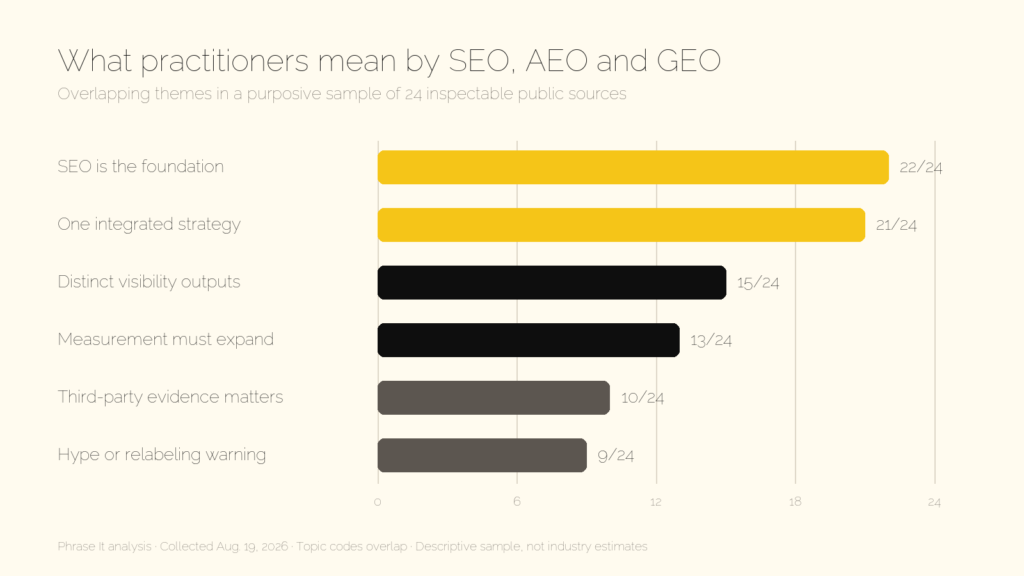
Phrase It analysis of 24 inspectable public sources, collected August 19, 2026. Topic codes overlap; descriptive sample only.
The sample included 16 Reddit discussion units, six inspectable LinkedIn units, one Search Engine Journal editorial, and Google’s platform guidance. Public community claims are unverified self-reports, and topic codes overlap.
The most useful pattern was not a new tactic. It was a mental model:
- SEO is discoverability. Can the page enter and compete in a ranked retrieval system?
- AEO is answer usability. Can a specific passage supply a clear, supported response?
- GEO is inclusion and trust. Does the system have enough evidence to cite, mention, compare, or recommend the source or brand?
Thirteen of 24 units said measurement must expand beyond rankings and direct organic clicks. Ten emphasized third-party mentions or corroboration. Nine warned about hype, guarantees, relabeled deliverables, or unsupported shortcuts.
The sample does not prove which tactic causes a citation. It does show what practitioners repeatedly consider when the acronyms stop being definitions and become work: keep the SEO base, structure useful answers, strengthen public evidence, and measure the whole discovery path.
Phrase It combines technical SEO, content, authority, and AI-search measurement so your team can work from one priority list instead of three competing acronyms.
Explore Phrase It ServicesWhich Should Your Business Prioritize First?
Prioritize SEO first to work on your technical access, commercial pages, search intent, or authority , add AEO while creating and refreshing content; expand GEO work when buyers use generative tools for comparison or recommendations. You rarely need to wait between phases, but the weakest foundation should control the order of investment.
Use this decision rule:
| Your Current Problem | Priority | Why |
|---|---|---|
| Important pages are not indexed or do not rank | SEO foundation | Answer systems cannot compensate for missing or weak discovery assets |
| Pages rank, but explanations are vague or hard to scan | AEO layer | Clear answer passages improve comprehension and extraction without a new content program |
| The site is strong, but the brand is absent from AI comparisons | GEO evidence layer | You need prompt research, source analysis, entity consistency, and credible third-party presence |
| AI mentions exist, but no one can connect them to business value | Measurement layer | Visibility reporting needs referrals, branded demand, conversions, and qualitative framing |
For a local business, the GEO layer may mean accurate profiles, reviews, local citations, and consistent service facts. For B2B SaaS, it may mean category comparisons, original data, expert commentary, review platforms, integration pages, and strong non-branded use-case content.
For ecommerce, product feeds, availability, merchant data, reviews, category structure, and third-party buying guides may matter more than publishing another broad definition post.
The channel mix changes. The foundation does not.
How To Optimize For SEO, AEO, And GEO Together
Build one workflow that starts with a buyer question, creates the right crawlable asset, answers the question directly, supports the claim with evidence, distributes that evidence where buyers research, and measures both visibility and business response. This sequence prevents “AI optimization” from becoming a pile of disconnected formatting tricks and dashboards.
- Map the decision, not only the keyword. Identify what the buyer is trying to compare, verify, calculate, or choose. Include conversational prompts, but map them to a real page and commercial next step.
- Fix technical eligibility. Confirm the preferred page is crawlable, indexable, internally linked, fast enough, and rendered correctly. Allow relevant search crawlers, including OAI-SearchBot if ChatGPT search visibility is desired.
- Create non-commodity evidence. Add firsthand experience, a tested process, original data, a useful tool, a specific case, or a defensible point of view. Summarizing the current top results gives an answer system little reason to cite you.
- Make key answers self-contained. Put the direct answer after the question-led heading. Define the entity, give the mechanism, and keep the necessary qualifier in the same passage.
- Clarify relationships. Use descriptive headings, internal links, author information, consistent product or service facts, and relevant structured data. Phrase It’s free internal-link anchor generator can help you vary anchors without turning them into keyword strings.
- Earn corroboration. Identify the publications, communities, reviews, directories, partners, customers, and experts that legitimately shape the topic. Contribute evidence; do not manufacture mentions.
- Measure repeated prompts and business outcomes. Freeze a useful prompt set, platform, location, persona, and cadence. Then compare citation data with referrals, branded searches, leads, sign-ups, assisted conversions, and sales.
In one B2B SaaS reporting dashboard I built, ChatGPT referral sessions recorded a key-event rate as high as 1-4%, with key events including sign-ups and purchases. That is not a benchmark or proof that AI traffic always converts better. It is a reason I refuse to stop the report at “we were mentioned.”
How Should You Measure SEO, AEO, And GEO?
Measure three layers: discoverability, answer visibility, and business impact. SEO data shows whether pages enter and win ranked search. AEO and GEO monitoring shows whether answers cite or mention you across a controlled prompt sample. Analytics and CRM data show whether that visibility creates qualified visits, branded demand, leads, purchases, or assisted conversions.
Use a measurement stack, not one score:
| Layer | Questions | Evidence |
|---|---|---|
| Discovery | Are priority pages indexed, visible, and earning qualified clicks? | Search Console, Bing Webmaster Tools, rank data, landing-page analytics |
| Answer visibility | Are we cited, mentioned, or recommended for controlled prompts? How are we framed? | Google generative Search reporting where available, Bing AI Performance, repeated platform tests, citation monitoring |
| Business impact | Do people visit, search the brand, sign up, buy, or convert later? | Analytics, CRM, revenue data, assisted-conversion analysis, customer research |
Microsoft’s AI Performance reports now show citations, cited pages, grounding-query samples, trends, intents, topics, and citation share across supported experiences. Microsoft carefully says these are citation observations, not rankings or proof of authority.
OpenAI says publishers can track ChatGPT search referrals through utm_source=chatgpt.com. That gives you real visits, but it does not capture every zero-click mention or a user who later searches your brand directly.
Every AI visibility score depends on prompts, platforms, time, location, personalization, model behavior, and sampling. If a vendor cannot show those inputs, the precision in the dashboard is cosmetic.
Common SEO, AEO, And GEO Mistakes
The biggest mistakes are buying a new label without new evidence, abandoning SEO fundamentals, creating answer blocks that remove important context, manufacturing third-party mentions, and reporting a proprietary visibility score as business impact. A useful program can explain what changed, where it changed, how the result was sampled, and what the reader or buyer did next.
Watch for these red flags:
- “Guaranteed ChatGPT rankings” or a fixed citation timeline.
- AEO deliverables that are only FAQ schema and 40-word paragraphs.
- GEO deliverables that are ordinary blog posts and backlinks with new names.
- An llms.txt file sold as a substitute for crawlability, evidence, or authority.
- Screenshots from one favorable prompt with no repeated test method.
- A visibility score with no raw prompts, platform scope, or business outcome.
When you evaluate a provider, the same due diligence still applies. My guide to choosing the right SEO agency gives you the base questions; for AEO and GEO, add prompt methodology, citation evidence, platform scope, and attribution limits.
Stop Debating The Acronyms And Fix The Evidence
The useful distinction is not three tactics. It is three outcomes: a page ranks, an answer uses your information, and a generated response includes your brand or evidence. Build the technical, editorial, and authority system once. Then measure each outcome honestly and invest where your buyers actually search.
If your next question is “what should we fix first?”, that cannot be answered by an acronym. It requires your pages, prompts, competitors, source profile, and conversion data.
Book a free 30-minute strategy call. I will look at your current SEO foundation, answer visibility, and brand evidence, then tell you where I would focus first.
Book My Strategy CallFrequently Asked Questions About SEO, AEO, And GEO
SEO, AEO, and GEO share a foundation but describe different visibility outcomes, which is why the same questions keep appearing in search and practitioner discussions. The short answers below clarify the boundaries without pretending the terminology is standardized across Google, Microsoft, OpenAI, every agency, or every AI visibility tool.
Are AEO And GEO The Same Thing?
Not exactly, but they overlap heavily. AEO focuses on making a specific passage or fact usable as a direct answer. GEO focuses more broadly on whether a source, entity, product, or brand is cited, mentioned, compared, or recommended inside a generated response. In practice, many teams use the terms interchangeably.
Does GEO Replace SEO?
No. GEO adds generated-answer visibility and brand-evidence work to the SEO foundation. Google states that its generative Search features remain rooted in core Search ranking and quality systems. Other answer systems may retrieve different sources, but they still need accessible, relevant, credible information.
Is AEO Just Featured-Snippet Optimization?
AEO uses some of the same habits: concise answers, descriptive headings, lists, tables, and self-contained passages. Its scope is broader because answer engines can synthesize several sources, interpret conversational prompts, and return cited responses. The useful principle is answer clarity, not formatting every paragraph to an arbitrary length.
Do I Need A Separate AEO Or GEO Agency?
No if your SEO provider can handle technical access, content strategy, entity clarity, digital PR or authority work, prompt research, and transparent measurement. A specialist can make sense when there is a defined capability gap, but ownership between providers must be explicit or you will pay twice for overlapping work.
How Long Does GEO Take To Work?
There is no universal timeline because crawl frequency, source authority, query type, model retrieval, brand evidence, competition, and measurement cadence vary. Ask for a baseline, a frozen prompt set, named changes, repeated observations, and business outcomes. Be skeptical of guaranteed citations by a fixed date.