
Your organic clicks are climbing. The lead graph is flat.
That is not a reason to publish another ten articles.
It is a reason to find the leak between the search query and revenue. I have seen teams celebrate rankings while sales quietly asks why none of the new traffic becomes pipeline. Both sides are looking at real data. They are just looking at different parts of the system.
Why Is SEO Traffic Not Converting?
In my experience working in SEO for 7+ years, SEO traffic usually fails to convert for one of five reasons: the queries attract the wrong intent, the landing page does not match the search promise, the offer or next step is weak, the conversion path has friction, or tracking loses the outcome. More traffic only helps when qualified traffic volume is genuinely the constraint.
The first mistake is treating every organic session as equally valuable. A visitor searching “what is payroll software” is solving a different problem from someone searching “payroll software for a 50-person construction company.” Both may land on your site. Only one is likely to be evaluating a shortlist today.
The second mistake is using one number called “conversions.” A newsletter signup, demo request, qualified opportunity, completed purchase, and closed customer are different outcomes. If GA4 records a form submit but the CRM never receives the lead, the site can appear healthy while the pipeline stays empty.
Google’s Search Console Performance report shows queries, pages, countries, devices, impressions, clicks, and click-through rate. GA4’s Landing Page report adds sessions, engagement, key events, and revenue where configured. Connect the two and you can stop asking whether “SEO works” as one vague question.
Ask a sequence instead:
- Did the right person see the result?
- Did the snippet earn a qualified click?
- Did the landing page satisfy the query?
- Did the visitor see and understand a relevant next step?
- Did the form, checkout, or booking flow work?
- Did analytics and the CRM preserve the outcome?
That sequence turns a frustrating metric into a diagnosis.
Start With The Traffic-To-Conversion Matrix
The matrix separates four situations that need different decisions. Compare qualified organic traffic with a meaningful conversion rate for the same pages, market, device mix, and time period. “High” and “low” should be relative to your own baseline and business target, not a generic industry average pulled from an unrelated funnel.
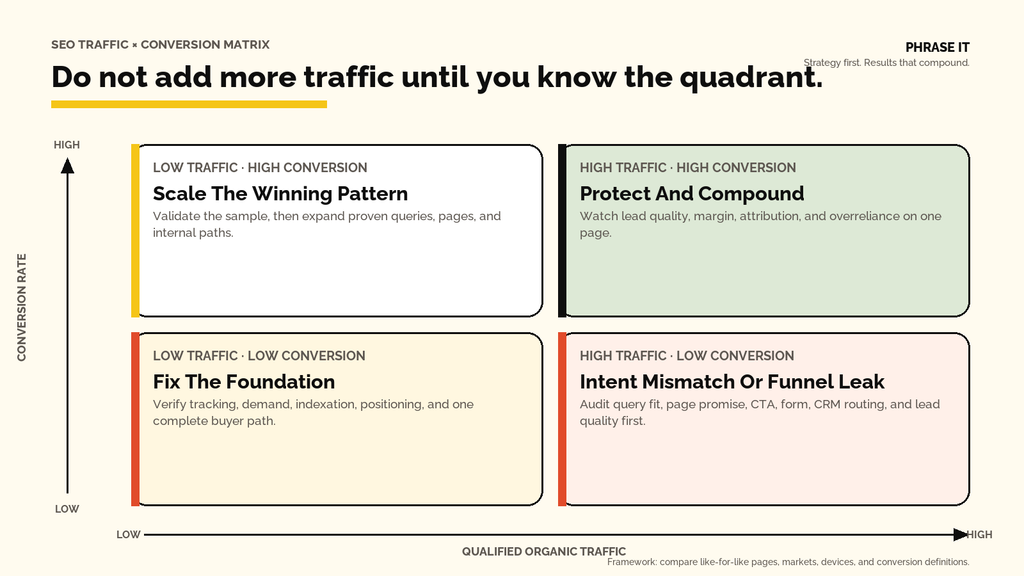
| Traffic Pattern | Conversion Pattern | Most Likely Diagnosis | Check First | Priority Move |
|---|---|---|---|---|
| High qualified traffic | Low meaningful conversions | Intent, promise, offer, UX, or tracking mismatch | Query-to-page fit and conversion instrumentation | Repair the highest-volume leak before creating more content |
| Low qualified traffic | High meaningful conversions | Proven offer with insufficient discovery | Converting pages, queries, and audience segments | Scale the pattern through SEO, internal links, and distribution |
| Low qualified traffic | Low meaningful conversions | Weak visibility, unclear offer, or foundational measurement problem | Demand, indexation, positioning, and event setup | Establish a working path before optimizing percentages |
| High qualified traffic | High meaningful conversions | Healthy system with concentration or scaling risk | Lead quality, margin, cohort, and page dependence | Protect what works and expand to adjacent demand |
Use qualified traffic in the matrix, not total sessions. Bot visits, job seekers, students, unsupported countries, existing customers looking for help, and irrelevant informational queries can inflate traffic without increasing the available buyer pool.
High Traffic, Low Conversions: Fix Intent Before Adding Content
High organic traffic with low conversions most often signals a mismatch: the site ranks for queries that do not lead naturally to the offer, or the landing page fails to move qualified visitors forward. Start with the highest-traffic landing pages and inspect their query mix, visitor segment, next-step clicks, and downstream lead quality.
Intent mismatch is the classic failure. A company sells a complex B2B service but earns most of its growth from definitions, templates, free examples, or career-adjacent searches. The content may be excellent. The visitor simply has no commercial reason to contact the company.
Do not “fix” that by turning an informational article into a sales page. Satisfy the query, then create a credible bridge to the next question. A beginner guide might lead to a comparison, calculator, case study, or diagnostic. A comparison page can lead to a scoped consultation.
Measuring SEO content performance only makes sense when you’re assigning a job to each page instead of judging everything by traffic alone. If a blog post has no useful next step, its commercial role is undefined.
Promise mismatch happens after the click. The title and snippet promise a pricing answer, but the page hides pricing behind a form. The query asks for a comparison, but the page gives a generic product pitch. The result earns attention and loses trust.
Search Console lets you filter by query and page, while the GA4 Search Console integration connects organic landing pages with on-site behavior and key events. Build a simple query-to-page review for your top organic entrances. Label each query cluster as informational, commercial investigation, transactional, navigational, support, job-seeking, or irrelevant.
Then look for the next observable break:
- Engaged readers who never see the CTA need a better content path or placement.
- CTA views without clicks point to a weak promise, unclear action, or poor visual hierarchy.
- CTA clicks without form starts point to a broken handoff or expectation mismatch.
- Form starts without completions point to friction, errors, privacy concerns, or an oversized ask.
- Recorded leads without qualified opportunities point to targeting, qualification, or sales follow-up.
Microsoft Clarity can filter recordings and heatmaps by source, medium, campaign, device, country, page, JavaScript errors, and Core Web Vitals. That is far more useful than watching random recordings. Filter the exact organic landing page and problem segment, then look for repeated behavior.
Your traffic report should tell you where revenue is leaking, not just where clicks grew. Bring me the query, landing-page, and conversion data, and I will tell you which layer I would fix first.
Book A 30-Minute Strategy CallLow Traffic, High Conversion Rate: Scale The Winning Pattern
Low traffic with a high conversion rate usually means the offer and page work for the people who find them, but discovery is limited. Protect the conversion path, confirm the result is not a tiny-sample accident, then expand around the queries, pages, audiences, and proof that already produce qualified outcomes.
This is the quadrant where more SEO can help. Not indiscriminate traffic. More of the right traffic.
Start by checking the denominator. Two conversions from 20 sessions can look wonderful and still tell you very little. Review a longer period, confirm lead quality in the CRM, and separate branded from non-branded search where Search Console provides enough data.
Then study what the converting pages have in common:
- They target a clear commercial problem or decision.
- The offer matches the query without a conceptual jump.
- Proof appears near the point of doubt.
- The next action is visible and proportional to intent.
- The page attracts a market and device mix the business can serve.
Internal links matter here because strong pages can still be buried. Use relevant content to pass readers toward the proven commercial page. For example, our Revenue-first internal linking approach is written for ecommerce, but the principle travels: links should support demand, commercial value, conversion readiness, and ranking opportunity.
Low Traffic, Low Conversions: Find The First Broken Layer
When both qualified traffic and conversions are low, conversion-rate optimization alone is premature. Verify measurement, demand, indexation, ranking visibility, and the offer in that order. Your goal is to establish one complete working path from a valuable query to a recorded business outcome before scaling content or running broad tests.
Begin with tracking because zero can be fake. Submit every form yourself. Complete a test checkout. Book a test meeting. Confirm the event appears in GA4, the thank-you state loads once, consent rules behave as expected, and the lead arrives in the CRM with its source information intact.
Next, verify that the right pages can be discovered. Check indexation, canonicals, robots directives, status codes, internal links, and whether Google is ranking the intended URL. If a technical failure blocks the commercial page, copy changes cannot rescue it.
Phrase It’s technical SEO services focus on protecting rankings and revenue because those outcomes share infrastructure. Indexation, rendering, redirects, tracking, and site performance are not separate concerns when they interrupt the same path.
Then validate demand and positioning. A page can be technically perfect and commercially irrelevant. Interview customers, review sales calls, examine paid-search terms, inspect competitor positioning, and ask whether the query represents a problem the offer actually solves.
Do not obsess over conversion-rate percentages before you have enough qualified visits. Your first milestone is evidence that a real buyer can discover the page, understand the offer, complete the action, and reach the business. Once that path works, optimize its rate.
High Traffic, High Conversions: Protect Quality While You Scale
High qualified traffic and high meaningful conversions indicate a healthy acquisition-to-outcome path. The work shifts from repair to protection: monitor lead quality, margin, assisted conversions, device and geography changes, page concentration, and tracking stability. Expand into adjacent demand without rewriting the pages or journeys already carrying the commercial result.
I use revenue reporting to stop those metrics from arguing with each other. Connecting SEO activity with revenue means knowing that rankings and last-click conversions alone miss too much of the commercial picture.
Protect the winning system with change annotations and page-level monitoring. Record major content edits, template releases, form changes, consent updates, CRM routing changes, and sales qualification changes. When performance moves, you need to know whether search demand, rankings, page behavior, measurement, or the business definition changed.
Trace The Leak From Query To Revenue
Diagnose SEO conversion problems as a chain of handoffs: query, search result, landing page, next-step action, form or checkout, analytics, CRM, and revenue. Compare the count and quality at each stage. The first material drop usually tells you where to investigate, while later drops show whether more than one problem is stacked.
| Observable Signal | Likely Failure Layer | Evidence To Pull | First Fix To Test |
|---|---|---|---|
| High impressions, weak clicks | Search result promise or wrong ranking query | Search Console query, page, country, device, and CTR | Align title, snippet, page angle, or target query |
| Clicks, immediate exits, weak engagement | Query-to-page mismatch or slow/unstable experience | GA4 landing pages, Clarity recordings, LCP/INP/CLS | Match the answer, improve the opening, or repair performance |
| Engaged sessions, few commercial-page visits | Missing content bridge or internal path | Path exploration, CTA views, internal-link clicks | Add the next decision page at the relevant moment |
| CTA views, few CTA clicks | Weak value proposition or wrong ask | CTA click rate, heatmaps, user interviews | Clarify outcome and reduce commitment |
| Form starts, few completions | Form friction or technical error | Field-level events, errors, recordings by device | Remove nonessential fields and fix failures |
| Thank-you views, missing GA4 key events | Analytics implementation failure | DebugView, tag logs, event parameters | Repair event firing and deduplication |
| GA4 leads, missing CRM records | Integration or routing failure | Webhook logs, CRM source fields, duplicate rules | Repair delivery and preserve attribution fields |
| Leads, few qualified opportunities | Audience, offer, or qualification mismatch | CRM disposition, query/page cohort, sales notes | Narrow targeting and strengthen prequalification |
| Opportunities, weak revenue | Commercial or sales problem beyond SEO | Pipeline stage, loss reason, cycle length, margin | Fix the downstream constraint; do not blame traffic |
Do not jump to heatmaps before you verify the numbers. Behavioral tools show what a recorded session did; they do not prove that your event, CRM integration, or revenue attribution is correct.
Page performance deserves a segmented check, especially when mobile converts worse than desktop. Google defines good Core Web Vitals at the 75th percentile as LCP at 2.5 seconds or less, INP at 200 milliseconds or less, and CLS at 0.1 or less. Those thresholds describe user experience, not a promised conversion lift.
Use them as diagnostic evidence. A delayed hero, unresponsive filter, moving CTA, or stalled checkout can explain behavior when recordings, field data, and conversion gaps point to the same page or device.
Run This 30-Day SEO Conversion Recovery Plan
A focused recovery month should fix measurement first, diagnose the highest-value landing paths second, ship a small number of evidence-backed changes third, and measure the full path last. Do not redesign the whole site. Choose the pages that combine meaningful organic traffic, commercial relevance, and a visible conversion gap.
Week 1: Make The Outcome Trustworthy
Define primary and secondary conversions in writing. A primary conversion should represent real business value: a qualified demo, accepted lead, purchase, trial activation, or another meaningful outcome.
Test events, thank-you states, consent behavior, forms, checkout, booking tools, call tracking, CRM delivery, deduplication, and source fields. Reconcile GA4 totals with platform and CRM totals, but expect definitional differences. Document them.
Week 2: Build The Query-To-Revenue Baseline
Export Search Console data by query and page. Pull GA4 landing-page sessions, engagement, key events, and revenue. Add CRM-qualified leads or orders where identifiers and privacy rules allow.
Group landing pages by job: awareness, evaluation, comparison, conversion, support, and irrelevant. Prioritize pages with substantial qualified traffic and weak downstream outcomes.
Week 3: Fix The Highest-Confidence Leaks
Make the smallest change that addresses the observed mechanism. Improve a promise mismatch. Add a missing comparison link. Put proof beside the CTA. Shorten a form. Repair a mobile error. Fix a lost source field.
Phrase It’s SEO content writing service is built around content that ranks and converts, which means the brief must define the reader, query, page job, proof, and next step before the draft exists.
Week 4: Measure The Whole Path
Compare the same segment before and after the change. Use counts and rates. Watch qualified outcomes, not only button clicks.
Keep seasonality, sales changes, promotions, brand demand, ranking movement, and sample size visible. If the result is inconclusive, extend the observation window instead of declaring a win from a handful of sessions.
Stop commissioning content with no commercial job. Phrase It builds SEO content around buyer intent, evidence, internal paths, and the outcome the page is meant to move.
Explore SEO Content WritingWhat Should An SEO Conversion Report Show?
A useful SEO conversion report shows the full relationship between visibility, qualified traffic, landing-page behavior, meaningful conversions, lead quality, and revenue. It segments the data enough to expose intent and UX problems, records important changes, and states where tracking or attribution limits what the numbers can prove.
At minimum, I want these views:
- Search visibility and clicks by query group and landing page.
- Qualified organic sessions by country, device, new/returning status, and brand/non-brand where available.
- Primary and secondary conversion counts and rates by landing page.
- CTA, form-start, form-complete, and thank-you steps for priority paths.
- CRM-qualified leads, opportunities, purchases, revenue, or margin by source cohort.
- Annotations for SEO, site, analytics, consent, offer, and sales-process changes.
GA4’s User Acquisition and Traffic Acquisition reports use different scopes: the first focuses on how new users were initially acquired, while the second focuses on sessions. That distinction can change the story when someone discovers you through organic search and returns later through another channel.
Attribution is a model, not a CCTV recording of a buyer’s mind. Report first-touch discovery, session-level traffic, assisted behavior, and closed outcomes separately where the business needs those views. Do not force them into one “SEO revenue” number without stating the rule.
I have worked in SEO and organic growth since 2019 across technical SEO, content strategy, reporting, ecommerce, WordPress, and B2B SaaS. The reporting lesson is consistent: the metric becomes useful when a team knows which decision it changes.
Turn SEO Traffic Into A Commercial System
When SEO traffic does not convert, the answer is rarely “do more SEO” in the abstract. Find your matrix quadrant, define the business outcome, and trace the path until the first material break appears. Fix that constraint, measure the downstream result, and only then decide whether the next dollar belongs in traffic or conversion work.
Rankings are an input. Clicks are an input.
The useful result is a system that brings the right person to the right decision and preserves the outcome all the way to revenue.
If your organic traffic is growing but the business result is not, book a 30-minute strategy call. I will look at the query mix, landing paths, conversion setup, and commercial goal, then tell you where I would focus first.
Discuss Your SEO PrioritiesFrequently Asked Questions About SEO Traffic Not Converting
Most questions about non-converting organic traffic come down to diagnosis, comparison, and sequencing. Define the conversion, segment the traffic, and locate the first broken handoff before choosing a fix. Generic benchmarks and sitewide averages can hide the page, query, device, or tracking problem that actually needs attention.
Why Does SEO Traffic Not Convert?
SEO traffic may not convert because the searcher’s intent does not match the offer, the landing page breaks the promise made in the search result, the next step is unclear, the form or checkout creates friction, or analytics loses the outcome. Inspect the path in that order instead of assuming more traffic is the answer.
What Is A Good Conversion Rate For Organic Traffic?
There is no universal organic conversion rate that is useful across every business. The answer depends on the conversion definition, offer, price, sales cycle, market, page type, brand familiarity, device mix, and traffic intent. Compare stable segments against your own baseline and commercial target, then track qualified outcomes and value alongside the rate.
How Do I Know If Search Intent Is Wrong?
Compare the queries that drive clicks with the page’s offer and the visitor’s likely next decision. Intent is probably wrong when high-traffic queries are informational, support-related, job-seeking, geographically irrelevant, or otherwise disconnected from what you sell. Confirm the pattern with landing-page behavior and CRM lead quality rather than keywords alone.
Should I Increase Traffic Or Improve Conversion Rate First?
Increase traffic when a proven page converts qualified visitors but lacks discovery. Improve the conversion path when qualified traffic is already substantial and outcomes are weak. If both are low, verify tracking, demand, indexation, and positioning first. The matrix helps you choose the constraint instead of funding the most familiar marketing task.
Can Blog Traffic Generate Leads?
Yes, blog traffic can generate leads when the article attracts a relevant audience, satisfies the informational need, and creates a credible path to the next decision. The path may be a comparison, tool, case study, commercial guide, or consultation. Forcing an early-stage reader directly into a sales form usually skips too much context.
Why Are GA4 And CRM Conversion Totals Different?
GA4 and CRM totals differ because they may use different identities, time zones, attribution models, event rules, consent states, deduplication, spam filters, and lead definitions. Test the technical handoff, then document the expected difference. Reconciliation should explain the gap; it does not require two systems to produce identical totals.