
The cleanest study I have seen tracked 1,885 pages after they added JSON-LD schema. ChatGPT citations rose 2.2%. Google AI Mode citations rose 2.4%. Both changes were statistically indistinguishable from zero.
That is not the result you would expect after reading most schema markup for AI guides.
It also does not make schema useless.
Schema is a machine-readable description of what is already on your page: the organization behind it, the product being sold, the author who wrote it, the price a shopper will pay, or the location a business serves. Used properly, it can qualify pages for established search features, reduce ambiguity, and make important facts easier for systems to process.
It cannot turn generic content into a source worth citing. That is the line I want to make clear.
I have implemented and audited schema across B2B SaaS, ecommerce, WordPress, and content programs, and I track referral and conversion data from ChatGPT, Gemini, Claude, and Perplexity. My rule is simple: use schema to represent the page accurately, then measure it as one part of the system. Never sell it as a magic trick.
Does Schema Markup Help With AI Search?
Schema markup can help AI search indirectly by making entities and facts explicit and by supporting the search indexes and rich-result systems that some AI products retrieve from. Current evidence does not show that adding JSON-LD alone reliably increases LLM citations. Think of schema as a clarity and eligibility layer, not a citation-ranking switch.
That distinction matters because “AI search” is not one system.
Google AI Overviews and AI Mode retrieve from Google Search. Microsoft Copilot uses Bing’s crawling, indexing, and grounding infrastructure. ChatGPT may answer from model knowledge, live web retrieval, licensed sources, or connected apps. Perplexity and Claude have their own retrieval paths and modes.
The large language model that writes the answer is only one component. A search index, retrieval service, ranking system, orchestrator, or browser agent may decide what the model sees before generation begins.
So I would split schema’s possible value into four jobs:
1. Rich-result eligibility: Google and Bing can use supported structured data to display prices, availability, ratings, breadcrumbs, app details, and other enhanced information.
2. Entity disambiguation: Organization, Person, sameAs, identifiers, and relationships can state that two names or profiles refer to the same real-world entity.
3. Fact extraction: Product, Offer, SoftwareApplication, and similar types can label price, availability, operating system, SKU, ratings, and specifications.
4. Citation selection: An AI system chooses your page as evidence for an answer.
The first three are defensible uses. The fourth is where the evidence becomes weak.
Google’s current generative AI search guidance says structured data is not required for AI Overviews or AI Mode and there is no special Schema.org markup to add. The same guidance still recommends ordinary structured data for supported rich results.
That is not a contradiction. Schema can be useful without being a generative-search requirement.
What Does The Research Say About Schema And AI Citations?
The best available studies point to a null or conditional effect, not a reliable citation boost. A large matched intervention found no meaningful uplift after pages added JSON-LD, while a separate cross-platform analysis found no independent overall schema effect after correcting for search-rank bias. One exploratory Product/Review result deserves testing, not a sales promise.
The 1,885-Page Test Found Almost No Movement
Ahrefs tracked 1,885 pages that added JSON-LD between August 2025 and March 2026 and matched them with about 4,000 control pages. It compared citations during the 30 days before and after the schema appeared.
| Platform | Estimated Citation Change | What It Means |
|---|---|---|
| Google AI Overviews | -4.6% | Small statistically significant decline, but both treated and control pages were already falling and the authors would not attribute harm confidently to schema. |
| Google AI Mode | +2.4% | Statistically indistinguishable from zero. |
| ChatGPT | +2.2% | Statistically indistinguishable from zero. |
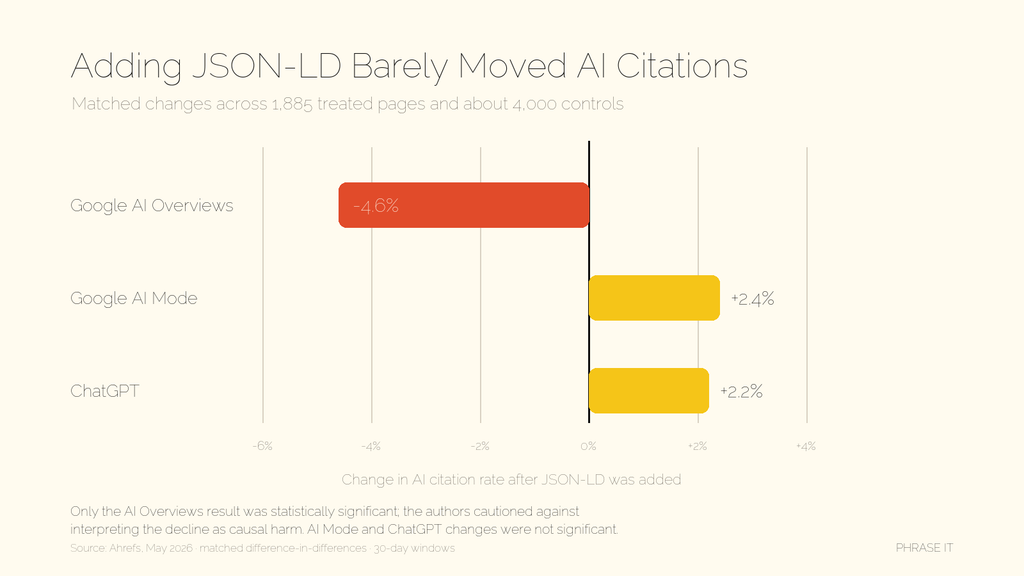
The study’s first observation explains why schema gets overcredited: in a six-million-URL analysis, AI-cited pages were almost three times more likely to contain JSON-LD than non-cited pages. Better-maintained, more authoritative sites are also more likely to implement schema, publish stronger content, and earn links. Schema can travel with the real causes.
The study has an important limitation. Its treated pages were already heavily cited, with at least 100 AI Overview citations. It tells us that adding schema to an established winner did not create an extra lift. It cannot prove schema never helps a new, ambiguous, or poorly represented entity.
The 1,006-Page Preprint Found The Same Overall Null
A February 2026 cross-platform preprint analyzed 1,006 pages, 730 citations, and 75 commercial queries across ChatGPT and Gemini. Its initial pooled result made schema look negative, but the author found that Google’s top results were already enriched with schema-bearing pages.
After correcting the comparison, schema presence was not a significant independent predictor of citation: odds ratio 0.678, p=.296. Entity richness and schema-to-query alignment were also null. Google position was the dominant predictor; pages ranking first were cited in 43% of queries where they appeared, versus 5% at position seven.
One result was more interesting. Pages with attribute-rich Product or Review markup were cited 61.7% of the time, compared with 41.6% for pages using generic types such as Article, Organization, or BreadcrumbList.
That is an association, not a randomized schema test. But it gives us a better hypothesis: schema may be more useful when it carries concrete factual payload—price, rating, specifications, availability—than when it merely repeats “this is an article.”
AI Traffic Can Matter Even When It Is Small
The business case for measuring AI referrals is stronger than the case for buying schema as a standalone growth tactic.
A 2026 Marketing Science analysis of 973 ecommerce sites covered more than 50,000 ChatGPT-referred transactions and 164 million transactions from other channels. One year after launch, LLM referrals accounted for less than 0.2% of traffic. Their financial outcomes beat paid social but trailed every other traditional channel in the study.
In a different sample, Ahrefs found that 63% of 3,000 sites received at least one measurable AI visit, but AI accounted for only 0.17% of visitors on the average site. ChatGPT, Perplexity, and Gemini generated 98% of the measurable AI traffic.
Seer’s 50-client sample reported a 13.8% conversion rate from AI referrals versus 9.3% from organic, while AI produced only 0.08% of sessions. Different samples and attribution rules create different results, which is exactly why you need your own data.
None of these traffic studies isolates schema. They show why the channel deserves measurement, not why JSON-LD deserves the credit.
A schema score cannot tell you whether the problem is access, content, entity clarity, authority, or measurement. I’ll map the prompts and sources that matter, then prioritize the work that can change them.
See the GEO audit scopeWhat LinkedIn And Reddit Practitioners Say Works
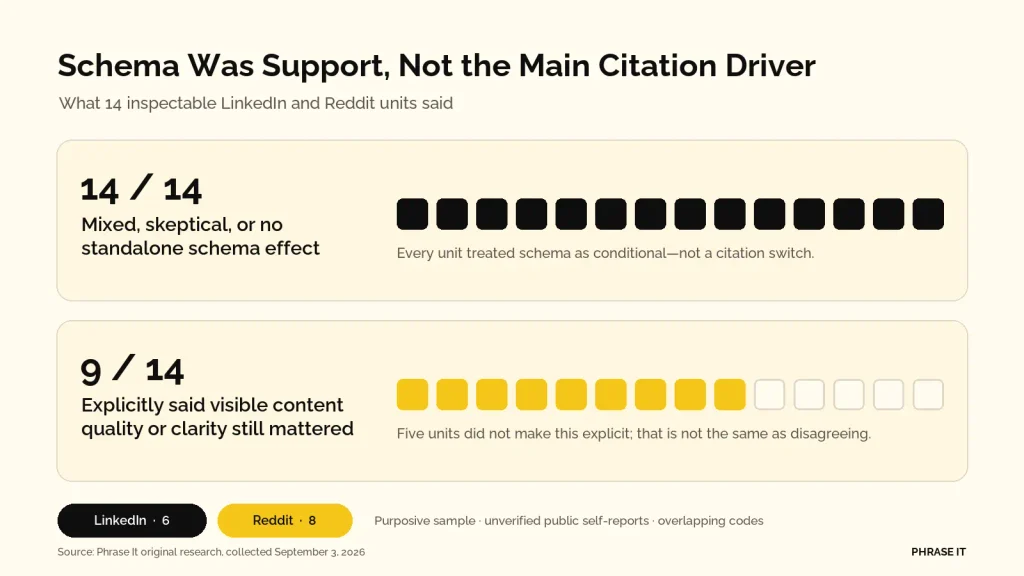
Public practitioners mostly describe schema as table stakes, a clarity layer, or a conditional helper rather than the main citation driver. In my purposive sample of 14 inspectable LinkedIn and Reddit units, all 14 were mixed, skeptical, or reported no standalone effect; nine explicitly said visible content quality or clarity remained necessary.
This is descriptive research, not an industry poll. The accounts are unverified self-reports, the sample is purposive, and promotional comments were excluded. Still, the recurring distinctions are useful.
In a LinkedIn discussion of the Ahrefs study, practitioners argued that schema tends to accompany better content, structure, and authority. Several still supported accurate schema as semantic hygiene, especially for ambiguous entities and products.
Another LinkedIn post described a self-run sample of 50 crypto protocols where schema scores did not predict AI visibility. The author’s exception was sameAs: unlike an article title that visible HTML already expresses, sameAs can assert that an organization is the same entity as a Wikidata record, LinkedIn company page, or another durable profile. That is a real disambiguation job, although the self-reported analysis is not a controlled experiment.
Reddit was messier, but the best thread made the right distinction. Practitioners described schema as useful for Merchant Center and local SEO, while saying they could not isolate a direct citation gain. One commenter reported zero change after schema fixes on some pages and larger gains when the visible answer became clearer. Treat that as an anecdote, not a benchmark, but the thread’s retrieval-versus-selection distinction matches the stronger studies.
I also found small positive tests. One claimed 200-page comparison said FAQ blocks were cited more often, yet its own conclusion was that visible question-and-answer structure mattered more than JSON-LD alone. Another six-site test reported gains from concrete properties but no change from Person credentials on two sites. Neither supplied enough raw data for independent validation.
A two-page greenfield test added FAQPage and still recorded zero citations across six systems after two weeks. That sample is far too small and too short for a general conclusion. It is still a useful warning against screenshots dressed up as science.
The practical consensus is less exciting than the LinkedIn carousels:
- Put the answer and evidence in visible HTML.
- Use schema that matches the visible page.
- Prefer concrete, verifiable properties over decorative type stacking.
- Keep entity names and identifiers consistent across your site and credible external sources.
- Fix crawl, indexation, rendering, and authority problems before blaming missing schema.
- Measure the same prompt set across platforms and over time.
Does Schema Help Different AI Models Differently?
Yes, the potential pathway differs by platform, but public evidence does not justify a precise schema “weight” for each model. Google and Bing document structured-data roles in their search systems. OpenAI documents crawler access, not schema weighting. Perplexity and Claude evidence comes mainly from small direct-fetch tests and practitioner observations.
| Platform | What Is Documented | Practical Schema Position |
|---|---|---|
| Google AI Overviews / AI Mode | Uses Google Search retrieval and quality systems; no special schema is required. Ordinary structured data supports rich-result eligibility. | Implement supported types for Search. Do not expect an AI citation lift from adding generic JSON-LD. |
| ChatGPT Search | OpenAI tells publishers to allow OAI-SearchBot and provides referral UTMs. It does not publish a schema ranking or citation rule. | Prioritize access, indexable visible facts, and measurement. Treat schema as indirect infrastructure unless your test shows otherwise. |
| Microsoft Copilot / Bing | Bing says accurate structured data may support clearer grounding but does not guarantee visibility or traffic. | Use accurate JSON-LD alongside IndexNow, sitemaps, crawlable links, and clear standalone facts. |
| Perplexity | No public schema weighting rule was identified in this review. Direct-fetch tests and anecdotes conflict. | Test important facts in visible HTML first. Track citations separately from mentions. |
| Claude | No public schema weighting rule was identified in this review. Search and non-search modes behave differently. | Do not assume a direct URL fetch reproduces a search-index pipeline. Validate access and outputs in the mode buyers use. |
This is why a universal claim such as “LLMs prefer FAQ schema” is too loose. Which LLM? Which product mode? Was the page retrieved through Google, Bing, a proprietary index, or a direct fetch? Did the visible content change at the same time?
If those questions are missing, the result is not actionable.
When I build an LLM SEO measurement system, I keep prompt, platform, model or mode, date, citation URL, mention status, and downstream session separate. One blended “AI visibility score” hides the mechanism you need to improve.
Which Schema Types Are Necessary For AI Search?
No schema type is universally necessary for AI search. A type becomes necessary when a documented search feature requires it or when your page needs machine-readable facts to represent its core entity accurately. For most sites, a small graph of complete, page-matched types beats a large stack of generic or unsupported markup.
Here is the hierarchy I use:
- Necessary for a feature: Required properties for a search experience you intentionally want, such as merchant listings.
- Useful for identity or extraction: Accurate types and relationships that clarify who, what, where, price, availability, or authorship.
- Optional: Valid markup that adds a genuine fact but has no documented feature or measured business case.
- Noise: Repeated, empty, inaccurate, hidden, or unsupported markup added only because an audit tool rewards volume.
Baseline Types For Most Sites
Organization or the correct LocalBusiness subtype belongs on the canonical organization/location entity, not copied with conflicting values across every plugin block. Include the real name, URL, logo, contact details, and identifiers that exist and can be maintained.
WebSite can state the site identity and preferred name. BreadcrumbList is useful where visible breadcrumbs reflect the real hierarchy. Article or BlogPosting can describe editorial pages with accurate headline, dates, image, author, and publisher.
None of those makes the underlying page authoritative. They reduce ambiguity and support established search behavior.
Is FAQPage Necessary?
No. FAQPage is not a universal AI schema and should not be added to every service page just because buyers ask questions. Google limits FAQ rich results largely to authoritative government and health sites, and Google’s generative search guidance says no special schema is required.
Use FAQPage only when the page visibly contains genuine questions with answers, the markup stays synchronized, and another consumer or internal data use justifies the maintenance. The visible answer block is the asset. The JSON-LD is its description.
Is HowTo Necessary?
Usually not. Google deprecated the HowTo rich-result experience, so it should not sit on a priority list merely because an old checklist calls it essential. If a platform you use consumes it or your content system benefits from the structure, keep it accurate. Otherwise, clear numbered steps in semantic HTML do more immediate work for readers and extraction.
What Schema Should SaaS Companies Use?
SaaS companies should prioritize Organization identity, accurate SoftwareApplication markup where a page meets Google’s app requirements, and page-level Article or FAQ markup only when the visible content supports it. The highest-value fields are concrete product facts—name, category, operating system, offer, price, ratings, and features—not a large generic graph.
Google’s SoftwareApplication documentation requires a name and offer price for rich-result eligibility, with application category and operating system among recommended properties. That makes the type useful for genuine app pages. It does not make every B2B platform page an app-store listing.
For a SaaS site, I would map schema to page jobs:
| Page | Primary Type | Useful Relationships | Avoid |
|---|---|---|---|
| Homepage / about | Organization | url, logo, sameAs, identifiers, contact points | Invented awards, copied social URLs, or multiple conflicting organization nodes. |
| Product/app page | SoftwareApplication or Product when accurate | offers, applicationCategory, operatingSystem, feature list, provider | Zero-dollar pricing when the real price is custom; review markup without eligible, visible reviews. |
| Pricing page | Offer / AggregateOffer connected to the product | Currency, price, billing terms, eligibility | Prices that differ from the visible plan or omit material conditions. |
| Blog/research | Article / BlogPosting / Dataset where real | Author, publisher, dates, citations, dataset distribution | Marking ordinary opinion as a Dataset or changing dates without updating content. |
| Documentation | TechArticle, APIReference, HowTo where semantically accurate | Dependencies, proficiency, steps, code references | Adding types solely because a generator supports them. |
In my B2B SaaS work, clearer pages and consistent product terminology make measurement easier across ChatGPT, Gemini, Claude, and Perplexity. Schema should encode that clarity. It cannot create it after the fact.
If your SaaS schema, visible copy, and external profiles describe three different products, another plugin will not fix the problem. Phrase It connects technical access, content, entities, authority, and AI-search measurement.
Explore AI SEO servicesWhat Schema Should MSPs Use?
MSPs should prioritize Organization or LocalBusiness identity, Service markup for real service pages, and accurate location/service-area relationships. Schema helps distinguish the provider, services, locations, credentials, and offers. It does not prove the MSP is the best cybersecurity or managed IT provider in a city; independent evidence and useful pages still carry that burden.
For MSP SEO, the common implementation mistake is mixing three entities:
1. The company that provides the service.
2. The managed IT or cybersecurity service itself.
3. The geographic area where the service is available.
Use Organization or the correct LocalBusiness subtype for the provider. Use Service for a specific managed service, with provider, areaServed, audience, and an Offer only when the commercial terms are genuinely present. Use location pages for real operational coverage, not dozens of swapped city names.
The strategic work is deciding which services and locations deserve pages. Phrase It’s MSP SEO and AI search playbook connects that decision to service architecture, buyer questions, proof, local intent, and citation tracking.
Useful MSP schema supports facts such as certifications, contact details, service coverage, and provider relationships. Noise includes fake aggregate ratings, every-city LocalBusiness nodes for one office, or Product markup on a vague “solutions” page.
What Schema Should Real Estate Companies Use?
Real estate sites should use Organization or RealEstateAgent identity, LocalBusiness/location data where applicable, breadcrumbs, and accurate listing entities connected to Offer and Place or Accommodation details. RealEstateListing is a valid Schema.org type, but it is not a documented Google rich-result guarantee, so treat it as representation rather than a traffic switch.
Schema.org defines `RealEstateListing` as a webpage describing one or more offers to sell or lease real estate. As of this review, the type sits in Schema.org’s “new” area. That is useful vocabulary, not evidence that Google AI Overviews or ChatGPT will cite the listing.
For listings, keep visible and structured facts synchronized:
- Address and geographic coordinates.
- Listing status and date posted.
- Offer price, currency, and availability.
- Property type, bedrooms, bathrooms, floor size, lot size, and amenities.
- Images and the canonical listing URL.
- Agent or brokerage identity.
Inventory changes fast. A stale structured price is worse than no price because it creates disagreement between feeds, visible pages, portals, and markup. Real estate SEO also depends on local expertise, neighborhood coverage, and pages that answer actual buyer and seller questions; real estate SEO strategy has to connect those pieces instead of treating listing schema as the whole plan.
What Schema Should Ecommerce Sites Use?
Ecommerce SEO has the clearest schema business case because Product and Offer data powers documented shopping experiences. Prioritize Product, Offer, ProductGroup for variants, ratings and reviews when eligible, Organization policies, LocalBusiness for real stores, and BreadcrumbList. Accurate price, availability, identifiers, shipping, returns, and variants matter more than generic Article or FAQ markup.
Google explicitly recommends `Product` structured data and Merchant Center feeds together to maximize shopping eligibility and help verify product data. This is not speculative LLM optimization. It is established ecommerce search infrastructure.
The same facts are also useful inputs when an AI system compares products. That still does not mean schema caused the citation. A product with clear specifications, reviews, availability, and an indexable canonical page is a better source in several ways at once.
I would implement ecommerce schema in this order:
1. Fix product identity: name, brand, SKU, GTIN or MPN, canonical, images, and variant relationships.
2. Synchronize Offer price, currency, availability, condition, shipping, and returns with the visible page and feed.
3. Add eligible ratings and reviews without marking up seller-written testimonials as independent product reviews.
4. Connect variants through ProductGroup and isVariantOf where the URL structure supports them.
5. Add Organization policies and physical-store LocalBusiness data where real.
6. Monitor Search Console merchant and product reports after deployment.
Schema cannot rescue a store whose canonical URLs, variants, categories, or filters are broken. Build the underlying ecommerce product page SEO and store architecture first, then encode clean facts.
What Schema Is Just Noise?
Schema becomes noise when it has no supported feature, no accurate fact, no consuming system, and no measurement plan. The most common waste is generic type stacking: adding Organization, Person, WebPage, Article, FAQPage, HowTo, Service, and Product everywhere so an audit score turns green while the visible page stays thin or contradictory.
| Noise | Why It Fails | Better Move |
|---|---|---|
| Adding every available type | Type count is not a quality metric and increases maintenance risk. | Represent the page’s main entity and only the relationships you can verify. |
| Hiding facts only in JSON-LD | Several direct-fetch tests failed to retrieve schema-only facts; users cannot verify them. | Put material facts in visible HTML and keep markup consistent. |
| FAQ schema without useful FAQs | The markup repeats weak answers and may have no rich-result eligibility. | Answer real sales, support, and comparison questions clearly on the page. |
| Fake reviews or self-serving ratings | Violates guidelines and creates trust and manual-action risk. | Mark up only eligible, visible, genuine review data. |
| Schema injected late through fragile JavaScript | Some fetchers may see raw HTML without the rendered block. | Prefer stable server-rendered or initial-HTML delivery for critical commerce data. |
| sameAs to every profile you can find | A pile of URLs does not establish identity and can connect the wrong entity. | Use durable, authoritative profiles that genuinely identify the same organization or person. |
| Measuring one screenshot | AI answers vary by prompt, platform, location, and time. | Run a fixed prompt panel repeatedly and record citations, not vibes. |
Validation tools answer “is the syntax recognized?” They do not answer “will this page be cited?”
That is why I treat schema errors by business impact. A broken price or availability field on revenue-driving products is urgent. A missing optional Article property on a post with no relevant rich-result or measurement objective is not.
This is the same prioritization principle I use in technical SEO work: fix the mechanism that blocks discovery, eligibility, comprehension, or revenue instead of clearing warnings alphabetically.
How Should You Implement Schema For AI Search?
Start with the page’s visible facts and the platform feature you want, then choose the smallest valid Schema.org graph that represents them. Deliver critical markup reliably, validate syntax and eligibility, inspect rendered and raw HTML, and monitor search features plus AI citations separately. Implementation should end with a testable hypothesis, not a green score.
1. Define the page job. Is it an organization page, service, product, app, article, listing, or location?
2. Name the consumer. Google merchant listings, Bing rich results, a knowledge graph, an internal content system, or an AI-search hypothesis all require different evidence.
3. List visible source facts. Do not start in a schema generator. Start in the page, database, feed, or CMS fields that own the truth.
4. Choose the most specific accurate type. More specific is useful only when it remains true.
5. Connect entities with stable IDs. Reuse @id values consistently for the organization, author, product, service, and webpage.
6. Deliver markup reliably. Check raw HTML, rendered DOM, crawler responses, status codes, canonicals, and robots rules.
7. Validate twice. Use Schema.org Validator for vocabulary and Google’s Rich Results Test for Google-supported features.
8. Monitor production drift. Prices, stock, authors, dates, locations, and plugin templates change.
I’ll separate revenue-critical product and service errors from low-value markup noise, then write developer-ready priorities with a clear validation plan.
See the technical SEO approachHow Do You Measure Whether Schema Works?
Measure schema with a controlled page set, fixed prompt panel, stable observation window, and separate outcomes for rich-result eligibility, citations, mentions, referral sessions, and conversions. Change schema without changing visible content in the treatment group, keep comparable controls untouched, and record crawl/index dates before interpreting movement.
For an honest test:
1. Select comparable eligible pages with enough baseline impressions or AI observations.
2. Randomly assign treatment and control pages where practical.
3. Freeze visible copy, internal links, canonicals, and page templates during the window.
4. Add one schema treatment, not six types plus a content rewrite.
5. Confirm the target crawler received the new version.
6. Run the same prompts across the same platforms, modes, location, and cadence.
7. Record answer inclusion, exact citation URL, position or prominence, and referral UTM separately.
8. Compare pre/post change against controls and the wider platform trend.
9. Inspect business outcomes, not only visibility.
For Google, monitor rich-result and merchant reports alongside the generative AI performance data available in Search Console. For ChatGPT, OpenAI’s publisher documentation says referral links include utm_source=chatgpt.com. Keep qualitative “How did you hear about us?” data because not every AI-influenced visit arrives with a clean referrer.
My preferred dashboard keeps these metrics separate:
- Valid eligible items and structured-data errors.
- Prompt-level brand mention rate.
- Prompt-level citation rate.
- Unique cited URLs.
- AI referral sessions by platform.
- Assisted and last-click conversions.
- Revenue, trials, leads, or another business outcome.
If citations rise but sessions and qualified actions do not, you learned something. If rich-result impressions rise while AI citations stay flat, schema may still have paid for itself. The channel has more than one valid outcome.
Schema Is Useful Infrastructure, Not A Magic Trick
Schema markup for AI is worth doing when it communicates accurate facts, reduces real ambiguity, or supports a documented search feature. It is not a magic trick that makes ChatGPT, Perplexity, Claude, Copilot, or Google cite weak pages. The evidence is strongest for eligibility and structured facts, and weakest for guaranteed citation lift.
For SaaS SEO, encode the product you actually sell. For MSPs, separate provider, service, and location. For real estate, synchronize listing and offer data without promising a rich result that does not exist. For ecommerce, treat Product and Offer markup as critical search infrastructure.
Then invest where citations are actually won: useful visible answers, original evidence, crawlable pages, consistent entities, independent corroboration, and measurement that reaches leads or revenue.
Book a free 30-minute strategy call. I’ll look at your setup and tell you whether the next move is schema, visible content, technical access, authority, or better measurement.
Book a 30-minute strategy callFrequently Asked Questions About Schema Markup For AI
Schema questions usually collapse several systems into one. The short version is that accurate structured data can support search features and reduce ambiguity, but no universal AI schema or guaranteed citation mechanism exists. Results depend on the platform, retrieval mode, page type, visible content, authority, and whether the change was measured cleanly.
Does Schema Markup Improve AI Citations?
Not reliably on its own. Ahrefs’ matched 1,885-page study found no meaningful uplift for ChatGPT or Google AI Mode after JSON-LD was added. A separate 1,006-page preprint also found no independent overall effect after correction. Attribute-rich Product and Review markup showed an exploratory positive association that needs causal testing.
Does ChatGPT Read JSON-LD Schema?
OpenAI does not publish a rule saying ChatGPT Search ranks or cites pages because of JSON-LD. ChatGPT products can use different retrieval routes, and direct-fetch tests do not necessarily reproduce search-index behavior. Put important facts in visible HTML, allow the appropriate crawler, and test the exact ChatGPT mode your buyers use.
What Is The Best Schema For AI Search?
The best schema is the most specific accurate type for the page and a documented consumer. Ecommerce often gets the clearest value from Product and Offer. SaaS may use SoftwareApplication. Service businesses can use Organization, LocalBusiness, and Service. Articles need accurate authorship and dates. None of these guarantees an AI citation.
Is FAQ Schema Still Worth Using?
FAQ schema is worth using when the page visibly contains genuine questions and answers, the markup stays synchronized, and a real consumer or workflow benefits from it. It is not required for AI search, and Google limits FAQ rich results. Prioritize the quality and visibility of the answers before the JSON-LD wrapper.
Can Too Much Schema Hurt?
More schema creates more opportunities for conflict, stale facts, invalid relationships, and guideline violations. Google recommends fewer complete and accurate properties over many incomplete or inaccurate ones. Extra valid markup is not automatically harmful, but markup without a feature, fact, consumer, or maintenance owner is technical debt.
How Long Does Schema Take To Affect AI Visibility?
There is no universal timeline. A crawler must receive the change, the relevant index or system must process it, and the target prompts must have enough observations to detect movement. Measure over repeated runs with controls. Do not interpret one new citation or a two-week zero as a durable schema effect.
Methodology
Collected 42 units on 2026-09-03: 32 evidence units, 6 ranking-page units, and 4 supplied keyword rows. The sample was purposive and descriptive. Evidence came from opened official documentation, empirical reports, and public LinkedIn/Reddit accounts. Search snippets were used only for discovery; inaccessible pages were not treated as negative evidence.
The codebook was frozen after a 10-unit pilot. Correlation, direct intervention, rich-result eligibility, machine-readable mechanisms, and unverified practitioner experience were coded separately. A deterministic SHA-256 sample of 10/38 eligible non-keyword units (26.3%) was re-coded without primary labels. Binary agreement was 108/110 (98.2%).
The study does not estimate the prevalence of beliefs or outcomes across the SEO industry. Platform behavior can change, vendor studies may contain undisclosed selection effects, and model-level parsing is often not documented.