
Three SEO proposals can describe almost the same service and still land at $800, $3,000, and $10,000 per month.
That does not automatically mean one agency is a bargain and another is overcharging. It usually means the word SEO is hiding three different scopes, three different levels of implementation, or three different assumptions about who supplies the strategy, content, development, authority building, and measurement.
I have worked in SEO since 2019 across agency, freelance, and in-house B2B SaaS roles. I have scoped client engagements, built technical and content roadmaps, written developer-ready tasks, led migrations, reviewed content, and owned reporting pipelines. The price only becomes useful when I can see the work behind it.
For this guide, I compared four current pricing studies, six public agency pricing pages, 14 advertised monthly tiers, and the live packages on Phrase It. Here is the short answer first.
How Much Does SEO Cost in 2026?
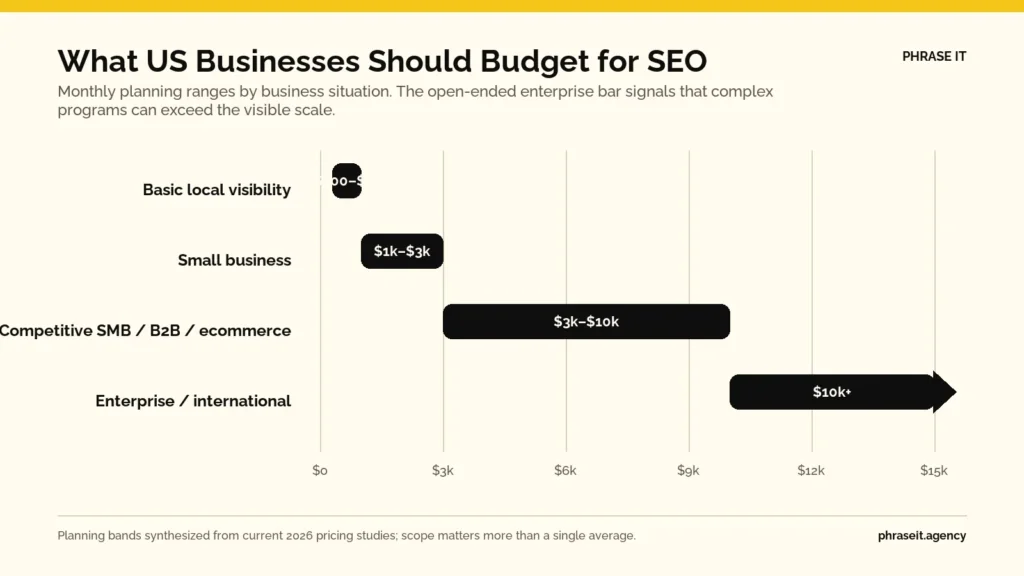
A US business should usually plan for $1,000-$3,000 per month for a focused small-business agency engagement, $3,000-$10,000 per month for a competitive SMB, B2B, ecommerce, or franchise program, and $10,000+ per month for enterprise SEO. Narrow local work can cost less, while content-heavy, international, ecommerce, and implementation-heavy programs can cost much more.
| Business Situation | Typical Monthly Planning Range | What the Budget Usually Needs to Cover |
| Basic local visibility | $300-$1,000 | Google Business Profile, citations, monitoring, and limited on-page work |
| Small business | $1,000-$3,000 | Strategy, technical priorities, selected pages or content, reporting, and some implementation |
| Competitive SMB / B2B / ecommerce | $3,000-$10,000 | Technical SEO, content production, internal linking, authority work, analytics, and active delivery |
| Enterprise / international | $10,000+ | Specialists, large-site governance, multiple markets, data pipelines, development support, and stakeholder coordination |
These are planning bands, not a universal rate card. Clutch’s current SEO agency pricing guide says agencies commonly charge $2,000-$20,000 per month and $100-$149 per hour. Its verified-project data has also produced an average monthly project cost of about $3,199 and an average total project cost of about $37,159.
Backlinko’s survey of more than 300 SEO professionals places the broad monthly average at $1,000-$2,500, with hourly work commonly at $50-$100. Both can be true. Backlinko includes a wider provider and geographic mix; Clutch is centered on reviewed agency projects.
My practical starting point is simple: if a US agency will own strategy and meaningful execution, budget from $1,000-$3,000 rather than assuming a few hundred dollars buys the whole channel. Then read the deliverables.
Table of Contents
Why Do SEO Pricing Studies Give Different Answers?
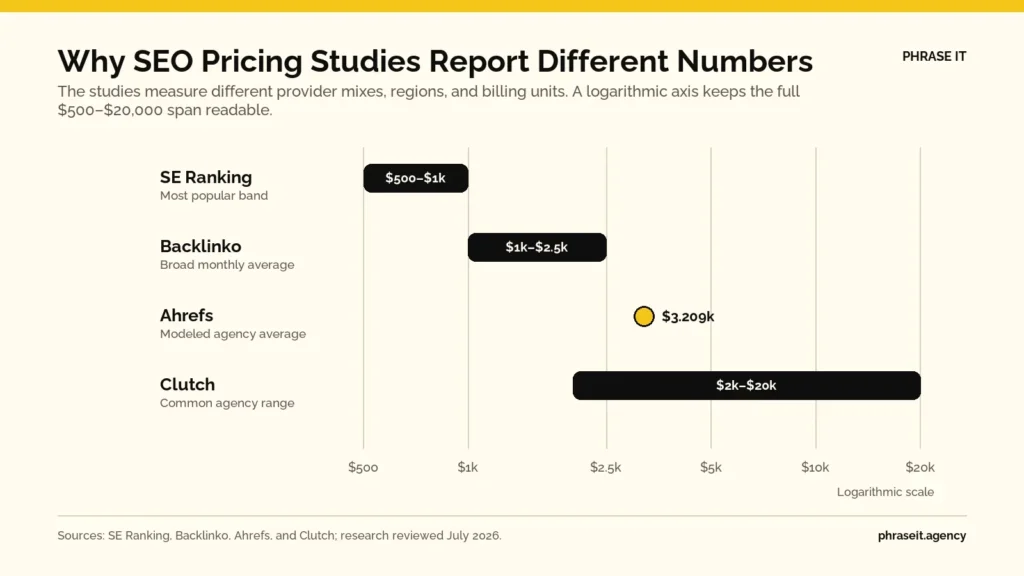
SEO pricing studies disagree because they do not measure the same market. A global survey of freelancers, consultants, and agencies will produce a different midpoint from verified US agency projects. A monthly retainer also cannot be compared directly with a one-time audit or a 12-month project total.
The Ahrefs SEO pricing study makes the provider split especially clear. In its 439-response survey, modeled monthly averages were approximately $3,209 for agencies, $3,250 for consultancies, and $1,349 for freelancers. The same study found that US and Canadian respondents skewed more expensive than the global sample.
SE Ranking’s agency pricing research found $500-$1,000 was the most popular monthly band in its respondent set. But that figure includes agencies from different regions and cost structures. It does not mean a US business should expect strategy, technical implementation, content, digital PR, and reporting for $500.
Whenever you see an average SEO cost, ask four questions:
- Who was measured? Agencies, consultants, freelancers, or a mixture?
- Where are they based? US delivery costs are not the same as global averages.
- What is the billing unit? Hourly, monthly, per project, or total contract value?
- What is included? Advice, content, development, authority work, reporting, or implementation?
If those labels are missing, the number is interesting but not very useful.
What My Public SEO Rate-Card Sample Found
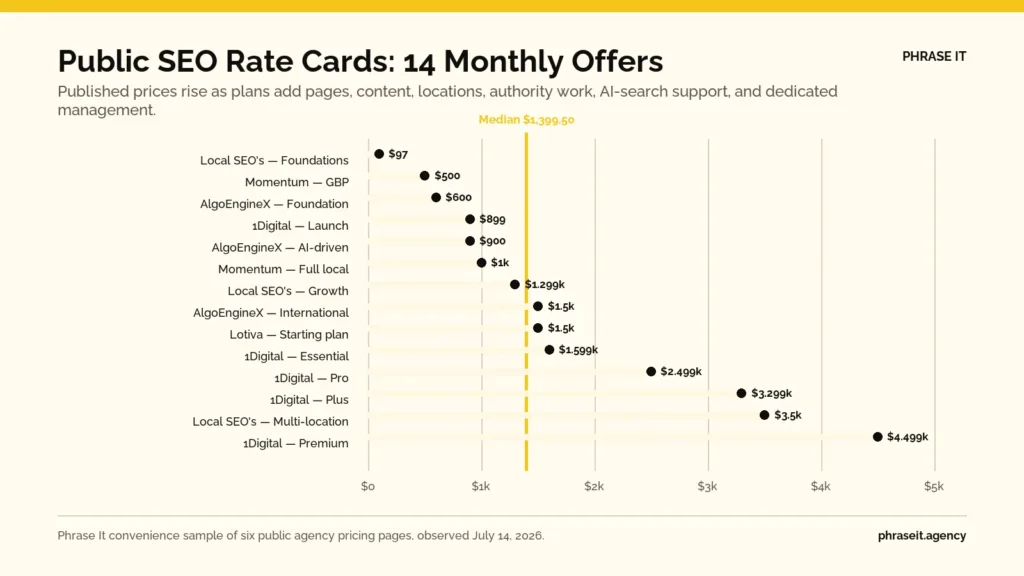
I reviewed six public agency pricing pages in July 2026 and recorded 14 explicitly advertised monthly tiers. The median among those 14 tiers was $1,399.50 per month. The observed range ran from $97 for Google Business Profile-only management to $4,499 for a fuller local package; another provider published a broader catalog reaching $5,999.
This is a convenience sample, not a representative market survey. Agencies that publish prices may differ from agencies that quote after discovery, and several tiers can come from the same provider. I use the sample to show how scope expands with price, not to manufacture a universal average.
| Public Offer | Monthly Price | Visible Scope Signal |
| The Local SEO’s – Foundations | $97 | Google Business Profile only |
| Momentum Digital – GBP | $500 | Google Business Profile package |
| AlgoEngineX – Foundation | $600 | Technical, on-page, internal linking, and reporting |
| 1Digital – Launch | $899 | Audit, up to four pages, one onsite and one offsite article |
| AlgoEngineX – AI-Driven | $900 | Entity, intent, AEO readiness, and authority |
| The Local SEO’s – Growth | $1,299 | GBP, website, content, authority, plus setup fee |
| Lotiva – Starting Plan | $1,500 | Content, links or PR, technical, on-page, and AI SEO |
| 1Digital – Essential | $1,599 | Up to seven pages and expanded content output |
| 1Digital – Pro | $2,499 | Up to ten pages and additional offsite output |
| The Local SEO’s – Multi-Location | $3,500+ | Four-plus locations, digital PR, dedicated management |
| 1Digital – Premium | $4,499 | Up to 16 pages and higher monthly content output |
Prices were observed on July 14, 2026 and can change. The most important pattern is not the median. It is the narrowing at the bottom of the market: low prices usually buy one defined slice, fewer pages, fewer locations, less senior time, or less implementation.
What Are You Actually Paying for in an SEO Retainer?
A serious SEO retainer pays for a decision system and the work that follows it. The provider should diagnose what limits organic growth, prioritize the highest-impact opportunities, coordinate delivery, check whether the changes worked, and update the roadmap. The exact mix depends on your site, but the scope should be visible before the contract starts.
In practice, monthly SEO pricing can include six different workstreams.
Strategy and Prioritization
Strategy decides which pages, technical fixes, markets, and content opportunities deserve resources first. I build master priority lists because SEO work competes for writers, developers, designers, and stakeholder attention. Without that sequence, a retainer can become a collection of individually reasonable tasks that never address the main constraint.
Technical SEO and Implementation Support
Technical SEO can include crawl and indexation analysis, rendering, structured data, internal architecture, Core Web Vitals, migrations, and template QA. The crucial pricing question is whether the provider only identifies problems or also writes developer-ready tickets, answers implementation questions, tests staging, and validates the release.
Content Strategy and Production
Content pricing changes with the standard. A basic brief assembled from keyword exports is not the same product as search-intent research, subject-matter interviews, original examples, conversion copy, editorial review, and ongoing optimization. Ask how many assets are included and who supplies expert input, writing, design, and approval.
On-Page SEO and Internal Linking
On-page work should connect the query, page purpose, title, headings, content, entities, internal links, and conversion path. Internal linking is not a monthly quota of random links. I use it to move authority toward pages with demand, business value, and realistic ranking opportunity, then check whether the target page is strong enough to deserve that support.
Authority Building and Promotion
Authority work may include digital PR, editorial outreach, linkable assets, expert commentary, partnerships, or content promotion. This is one of the easiest areas to hide poor quality behind a number. If a proposal promises links, require standards for relevance, editorial control, placement, traffic, disclosure, ownership, and what happens when a link disappears.
Measurement and Decision Support
Reporting should explain what changed and what the team should do next. I work across Google Search Console, GA4, Sheets, Apps Script, Looker Studio, CRM or ecommerce data, and AI-referral tracking where the setup permits it. A dashboard is only valuable if it changes the priority list or proves that an implementation worked.
Not every business needs all six workstreams every month. But every proposal should make the chosen mix explicit. If the scope says “technical SEO, content, links, and reporting” with no quantities, owners, or timing, you still do not know what you are buying.
What Buyer Discussions Reveal About SEO Quote Confusion
Buyer discussions are useful for understanding the questions behind SEO pricing, but they are not reliable market surveys. Posts usually contain self-reported quotes, unclear currencies, vendors answering potential customers, and scopes that cannot be compared. I use them as qualitative evidence about confusion, never as the source of a universal average.
In a July 2026 small-business discussion, a two-location plumbing and HVAC company reported agency quotes ranging from roughly $1,200 to $4,500 per month. Replies mentioned personal spends around $800 and $3,000, while one provider described $1,500 as a basic package. The numbers differed because the services differed, but the original question treated them as interchangeable.
Other search-indexed discussions showed similar gaps. Software and service businesses reported agency ranges from approximately $2,000 to $8,000 per month. Audit conversations ranged from a few thousand dollars to $10,000 for larger, technically complex websites. A number without site size, implementation, content volume, locations, and authority work is almost impossible to interpret.
The useful lesson is not “Reddit says SEO should cost X.” It is that buyers consistently struggle to translate a proposal into work. That is why I would normalize every quote before comparing it: same deliverables, same implementation responsibility, same quantities, same timeline, and the same definition of success.
What Does SEO Cost for Different Types of Businesses?
The right SEO budget follows the amount and difficulty of work required, not company size alone. I scope from the constraint: locations, templates, products, markets, content gaps, authority gap, implementation resources, and reporting needs. Two businesses with the same revenue can need completely different programs.
Local Service Businesses
A single-location service business often needs Google Business Profile work, technical cleanup, service and location pages, reviews, citations, local links, and conversion tracking. A $300-$500 package can cover a narrow slice. Once an agency writes pages, implements fixes, earns relevant mentions, and measures leads, $1,000-$3,000 per month is more realistic.
B2B and SaaS Companies
B2B and SaaS SEO usually needs product or service pages, comparison content, use-case pages, technical health, subject-matter input, conversion tracking, and alignment with sales. A focused program often begins around $3,000-$8,000 per month. Complex categories, weak authority, multiple products, or digital PR push the investment higher.
I have run cross-functional SEO and content programs across multiple B2B SaaS products, built priority systems from zero, and connected technical, content, AI-search, and conversion work. The cost is not only the article or audit. It is the operating system that keeps the right work moving.
Ecommerce Businesses
Ecommerce adds categories, product templates, filters, duplicate URLs, inventory, structured data, internal linking, merchandising, Core Web Vitals, and revenue measurement. A smaller store might begin around $2,000-$5,000 per month; a competitive or technically complex store can move into $5,000-$15,000+.
Phrase It’s ecommerce SEO services currently start with a $2000 managed core SEO services, move to a $3000 monthly growth retainer, and reach $5000+ for managed scale package. Catalog size, faceted navigation, platform complexity, content volume, and page-speed work are scoped separately.
Enterprise and International Websites
Enterprise SEO pays for coordination as much as analysis. Large sites need log files, templates, international targeting, data pipelines, experimentation, stakeholder alignment, developer tickets, QA, and governance. $10,000+ per month is a reasonable planning floor, but major programs can rise far beyond it.
What Should You Get at Each SEO Pricing Level?
A fair SEO fee should map to named outputs, owners, quantities, and decision criteria. Cheap plans usually narrow the number of pages, locations, assets, or implementation hours. Higher fees should buy more specialist time and execution, not merely more keywords in a report.
| Budget | Reasonable Expectation | What Usually Does Not Fit |
| Under $500/mo | A narrow local product, citations, monitoring, limited on-page work, or advisory time | Full strategy, content, development, PR, and proactive testing |
| $500-$1,500/mo | Focused small-site work, limited content, local management, or a specialist freelancer | Multiple specialists and heavy monthly implementation |
| $1,500-$3,000/mo | Small-business strategy, technical fixes, selected content, reporting, and calls | Enterprise analytics, high-volume production, and major digital PR |
| $3,000-$10,000/mo | Cross-functional technical, content, authority, local or ecommerce work, and active delivery | Unlimited scope or enterprise coordination by default |
| $10,000+/mo | Dedicated specialists, complex sites and markets, governance, analytics, and implementation support | Guaranteed rankings, revenue, or AI citations |
Ask the provider to rewrite every broad item as deliverable, quantity, owner, due date, acceptance criterion, and metric. “Technical SEO” is not a deliverable. “Prioritized crawl and indexation review for all revenue templates, with developer tickets and post-release validation by day 30” is.
How Phrase It Prices SEO, Fractional Leadership, and Page Speed
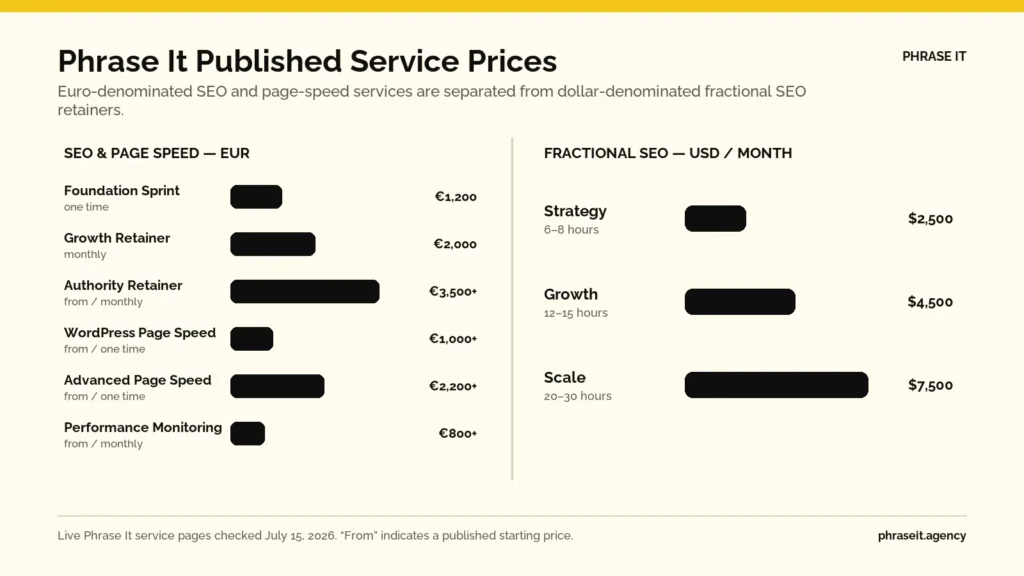
I publish Phrase It SEO pricing because I do not want the first call to be a guessing game. These are our live starting points as of July 15, 2026. They are examples of defined scopes, not market averages or a promise that every site fits the same package.
| Phrase It Service | Published Price | Best Fit |
| Managed SEO Core | $2000 per month | Businesses that want steady SEO progress around one priority product, service or category. |
| Managed SEO Growth | $3000 per month | Businesses that need broader content coverage and faster progress across commercial and informational search. |
| Managed SEO Scale | $5000 per month | Competitive markets where multiple page groups and technical priorities need to move at the same time. |
| Fractional SEO Core | $2,500 per month | Smaller teams that need a senior SEO owner focused on one priority product, service, category, or market. |
| Fractional SEO Growth | $4,500 per month | Growing teams that need SEO managed across content, technical work, publishing, and up to two commercial priorities. |
| Fractional SEO Scale | $7,500 per month | Businesses where SEO touches several products, departments, stakeholders, or growth priorities. |
| Speed Audit + Fix | From $1,000 one time | WordPress sites with straightforward performance issues – mainly image, caching, and asset delivery problems. |
| Deep Performance Overhaul | From $2200 | Server, database, JavaScript, INP, WooCommerce, and deeper Core Web Vitals work |
| Performance Monitoring | From $800 per month | Sites where updates, plugins, or releases can reintroduce regressions |
The fractional SEO service is priced differently from a production retainer because it solves an ownership gap. Your team executes; I keep the roadmap, content direction, technical priorities, reporting, and decision rhythm sharp.
The WordPress page-speed service is a one-time engagement because the work has a defined technical outcome. The live page gives a broader ballpark of €1,000-€3,500 after inspection, with ongoing monitoring available separately.
That distinction matters. A project, a production retainer, and fractional leadership can all appear under the broad label “SEO,” but they solve different constraints.
Which SEO Pricing Model Is Right for Your Business?
Use a monthly retainer for compounding work, an hourly rate for bounded expert access, and a project fee for a defined outcome. The model should follow the uncertainty and duration of the work. Performance pricing is the hardest to govern because attribution, brand demand, development, media, and sales all affect the result.
Monthly SEO Retainers
Retainers fit ongoing technical fixes, content, authority building, measurement, and iteration. I prefer a retainer when the priority list will change as new data arrives. The agreement should still name monthly outputs and decision points; “ongoing optimization” is not enough.
Hourly SEO Consulting
Hourly SEO consulting fits strategy calls, technical diagnosis, training, implementation review, and temporary senior support. A lower hourly rate is not automatically cheaper if the diagnosis takes longer or the output cannot be implemented. Compare the expected outcome, not only the rate.
Project-Based SEO
Projects fit audits, migrations, keyword architectures, measurement setups, page-speed remediation, and fixed content programs. Confirm whether the price includes presentation, developer tickets, implementation support, QA, and post-release validation. Those items can materially change the value.
Performance-Based SEO
I would only use performance pricing with a written baseline, agreed conversion event, attribution window, exclusions, and data-access rules. Rankings alone are a weak payment trigger because location, personalization, competitors, indexing, and search features change the result.
What Changes the Cost of SEO Services?
SEO prices rise when the provider must analyze more entities, create more assets, coordinate more people, or carry more implementation risk. These seven factors have the biggest effect on the quote.
- Competition and authority gap. A new site entering legal, finance, SaaS, or national ecommerce needs more original content and credible mentions than a local niche with weak competitors.
- Site size and template complexity. Ten service pages are not the same job as 100,000 products, filters, international variants, and JavaScript rendering.
- Locations and markets. Every location, language, or country creates additional research, content, listings, reporting, and governance.
- Content standard and volume. Subject-matter interviews, original data, design, editorial review, and conversion copy cost more than lightly edited generic posts.
- Authority acquisition. Digital PR and editorial links require research, assets, relationships, outreach, and quality control.
- Implementation ownership. Advice costs less when your developers and writers execute it. Agency implementation adds production, QA, release coordination, and accountability.
- Measurement and stakeholder load. CRM attribution, dashboards, experiments, AI-search tracking, executive reviews, and multiple teams increase the work beyond ranking reports.
Page speed is a good example. A simple image, cache, and asset-delivery cleanup is not the same scope as debugging server response time, database queries, JavaScript long tasks, WooCommerce checkout, and Interaction to Next Paint. A responsible quote changes after diagnosis.
How I Compare Two SEO Proposals
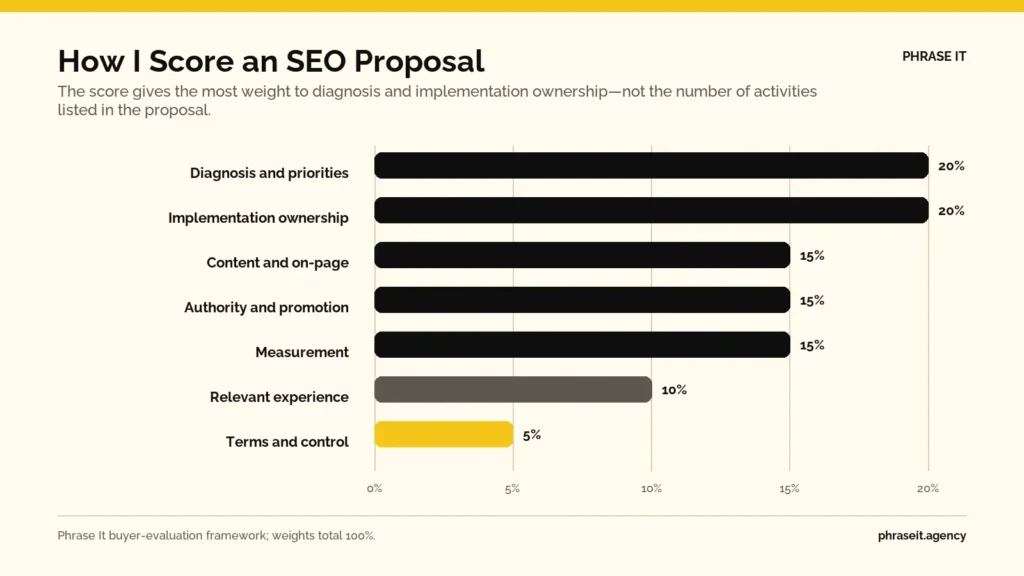
I compare proposals by the work they make verifiable, not by the number of line items. A proposal with ten consequential outputs can be stronger than a 40-item checklist filled with automated reports.
| Criterion | Weight | Evidence I Want to See |
| Diagnosis and priorities | 20% | Baseline, constraints, opportunity sizing, and a 90-day sequence |
| Implementation ownership | 20% | Named outputs, owners, development or writer workflow, and QA |
| Content and on-page | 15% | Pages or assets, briefs, expert input, and editorial standard |
| Authority and promotion | 15% | Method, relevance standards, quality controls, and disclosure |
| Measurement | 15% | GSC, GA4, CRM metrics, conversions, reporting cadence, and decisions |
| Relevant experience | 10% | Comparable problems, evidence, references, and the named delivery team |
| Terms and control | 5% | Contract length, access, asset ownership, and cancellation terms |
My guide to choosing the right SEO agency goes deeper into proof, people, implementation, reporting, decision authority, and the responsibilities your team still needs to own. Price belongs inside that evaluation, not above it.
Which SEO Pricing Red Flags Should You Avoid?
The clearest red flags are guaranteed rankings, secret methods, undefined links, activity-only reporting, and contracts that hide ownership or access. Google’s guide to hiring an SEO explicitly warns that nobody can guarantee a number-one ranking.
- Guaranteed rankings, traffic, leads, revenue, or AI citations without assumptions and dependencies.
- A backlink quota with no standards for relevance, editorial review, traffic, placement, or disclosure.
- Reports centered on proprietary scores while Search Console, analytics, and conversions are absent.
- No named strategist, writer, developer, or account owner assigned to the work.
- No distinction between recommendations and implementation.
- The provider controls your analytics, content, domains, listings, or accounts after cancellation.
A credible provider cannot promise the algorithm. It can promise the process, outputs, communication, implementation standard, and measurement quality.
How Should You Set Your SEO Budget?
Set the ceiling from contribution margin, close rate, and the number of incremental qualified opportunities SEO must create. The simplest revenue formula is:
| Break-Even Formula: Required incremental revenue = monthly SEO fee divided by gross margin. |
For a lead-generation business, divide the monthly fee by contribution profit per new customer, then account for the qualified-lead close rate.
Example: a company pays $3,000 per month, earns $4,000 in contribution profit per new customer, and closes 20% of qualified leads. The engagement needs 0.75 additional customers, or about 3.75 additional qualified leads per month, to cover the fee before considering customer lifetime value.
That does not mean SEO must break even in month one. Technical remediation, content, authority, and internal linking compound. It does mean you and the agency should agree on the commercial hypothesis, leading indicators, expected lag, and review date.
Ecommerce businesses can model this with Phrase It’s free ecommerce SEO ROI calculator, which uses organic sessions, conversion rate, average order value, product margin, ranking upside, SEO cost, and projected break-even month.
How Long Should You Pay for SEO Before Evaluating It?
Evaluate SEO every month, but do not judge a compounding program only by month-one revenue. The first 30-90 days should produce observable work and leading indicators: completed fixes, improved indexation, stronger page quality, published assets, better rankings or impressions, cleaner attribution, and a roadmap that changes as evidence arrives.
For many engagements, three to six months is a reasonable initial decision window. That is not a guarantee of rankings. The right window depends on your starting condition, competition, release speed, content cycle, authority gap, seasonality, and whether your team implements recommendations promptly.
I separate three questions during reviews:
- Did the provider deliver the agreed work? This should be verifiable immediately from tickets, pages, releases, reports, and communication.
- Are the leading indicators moving? Look at crawl and indexation health, impressions, relevant rankings, qualified organic sessions, and conversion paths.
- Is the commercial hypothesis still credible? Revisit contribution margin, expected demand, conversion rate, sales quality, and the remaining time to break even.
A long SEO timeline should never become an excuse for invisible work. You may need patience for compounding results, but you should not need patience for unclear ownership, missed outputs, or reports that cannot explain what changed.
A Fair SEO Price Starts With a Legible Scope
The most defensible SEO price is not one average. It is a band tied to a specific job.
Make every proposal comparable: deliverables, quantities, implementation ownership, timing, acceptance criteria, and measurement. Once the scope is legible, the cheaper quote may still win. But it will win for a reason you can explain.
If you want help applying these numbers to your own website, book a 30-minute SEO strategy call. I will look at your current setup, tell you which constraint I would address first, and recommend the smallest scope that can realistically move it.
Frequently Asked Questions About SEO Pricing
How Much Does SEO Cost per Month?
A US business should generally plan for $1,000-$3,000 per month for focused small-business agency work, $3,000-$10,000 for competitive SMB, B2B, ecommerce, or franchise programs, and $10,000+ for enterprise SEO. Narrow local products can cost less. Scope and implementation ownership matter more than a single average.
How Much Does SEO Cost for a Small Business?
Small-business SEO commonly costs $1,000-$3,000 per month when an agency owns strategy and some implementation. A lower fee may work for a narrow local service, limited advisory time, or a specialist freelancer. It is less likely to cover technical implementation, content production, authority building, and measurement together.
Is $500 per Month Enough for SEO?
It can be enough for Google Business Profile management, citations, monitoring, a small amount of on-page work, or limited consulting. It is rarely enough for a full competitive program. Ask what is deliberately excluded rather than assuming the package includes everything.
How Much Do SEO Services Cost?
Professional SEO can be priced hourly, monthly, or by project. Broad market studies commonly place hourly work between roughly $75 and $200, monthly retainers from about $1,000 upward, and defined projects from a few thousand dollars. Provider type, geography, complexity, and implementation change the number.
How Much Does an SEO Agency Cost?
Clutch currently places common agency retainers between $2,000 and $20,000 per month, with many listed agencies charging $100-$149 per hour. Smaller specialist agencies can sit below or inside that range, while enterprise engagements can exceed it. Compare scope before comparing totals.
How Much Does an SEO Audit Cost?
A focused small-site audit may cost $1,000-$5,000. Complex ecommerce, JavaScript, international, or enterprise audits can cost $10,000 or more. Confirm whether the quote includes analytics review, developer tickets, presentation, implementation support, and validation.
Should I Choose a Retainer or a One-Time Project?
Choose a project when the outcome is bounded, such as an audit, migration plan, keyword architecture, or page-speed fix. Choose a retainer when the provider will implement, publish, build authority, test, and adapt over time. Fractional SEO fits teams that can execute but need senior ownership.
Can an SEO Agency Guarantee Rankings?
No credible provider can guarantee a number-one Google ranking. Agencies can guarantee deliverables, communication, quality controls, access, and measurement. They cannot control competitors, algorithms, indexing, demand, or every change your team makes to the website.
Research Methodology and Limitations
Research was updated July 15, 2026 for US commercial-search intent. Survey evidence came from Ahrefs, Clutch, SE Ranking, and Backlinko. I preserved each source’s provider mix, geography, and billing unit instead of pooling incompatible averages.
The public rate-card sample includes pages with explicit monthly prices from 1Digital, AlgoEngineX, The Local SEO’s, Momentum Digital, Lotiva, and SEO.com. The 14-tier median is descriptive of those observed pages, not the entire market. Prices and inclusions can change after publication.
Sources
- Ahrefs, SEO Pricing: How Much Does SEO Cost?
- Clutch, SEO Agency Pricing Guide 2026
- SE Ranking, SEO Pricing Survey Insights
- Backlinko, SEO Pricing in 2026
- Google Search Central, Do You Need an SEO?
- Phrase It, SEO Pricing
- Phrase It, SEO Services
- Phrase It, Fractional SEO Services
- Phrase It, Ecommerce SEO Services
- Phrase It, WordPress Page Speed Optimization