
If ten articles answer a question with the same advice, publishing an eleventh gives readers, Google, and LLMs little reason to choose it. An original test, a documented exception, or a clearer explanation of a difficult decision can change that.
That additional useful contribution is what content marketers usually mean by information gain.
The idea matters for both SEO and AI Search. Traditional search connects people with relevant pages. AI Search can assemble an answer from multiple sources. In either setting, a page needs a reason to exist beyond repeating what is already easy to find.
But the claim that you must “add to Google’s or an LLM’s knowledge base” to rank or get recommended goes further than the evidence supports. You do not need to discover a fact nobody has ever known. You need to help your intended reader understand something, evaluate evidence, or make a decision better than the available alternatives.
Your subject matter expert probably has a better answer than the five articles your writer used for research. It might be buried in a client call, a support conversation, or an explanation they give every week without thinking much of it.
That is where I want to start a content brief.
Keyword research tells me what people are looking for. Reviewing search results tells me what they can already find. The next question is what we can add from the business itself: a useful example, a difficult decision, a free tool, a lesson from doing the work.
At Phrase It, we use guided interviews with clients and their subject matter experts to bring that knowledge into the article. We also source outside experts through platforms like HARO when another perspective would make the answer stronger. We also create free tools that make people click on your content because AI overview can’t summarize it (yet).
This is how I approach information gain for SEO and AI Search: find something worth contributing, then explain it well enough for someone else to use.
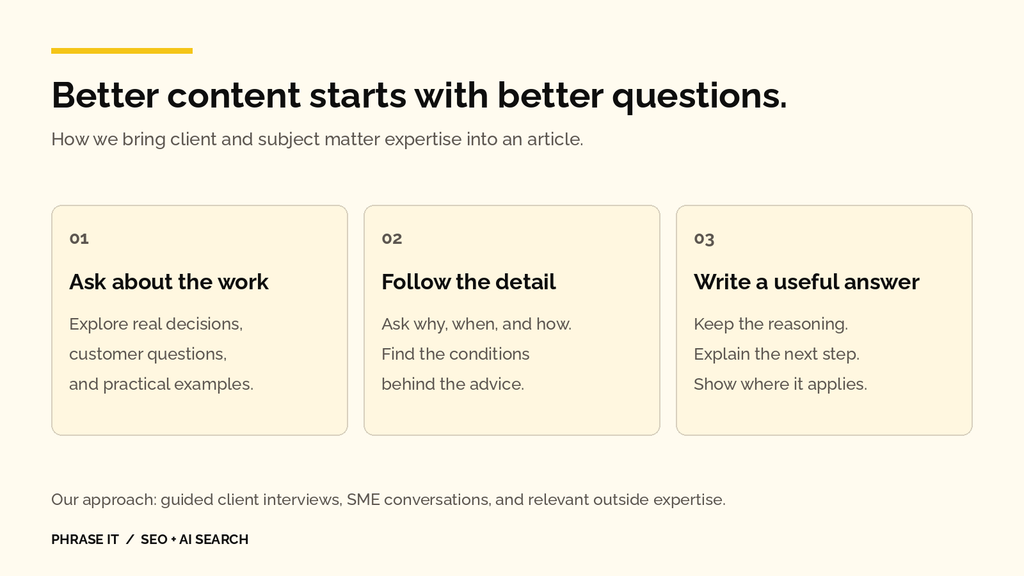
Figure 1. Guided interviews turn practical knowledge into useful explanations.
What is Information Gain in SEO?
In SEO content strategy, information gain means the additional useful knowledge a page provides relative to the information a reader already has or can readily find elsewhere.
That contribution can come from original research, firsthand testing, expert interpretation, a missing comparison, or an explanation that resolves a practical uncertainty.
Consider an article about choosing ecommerce software. Repeating that buyers should compare price, integrations, and support adds little. Testing how each platform handles a partial refund across multiple warehouses gives a specific buyer information they can use.
The important word is useful. A surprising anecdote unrelated to the decision adds novelty without helping. A familiar fact explained for an overlooked situation may help substantially.
There are also different uses of the term. In information theory and machine learning, information gain has formal meanings involving reduced uncertainty.
What Does Information Gain Mean for SEO Content?
Information gain is the useful understanding your article adds beyond what a reader can already find. I look for a contribution that helps someone make a decision, solve a problem, or understand why the usual advice changes in their situation. That contribution gives the page a reason to exist.
Take an article about choosing an SEO agency. You can repeat the familiar advice: check case studies, ask about reporting, and understand the deliverables.
Or you can explain how to assess a case study when the agency cannot name the client. Which details should still be available? What would make the result relevant to your business? What should you ask on the call?
The second version helps the reader do something with the advice.
You do not need a groundbreaking discovery for every article. Sometimes the valuable contribution is an experienced person explaining a decision that everyone else has glossed over.
My test is simple: what will the reader understand after this article that they would still be unsure about after reading the others?
Why This Matters for Both SEO and AI Search
For SEO, information gain gives readers a useful reason to choose your page over similar answers. For AI Search, specific evidence and clear explanations can provide material for a relevant response. I plan for both by identifying which reader questions our experience and sources can answer better than the existing coverage.
Google’s patent, “Contextual estimation of link information gain,” describes estimating whether a document contains additional information beyond documents already presented to a user.
That is a more specific idea than measuring how much a page adds to the entire internet.
For example, if someone has already read an introduction to software troubleshooting, another introduction may provide little additional information. A relevant diagnostic procedure could add more. The patent describes ways documents might be selected or ranked using that context.
Three distinctions matter:
| Concept | What it means for content planning |
| Information gain in the patent | Additional information relative to documents already presented to the user |
| Information gain in SEO practice | A useful way to plan contributions beyond existing coverage |
| A third-party information gain score | A vendor’s or researcher’s estimate, dependent on its method and comparison set |
It might be a firsthand explanation from a client. It might be an expert describing why a popular recommendation fails under certain conditions. It might be a comparison that puts competing options on the same terms.
Each gives the reader something more concrete than another summary of the search results.
In LLM SEO, those detailed follow-up questions matter. Google explains that AI Mode and AI Overviews may use query fan-out, searching across related subtopics to develop a response.
That is why I want an article to answer the follow-up questions too. If the main topic is ecommerce migration, the useful detail might be how to handle discontinued product URLs or decide which redirects deserve priority.
Those are questions a client or specialist can often answer much better than a generic brief.
Search Retrieval vs Model Training
“Getting into the LLM’s knowledge base” can blur distinct processes:
- Training shapes a model using a body of data.
- Search or retrieval brings external information into an answer when the system uses those capabilities.
- Citation identifies a source associated with the answer.
- Recommendation involves selecting an option for a particular need; a citation alone does not establish an endorsement.
Your page can be found through search without first becoming part of a model’s training data. OpenAI’s crawler documentation explicitly separates OAI-SearchBot, used for ChatGPT search, from GPTBot, which crawls content that may be used for training. Their controls are independent.
The immediate content goal is to publish relevant, credible information that se
We Create Information Gain with Guided Client and SME Interviews
We use guided interviews to get the client’s knowledge into the article before writing around it. The conversation starts with the topic and the reader’s problem, then moves into examples, decisions, and explanations from the client or subject matter expert. The aim is to uncover what the reader actually needs to know.
A subject matter expert does not need to arrive with a polished article in their head. That is our job.
They need space to explain the work. The writer needs enough preparation to recognize a useful detail and ask the next question.
We Ask About Decisions, Examples, and Exceptions
“What should people know about this?” is a starting point. I would rather get to a question like, “When would you advise a customer against this option?”
That is more likely to reveal the conditions behind the recommendation.
Useful interview prompts include:
- What do customers usually misunderstand about this?
- Can you walk me through a situation where that happened?
- Why did you choose that approach over the alternatives?
- What would have changed your recommendation?
- What does someone need to check before following this advice?
- Which part is difficult in practice, even if it sounds straightforward?
The follow-up is where the explanation gets useful. If an expert says a migration needs careful planning, I want to know which decision causes problems, how they spot it, and what the reader should do about it.
We Turn the Conversation Into Something the Reader Can Use
In SEO content writing, an interview gives us raw material. The article still needs to turn that material into a clear answer.
That might mean building a comparison around the expert’s decision criteria, explaining a process in the right order, or showing an example alongside the recommendation.
The expert might spend ten minutes explaining why two apparently similar customer situations require different solutions. The reader may need three paragraphs and a short table to understand the distinction.
I want to preserve the reasoning. That is usually where the value is.
If your content sounds less knowledgeable than your team does on a client call, start with one interview before commissioning another batch of articles.
We Use Outside Experts to Fill Specific Gaps
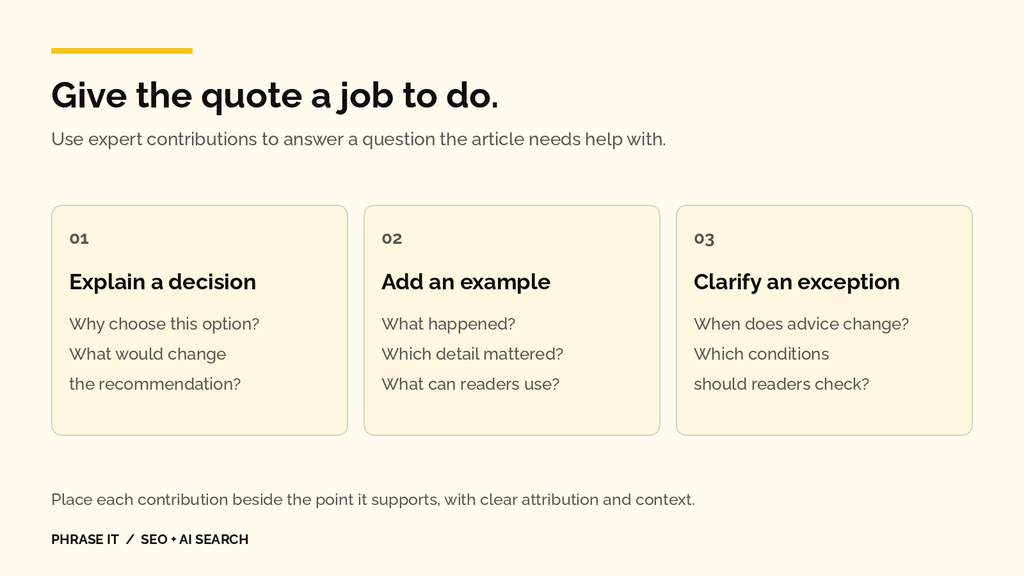
We also use platforms like HARO to interview external experts and gather relevant quotes. I want those contributions to answer a question the article needs help with: a specialist explanation, another perspective, or an example outside the client’s experience. That makes the sourcing part of the research rather than a finishing touch.
The question matters as much as the contributor.
Ask an expert why customer retention matters and you will probably get an answer the reader has already heard. Ask what a business should investigate when repeat purchases fall despite improving review scores, and there is more room for a useful explanation.
A Good Quote Adds Reasoning
I look for a quote that helps the reader understand something: why an expert favors one option, what they have observed in practice, or which detail changes their advice.
“A clear strategy is essential” does little on its own. An explanation of how the expert chooses between two competing priorities can move the article forward.
Here is how I would use different contributions:
| Contribution | What It Adds to the Article |
| A client explains a recurring customer misunderstanding | A specific problem to address in the article |
| An SME walks through a difficult decision | Criteria the reader can apply to their own situation |
| An outside expert describes an exception | A more complete explanation of when the advice applies |
| Two experts take different approaches | A chance to explain the conditions behind each choice |
The quote should sit beside the point it supports. Readers should understand who is speaking, why their experience is relevant, and what their contribution helps explain.
Different Views Can Improve the Answer
If two experts disagree, I want to understand the reason before smoothing it out of the article.
They may work with different budgets, business sizes, technical setups, or levels of risk. Explaining those differences can give the reader a better answer than choosing a single recommendation and presenting it as universal.
That is useful information gain: the reader learns which circumstances should influence their decision.
How Information Gain Connects to E-E-A-T
E-E-A-T stands for experience, expertise, authoritativeness, and trustworthiness. Google explains that E-E-A-T is not itself a specific ranking factor, and that trust is the most important of its aspects. Different topics require different kinds of evidence and expertise.
Information gain concerns what the content contributes. E-E-A-T helps frame why someone should trust that contribution.
| Aspect | What it can contribute to an article |
| Experience | Observations from using a product, running a process, or encountering a problem |
| Expertise | A sound method and an explanation of what the evidence does and does not show |
| Authoritativeness | Relevant recognition and a track record that help readers evaluate the source |
| Trustworthiness | Accurate claims, visible sourcing, appropriate disclosures, and honest limitations |
A writer who has migrated an ecommerce store may know which problems a generic checklist misses. That experience becomes more useful when the article explains the platform versions, migration conditions, observed failures, and resulting recommendation.
How Interviews Bring E-E-A-T Into the Article
Interviews let us bring experience and expertise into the explanation itself. A client can describe what happens in practice; a specialist can explain why it happens and how to respond. Clear attribution and supporting evidence help the reader assess that advice. That is how I connect our interview process with E-E-A-T.
I find it more useful as an editorial question than as something to mention repeatedly in the copy: have we given the reader a reason to trust this answer?
If the article says a process is difficult, explain where people get stuck. If it recommends an option, show the conditions that make it a good choice. If it includes an expert’s insight, make their relevant background clear.
That is stronger than adding a bio underneath an article that could have been written without speaking to anyone.
The same applies to our own experience. I work across content strategy, technical SEO, and conversion optimization, so I want an article to connect the explanation to the reader’s next decision. What should they check, change, compare, or ask?
An article about information gain should help you improve a brief. An article about SEO reporting should help you decide which performance questions your report needs to answer.
If the expertise does not make the advice more useful, I would keep working on the explanation.
Make the Insight Easy to Find and Understand
Once we have a useful contribution, I want it to be easy to find inside the article. That means descriptive headings, direct answers, examples close to the recommendation, and sources beside the claims they support. The reader should not have to work through a long introduction to reach the answer they came for.
This matters whether someone lands from Google, follows a link from ChatGPT, or arrives through a colleague’s recommendation.
Answer the Question Before Expanding on It
If the heading asks how interviews improve an article, answer that first. Then show the questions, the follow-up, and the way the contribution appears in the finished piece.
I use the detail to develop the answer. It should not delay it.
Keep the Conditions Beside the Advice
An expert’s recommendation can lose its meaning when the conditions are separated from it.
If a choice works best for a small catalog, say that beside the recommendation. If an example comes from a particular setup, explain the setup where the example appears.
This makes the advice easier to assess and helps its meaning survive when someone quotes or summarizes it.
Make Sure the Content Can Be Accessed
The technical basics still matter. Google says a page needs to be indexed and eligible to appear with a snippet to serve as a supporting link in its AI features.
For ChatGPT search, OpenAI separates its search crawler from its training crawler. I would check search access directly rather than assume a page needs to become part of a model’s training data first.
The practical task in AI SEO is to make useful content accessible and understandable, then measure where it earns visibility.
If you are deciding where to improve an existing article, pick the explanation your customers struggle with most. A focused interview can give the next content refresh a much clearer purpose.
What I Want in the Brief Before We Start Writing
Before writing, I want a clear reader question, a useful contribution, and a plan for getting the evidence. Keyword research and search results define the opportunity, while guided interviews and expert sourcing help develop the answer. The brief connects those pieces so the writer knows what the article needs to deliver.
I would put these six questions in the brief:
- What is the reader trying to decide or do?
- What can they already learn from the current results?
- What is still unclear, missing, or poorly explained?
- Which client or subject matter expert can help answer it?
- Do we need an outside perspective, supporting data, or a practical example?
- How will that contribution help the reader take the next step?
This also makes the review more useful. Instead of checking only whether the article includes the right terms, I can check whether it delivered the explanation we set out to create.
If you are reviewing your own content, try the same exercise on one important page. Compare the brief with the questions your sales or support team actually gets.
That gap is a good place to start your next SME conversation.
How to Write Information Gain Content & Rank in Google & LLMs
1. Run a Test That Answers a Real Buying or Implementation Question
Test the scenario your audience cares about. For software, that might mean performing the same task across competing products under comparable conditions. For a technical guide, it could mean reproducing an error and documenting which intervention resolved it.
Explain the setup, date, relevant versions, and limitations. Screenshots can support the account, but the written explanation should state what they demonstrate.
2. Analyze Data You Can Legitimately Use
Support tickets, search queries, product returns, and project records may reveal useful patterns. Aggregate and anonymize sensitive information, and use records you have permission to analyze and publish.
Describe the sample, period, inclusion criteria, and missing data. Distinguish what you observed from what you infer. A dataset drawn from one business should not silently become an industry benchmark.
3. Interview Someone Who Has Done the Work
Ask for decisions, surprises, and failure conditions. “What should beginners know?” often produces general advice. “What caused the last implementation to run over budget?” is more likely to uncover something specific.
Attribute the insight and explain the context. An expert’s opinion is valuable evidence of their judgment, but it is still different from a controlled study.
4. Document an Exception to Common Advice
Many useful articles explain when a recommendation stops working. “Use a CDN” is familiar guidance. Explaining which requests remain uncached, how to identify them, and when the bottleneck sits elsewhere helps the reader diagnose a real problem.
The exception should narrow or improve the recommendation, with evidence for why it matters.
5. Make Comparisons Genuinely Comparable
A list of product features is less useful when each product is described on different terms. Compare the same task, configuration, cost basis, and constraints wherever possible.
Explain unavailable data rather than filling gaps with assumptions. A carefully bounded comparison can be more useful than a confident but unsupported winner.
6. Resolve Conflicting Sources
Original contribution can come from synthesis. Two credible studies may disagree because they examine different populations, time periods, or definitions. Explaining that difference can resolve uncertainty without collecting a new dataset.
Keep the original sources visible and separate their findings from your interpretation.
7. Turn Evidence Into a Decision Aid
A checklist, decision tree, calculator, or worked example can help readers apply information. Its value depends on the reasoning and assumptions behind it.
A calculator that hides arbitrary assumptions may be less useful than a short table that clearly explains the tradeoffs. Choose the format that makes the decision easier.
A Practical Workflow for SEO and AI Search Content
Step 1: Define the Decision Behind the Query
Write down what the reader should understand or be able to do afterward. For “information gain SEO,” that might be deciding how to improve a content brief and which claims about ranking to trust.
Step 2: Map the Existing Answer
Review relevant search results, primary documentation, and credible practitioner discussions. Note repeated advice, unsupported claims, missing conditions, and unanswered follow-up questions.
LinkedIn and Reddit can help identify disagreement and the language practitioners use. Check who is speaking and what evidence they provide before treating a post as support. A popular discussion is not automatically expert consensus.
Step 3: Write a Contribution Statement
Before drafting, finish this sentence:
This page helps the reader decide ___ by providing ___, supported by ___.
For example: “This page helps ecommerce teams decide which checkout performance problems to investigate first by providing a diagnostic sequence supported by reproducible tests.”
If the statement merely promises “a comprehensive guide,” the assignment needs more definition.
Step 4: Collect Evidence
For each important finding, capture the observation, source, method, date, relevant conditions, limitation, and practical implication. This creates a reusable evidence record for the writer and reviewer.
Step 5: Write the Answer so its Meaning Survives Quotation
Use descriptive headings and explain the finding directly. Keep the source and important qualifications near the claim. A table should identify units, dates, and comparison conditions.
This makes the page easier for people to assess and for systems to interpret. It is an editorial recommendation, not a documented citation-ranking formula.
Step 6: Check Discoverability
For Google’s AI features, a supporting page must be indexed and eligible to appear in Search with a snippet. Check crawling, internal links, textual availability of important content, and relevant preview controls. Google says no special AI markup is required.
For ChatGPT search, review OAI-SearchBot access separately from training permissions. Access establishes a prerequisite for discovery, not a promise of inclusion.
Step 7: Review Whether the Contribution Changes Anything
Ask an informed reviewer what they learned and what decision became easier. If removing the original contribution leaves the page equally useful, it may be decorative rather than central.
Before and After: Making a Generic Recommendation Useful
Imagine an agency writing about improving WooCommerce performance.
Generic version: “Choose fast hosting, optimize images, and use caching.”
A useful evidence-led version would document: the store configuration, the slow request, repeat measurements under defined conditions, the intervention, and the observed change. It would explain which pages or requests the finding applies to and what still needs investigation.
The contribution is the diagnostic evidence and its interpretation. Merely adding “in our experience” to the generic advice would not create it.
For SEO, that evidence helps answer a specific troubleshooting query. For AI Search, it provides a bounded finding that could support a relevant answer. For the reader, it reduces uncertainty about what to investigate next.
Start With the Knowledge Your Team Already Has
Your next useful article may start with an explanation your team already gives customers. I would choose one important topic, speak to the person closest to the work, and follow the conversation beyond the standard advice. Then use outside expertise where it helps complete the answer and write around what the reader needs to understand.
You can still use AI to organize interview notes, explore questions, or work through a draft. The substance comes from the knowledge and evidence you give it.
For me, that is the point of information gain in SEO and AI Search. We have something useful to contribute because we have done the research, asked the follow-up questions, and brought real experience into the article.
If you want to build that process into your content, talk to us about your SEO and AI Search priorities. We can start with what your audience needs to know and who inside your business is best placed to explain it.
Frequently Asked Questions About Information Gain
You can add useful information to an article through the knowledge your team already has, a well-chosen expert contribution, or a clearer explanation of a decision. These are the questions I would work through when deciding who to interview, what to ask, and how to improve an existing page.
How Can We Add Information Gain Without Running Original Research?
Start with the knowledge your team already uses to help customers. I would interview the person closest to the topic and ask them to explain a real decision, a recurring misunderstanding, or an exception to the usual advice. That can give an article useful detail without commissioning a survey or building a dataset.
What Should We Ask a Subject Matter Expert?
Ask about situations and decisions: what happened, why they chose that approach, and what would have changed their recommendation. If the first answer sounds like something you could find in any article, follow up with “Can you walk me through an example?” That is where I would keep the conversation going.
Do Expert Quotes Help With SEO and E-E-A-T?
A relevant quote can make the article more useful by adding experience, specialist reasoning, or a perspective the writer could not supply alone. At Phrase It, we use client and SME interviews, alongside outside experts sourced through platforms like HARO, to find those contributions. I want the quote to explain something the reader needs to understand.
How Does Information Gain Help Content for AI Search?
Specific explanations and attributed insights give an answer engine useful material to draw on when answering a related question. I would focus on answering the main question clearly, then developing the follow-up questions with examples and expert input. Keep the source and the conditions beside the advice so the meaning stays clear when it is summarized.
Can We Use AI to Create Content With Information Gain?
Yes. I use AI-assisted workflows for research and content briefs, and AI can help organize interview notes or develop a draft from supplied material. Start with the client’s knowledge, relevant expert contributions, and supporting evidence, then check that the finished explanation reflects those sources accurately.
How Do We Add Information Gain to an Existing Article?
Choose one question the article leaves unresolved and bring it to a client or subject matter expert. I would use their explanation to improve the relevant section, whether that means adding an example, clarifying a tradeoff, or explaining when the advice changes. Then check whether the reader can make a better decision with the revised answer.