
Publishing more content has become the default approach to MSP SEO. I think that’s the wrong instinct for most managed service providers.
The MSPs I see struggling aren’t short on blog posts. They’re competing for keywords a 10-person shop in Denver will never win from IBM, on a website structured so that even their good pages can’t rank. More content on a bad foundation just gives Google more pages to ignore.
So, this is the MSP SEO strategy I use when the goal is qualified inbound leads. It is built to attract companies with a real managed IT need, the budget to outsource it, and enough buying intent to become a real sales opportunity.
Table of Contents
Free MSP SEO Playbook for Traditional & AI Search
What is MSP SEO?
MSP SEO is a specialized approach to getting a managed service provider’s website to rank for the searches IT buyers make, such as “managed IT services [city]” or “IT support for dental practices.”
Technical fixes, site structure, local search, and buyer-intent content all work toward the same outcome: qualified inbound leads without paying per click.
Most MSPs grow on referrals and repeat business until that pipeline hits a ceiling. SEO opens another route to growth, but the trust that comes with a referral has to be built from scratch.
An MSP found through Google has to establish technical competence, commercial fit, and credibility before the buyer agrees to a call. Ranking a service page is not enough. It also has to answer the questions a referral would normally settle: who you support, which environments you understand, how support is delivered, what happens during an incident, and why a business should trust you with access to its systems.
Your SEO also has to reach buyers at different points in that journey. Your buyer is not searching “Microsoft 365 email infrastructure specialist.” They’re searching “why does our email keep going down” or “managed IT services near me.”
If your SEO doesn’t map to both moments – when the problem appears and when they start looking for a provider – it’s not very useful.
MSP SEO Statistics: We Analyzed 71 MSP Websites
I analyzed 71 managed service provider websites, 65 inspectable homepages, and 3,455 unique ranking pages to see which patterns separated stronger organic performers from weaker ones. The clearest result was not that top sites used one magic tactic. They built stronger commercial architecture, deeper resource libraries, and more effective location pages together.
The main takeaway: stronger MSP SEO came from coordinated commercial pages, resources, proof, internal links, and authority. Page volume alone was not the strategy.
The MSP SEO Benchmark At A Glance
The benchmark found a large gap between general domain visibility and visibility for high-value commercial searches. Although the median MSP domain ranked for 205 keywords, 65 of 71 websites ranked outside the organic top 20 or were absent at the collected depth for the exact outreach keyword used to evaluate them.
That distinction matters. A website can rank for vendor names, old articles, employee pages, or broad technology questions while remaining weak for the query that could produce a qualified sales conversation.
Only 1 of 71 sites reached the top 10 for its frozen outreach keyword. Because the source list intentionally contained outreach prospects with SEO gaps, that 1.4% rate is not an industry prevalence estimate. It is evidence that these specific commercial opportunities were largely unowned.
| Benchmark | Result | What It Means |
|---|---|---|
| Eligible MSP websites | 71 | Purposive outreach sample |
| Unique ranking pages | 3,455 | Canonicalized US organic page records |
| Median ranking keywords | 205 | The typical domain was visible somewhere |
| Outside top 20 for outreach term | 65 of 71 (91.5%) | The commercial opportunity was usually weak |
| Top 10 for outreach term | 1 of 71 (1.4%) | First-page ownership was rare in this sample |
I can compare your service, market, authority, and technical signals with the benchmark and show you which gap deserves attention first.
Discuss Your MSP SEO PrioritiesWhat Higher-Visibility MSP Websites Did Differently
Higher-visibility MSP websites ranked through a broader page portfolio, not one isolated page type. The top visibility quartile had median counts of 24 ranking resource pages, eight service pages, and five location pages. The bottom quartile had three, three, and two respectively, with a much smaller share of keywords in the top 10.
Resource depth produced the largest contrast: 24 ranking resource pages in the top quartile versus three in the bottom quartile, an 8x difference. Service-page depth was 2.7x higher, location-page depth was 2.5x higher, and the median top-10 keyword share was 3.9x higher.
I would not translate this into ‘publish 24 blog posts.’ A ranking resource library is the result of useful topics, internal links, authority, age, and demand working together. The practical lesson is to connect decision-stage guides, implementation content, proof, service owners, and legitimate market pages so each part supports the rest.
| Median Portfolio Measure | Top Quartile (n=17) | Bottom Quartile (n=17) | Gap |
|---|---|---|---|
| Ranking URLs returned | 100+ | 15 | 6.7x+ |
| Ranking resource pages | 24 | 3 | 8.0x |
| Ranking service pages | 8 | 3 | 2.7x |
| Ranking location pages | 5 | 2 | 2.5x |
| Keywords in the top 10 | 9.4% | 2.4% | 3.9x |
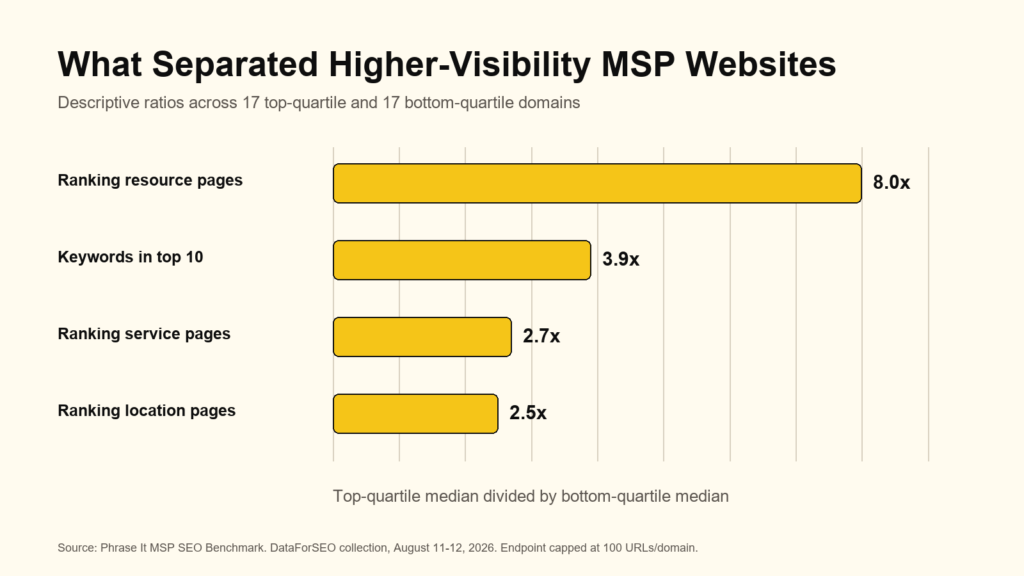
Top-to-bottom-quartile median ratios. The ranked-page endpoint was capped at 100 URLs per domain, so 100 is a lower bound for larger sites.
Did Location Pages Improve MSP SEO Performance?
Location pages were associated with broader organic coverage, but they did not guarantee more efficient rankings. The 57 MSP domains with at least one ranking location page had 1.6x the median keyword footprint and 1.6x the estimated traffic of the 14 without one, yet their median top-10 keyword share was lower.
Sites with ranking location pages had a median 227 ranking keywords and 323.6 estimated monthly organic visits. Sites without one had 143.5 keywords and 196.7 estimated visits. Their median top-10 shares moved in the opposite direction: 5.8% with location pages versus 8.8% without.
That does not mean location pages hurt rankings. Authority-stratified groups were small and inconsistent, and the cohorts differed in business model, market demand, brand, and domain strength. The defensible conclusion is narrower: local architecture can expand coverage, but the URL alone does not make that coverage competitive.
| Domain Group | n | Median ETV | Median Keywords | Median Top-10 Share |
|---|---|---|---|---|
| At least one ranking location page | 57 | 323.6 | 227 | 5.8% |
| No ranking location page | 14 | 196.7 | 143.5 | 8.8% |
Why More MSP Location Pages Did Not Guarantee More Traffic
Publishing more city URLs was not monotonically associated with more estimated traffic. Domains with four to nine ranking location pages had median estimated traffic of 502.7, compared with 348.2 among domains with 10 or more. The larger cohort ranked for more keywords, but page volume did not produce proportional traffic growth.
The 10-plus cohort had more authority and a larger median keyword footprint, so this is not evidence of a Google penalty. It does reject a simpler assumption: if five city pages help, 30 templated city pages must help six times as much.
A location page should exist because the MSP can demonstrate a real service area, distinct demand, relevant proof, local operating details, and a useful internal-link path. If the only unique element is the city name, the page may exist in the index without becoming a meaningful search asset.
| Ranking Location Pages | Domains | Median ETV | Median Keywords | Median Referring Domains |
|---|---|---|---|---|
| 0 | 14 | 196.7 | 143.5 | 216.5 |
| 1-3 | 17 | 178.8 | 114 | 143 |
| 4-9 | 21 | 502.7 | 262 | 235 |
| 10+ | 19 | 348.2 | 357 | 314 |
Before you duplicate another market template, I can map the actual location demand, page ownership, proof requirements, and internal links your MSP needs.
See How Phrase It Structures SEO WorkThe Technical And On-Page Gaps Were Common, But Not Equal
The most common technical signal was render-blocking resources, detected on 54 of 65 inspectable homepages. Page completion exceeded three seconds on 23 sites, while 31 had homepage titles outside the study’s frozen 30-to-60-character diagnostic range. These are triage signals, not standalone explanations for weak rankings.
A long title is not automatically bad, and Google does not use the study’s character range as a ranking rule. The range simply identified pages where snippet control deserved review. The same applies to timing: the DataForSEO page record is a controlled third-party observation, not a replacement for Chrome User Experience Report field data.
I would fix measurement and indexation first, then inspect slow or render-blocked templates that support commercial pages. Chasing a perfect homepage score while the service architecture remains unclear is busywork. Phrase It’s approach to SEO services follows the same sequence: decide which pages and outcomes matter, then prioritize the technical work that supports them.
| Homepage Signal | Count | Applicable Denominator | Share |
|---|---|---|---|
| Render-blocking resources detected | 54 | 65 | 83.1% |
| Title outside frozen 30-60 character range | 31 | 65 | 47.7% |
| Page completion above 3,000 ms | 23 | 65 | 35.4% |
| Not exactly one non-empty H1 | 11 | 65 | 16.9% |
| No detected meta description | 6 | 65 | 9.2% |
MSP Websites Often Disconnected Proof From Commercial Discovery
Proof and buying information were frequently hard to reach from the homepage. Among 64 applicable sites, 28 had no detected homepage-linked case study, customer story, project, or results pathway. Nineteen lacked a detected location pathway, while 20 lacked a pricing, cost, plan, package, or calculator pathway.
These are homepage-pathway findings, not claims that the assets did not exist anywhere on the site. The distinction matters. A strong case study buried outside the navigation may help a sales rep who already has the URL, but it does little to support a prospect moving from a service page toward a decision.
The commercial architecture should answer three questions without forcing the buyer to search the site: can you solve this problem, can you serve an organization like mine, and what proof reduces the risk of contacting you? Service pages, vertical pages, case studies, pricing guidance, and resources should pass the buyer between those questions deliberately.
| Undetected Homepage Pathway | Count | Denominator | Share |
|---|---|---|---|
| Case study, customer story, project, or results | 28 | 64 | 43.8% |
| Pricing, cost, plan, package, or calculator | 20 | 64 | 31.2% |
| Location or service area | 19 | 64 | 29.7% |
| Industry or vertical | 13 | 64 | 20.3% |
How I Conducted The MSP SEO Research
I combined a user-authorized MSP outreach corpus with DataForSEO domain, backlink, on-page, ranked-page, and live SERP data. The study covered 71 eligible root domains, 65 inspectable homepages, and 3,455 canonical ranking URLs. Rules, thresholds, missing-data handling, rechecks, and limitations were frozen before publication.
The source list contained 72 unique MSP-labeled rows. One adjacent outsourcing firm did not meet the frozen eligibility rule, leaving 71 websites. The sample concentrated on Dallas, Chicago, and co-managed IT opportunities, so it should be read as a supplied-corpus benchmark rather than a representative industry survey.
Homepage findings used only inspectable and applicable records. Six eligible homepages were not inspectable as HTML. Ranked-page collection returned 3,498 occurrences; canonicalization removed 43 query or URL variants, leaving 3,455 unique URLs. A rule-based classifier identified 504 ranking location pages.
DataForSEO traffic, keyword, backlink, and authority values are third-party estimates. Live rankings were point-in-time desktop observations. Quartile and cohort comparisons are descriptive associations, not causal tests. A deterministic recheck reproduced frozen derived fields, but no independent human second coder participated.
| Research Component | Achieved Sample | Boundary |
|---|---|---|
| Eligible MSP domains | 71 | Purposive outreach corpus |
| Inspectable homepages | 65 | Homepage findings only |
| Canonical ranking URLs | 3,455 | Up to 100 returned per domain |
| Ranking location pages | 504 | Rule-classified ranking URLs |
| Page-body audit selection | 270 | Only 18 bodies were usable |
| Classification recheck | 691 URLs (20.0%) | Same-researcher deterministic reapplication |
How To Compare Your MSP Website With The Benchmark
Compare your site at the query and page level, not by total traffic alone. Start with five commercial clusters: managed IT, co-managed IT, cybersecurity, priority industries, and legitimate service areas. For each cluster, identify the intended page, its rankings, proof, internal links, conversions, and competing URLs.
Use Google Search Console for first-party impressions, clicks, landing pages, and query-to-page ownership. Pair it with analytics and CRM outcomes so a rise in informational traffic does not masquerade as pipeline growth.
If you are evaluating outside help, the useful question is not whether an agency promises more content. Ask how it will decide which pages deserve ownership, what it will consolidate, how it will connect proof, and which business signal will determine whether the work succeeded. My guide to choosing the right SEO agency explains how to assess that operating model before you commit.
- Coverage: non-brand impressions and ranking keywords by service, industry, and market cluster.
- Movement: priority keywords grouped into positions 1-3, 4-10, 11-20, 21-50, and beyond.
- Ownership: the percentage of priority terms with one clear canonical page owner.
- Authority: relevant referring domains and internal links to commercial and research assets.
- Commercial impact: qualified organic leads, booked calls, assisted pipeline, and win rate by landing page.
If you want a specific answer instead of another generic audit, I’ll map your MSP’s commercial pages, evidence gaps, technical blockers, and first 90 days.
Book An MSP SEO ConversationA 90-Day MSP SEO Action Plan
The practical sequence is measurement first, commercial ownership second, and authority third. In the first 30 days, establish clean tracking, indexation, and keyword-to-page ownership. In days 31 to 60, rebuild priority service and market pages. In days 61 to 90, publish proof-led resources and earn relevant authority.
Do not convert this benchmark into a 200-item backlog. Pick the smallest set of pages that can change qualified organic demand, define success, and give each page one clear job.
| Window | Priority | Core Deliverables | Success Signal |
|---|---|---|---|
| Days 0-10 | Measurement and index control | Search Console, analytics, conversions, sitemap, robots, canonicals | Clean indexation and trusted conversion events |
| Days 11-30 | Commercial ownership | Keyword-to-page map; title, H1, and snippet triage | One owner for every priority query |
| Days 31-45 | Service and market pages | Rebuild, differentiate, or consolidate priority owners | Indexable pages with proof and clear intent |
| Days 46-60 | Internal authority | Contextual links from resources, navigation, and proof | More relevant links to commercial owners |
| Days 61-75 | Proof and research | Case studies, buyer guides, implementation content, proprietary data | Decision-stage assets that earn links |
| Days 76-90 | Authority and iteration | Digital PR, partner links, local citations, performance retest | Top-20-to-top-10 movement and qualified leads |
The MSP SEO Keyword Tiers
The keyword tells you what the searcher needs, how commercially valuable that search is, and which page should rank for it. Get the page type wrong, and even strong content can struggle to perform.
Start with the keywords closest to a sale, then work down:
- High-intent service keywords
“[City] IT support,” “managed IT services [city],” and “outsourced IT [city]” signal that someone is actively looking for a provider. These are your money terms, and they belong on tightly focused service pages.
- Industry keywords
Searches such as “HIPAA-compliant IT services [city]” and “IT support for dental practices” tell you that the buyer is looking for more than general technical competence. They want an MSP that understands their environment, requirements, and risks. The volume may be lower, but the likelihood of a strong commercial fit is much higher.
- Problem-solution keywords
Searches such as “when should a business outsource IT?” and “questions to ask before hiring an MSP” belong on the blog. They help you reach buyers before they begin comparing providers, establish your expertise, and feed authority into your commercial pages through internal links.
Also, commercial intent is only one part of the decision. I also check whether the keyword is likely to attract an account the MSP would accept. A term can be close to a sale and still be a poor target if it mainly brings one-person businesses, residential support requests, break-fix work, or companies outside the provider’s service radius.
The right keyword strategy is made around the MSP’s minimum seat count, strongest verticals, delivery model, geography, and average contract value. Rankings are not useful if sales has to disqualify nearly every enquiry they produce.
I also always steer smaller MSPs away from the national terms like “managed IT services.” Those head terms demand enormous authority, budget, and time, while local and industry-specific keywords can bring in better-fit prospects with far less traffic.
That difference between traffic and qualified demand becomes clearer when you look at how an MSP qualifies opportunities in practice.
“At Impress Computers, our best-fit leads usually come from businesses with at least 10 users located within about 60 minutes of Katy, Texas,” says Roland Parker, founder and CEO of Impress Computers. “Compliance pressure is another strong signal, especially among tax and accounting firms dealing with Written Information Security Plan and FTC Safeguards Rule requirements. Broad cybersecurity content may attract more traffic, but much of it comes from individuals looking for free troubleshooting. Lower-volume content about AI security consulting or Zero Trust tools such as ThreatLocker brings fewer clicks, but the conversations are more likely to involve decision-makers with an active need.”
Roland Parker, founder and CEO of Impress Computers
Parker sees the same distinction in the language prospects use. Someone asking about managed detection through RocketCyber or a secure Microsoft Azure environment is much closer to a managed-services engagement than someone looking for a one-off break-fix repair.
That is why I would not judge an MSP content plan by total clicks. I would judge it by whether it attracts accounts inside the provider’s real service area, above its minimum seat count, and with a problem that matches the services it wants to sell.
| Keyword type | Example | Search intent | Page it belongs on |
|---|---|---|---|
| Service (Tier 1) | managed IT services Nashville | Ready to buy | Service page |
| Industry (Tier 2) | IT support for dental practices | Comparing specialists | Industry landing page |
| Problem (Tier 3) | How to prepare for ransomware | Researching, not buying yet | Blog post |
| Head term (avoid) | managed IT services | Mixed/national | Usually none – too competitive |
| If you’re staring at your own keyword list wondering which terms are winnable, that’s the first thing I map in a strategy call for your specific market. |
What’s the Best Site Structure for Managed IT Service Providers SEO?
For most MSPs, site structure matters more than publishing more blog posts.
A good architecture does two things: it gives each important search intent a clear destination, and it shows Google how your services, industries, locations, and expertise relate to one another.
| Page type | Primary intent | SEO function |
| Core service page | Linked prominently from the main navigation and supported by relevant industry pages, location pages, and blog posts. | Ranks for high-intent service searches and converts demand. |
| Industry page | Connects a specific market to the services it needs, then links back to those core service pages. | Establishes specialization and commercial fit. |
| Location page | Connects a real service area to the services available there. | Targets local buying intent. |
| Blog post | Links upward into the service or industry page most relevant to the problem. | Builds topical depth and passes authority into commercial pages. |
That hierarchy gives every page a defined job. Service pages are at the center of the commercial architecture, industry and location pages make those services relevant to specific buyers, and blog content supports them by covering the problems, risks, and decisions that lead someone toward the service.
So, which service pages should an MSP website have?
An MSP website should have a dedicated page for every service that represents a distinct buying decision. For most providers, that means separate pages for managed IT, co-managed IT, cybersecurity, cloud services, backup and disaster recovery, Microsoft 365, and IT consulting, assuming each is genuinely offered.
I would not split every technical capability into its own page. Endpoint monitoring, patch management, and help desk support usually belong within the managed IT page unless buyers search for them separately or you sell them independently.
The test is simple: does this service solve a different problem, target a different buyer, or require a different sales conversation? If it does, it probably deserves its own page.
Internal links complete your structure. Your problem-solution blog posts should link up into the service and industry pages they support – a ransomware post linking to your cybersecurity service page, for instance. That’s how authority flows to the pages that actually convert.
Do Local SEO and Google Business Profile Play a Role?
Local SEO is how a small MSP can beat a national one. Your Google Business Profile, local reviews, and city-specific pages let you appear in the map pack for “IT support near me,” which is a placement a national brand with no local address cannot earn.
For MSP searches, the Maps pack often appears before the organic results, which makes your Google Business Profile and reviews a major part of the SEO strategy.
Confirm That You Are Eligible For a Google Business Profile
Remote-only MSPs may not qualify because Google generally requires in-person customer contact. A legitimate office or service-area operation can qualify. A virtual office or rented address without a real business presence cannot.
Optimize For Relevance, Distance, and Prominence
Choose the most accurate available category, list the services you provide, and make sure your website reinforces the same services and location. Reviews and relevant local links can strengthen prominence, but a large service area will not make you equally competitive in every city.
Build City Pages Around Local Relevance
City pages can support organic rankings, but they cannot erase physical distance in the map pack. Give each page local substance through clients served, response coverage, nearby technicians, partnerships, market-specific needs, or regional case studies. Changing the city name in the same template is not enough.
Build a Consistent Review Process
Ask clients for honest feedback without requesting keywords or positive ratings. Reviews that naturally mention the work completed, business supported, or quality of response give buyers more useful evidence than generic praise.
Keep Your Business Information Accurate
Use consistent contact and location details across your website, Google Business Profile, and major directories. Conflicting information makes it harder for buyers and search engines to verify the business.
Earn Relevant Local Links
Prioritize links from chambers of commerce, local business groups, sponsorships, vendor directories, and community organizations. These links connect the MSP to the market more convincingly than another batch of generic directory listings.
What Type of MSP SEO Content Converts IT Buyers?
The content that gets you MSP contracts is problem-first and buyer-filtered.
Some buyers are unhappy with their current provider. Others have outgrown internal support, need industry-specific expertise, or are deciding what kind of IT partnership they need. Your content should meet them at those moments and help them move toward a buying decision.
These are the best formats in my experience, because I found that they attract buyers rather than browsers:
- Provider-evaluation content
This content reaches businesses already questioning their current IT support, which makes them some of the warmest leads. Topics like “how to tell if your MSP is underperforming” and “what should an IT support contract include?” speak directly to that stage.
- Industry-specific guides
These turn your vertical expertise into a practical resource for the exact buyers you want to attract. A guide such as “cybersecurity requirements for accounting firms” can also work as a gated PDF for lead capture.
- Decision-framing comparisons
These help buyers weigh their options while giving you room to show where managed services make the most sense. “Co-managed IT vs fully managed IT” is one example that can move a growing business closer to the right engagement model.
- Commercial-objection content
Some of the most useful MSP content answers the questions prospects raise after they understand the service but before they are ready to talk. That includes what managed IT pricing depends on, what onboarding involves, how switching providers works, what happens to the internal IT team, and how responsibility is divided during a security incident. These topics may never produce enormous traffic, but they remove uncertainty from an active buying process.
I also often deprioritize topics that mainly attract people looking for a quick DIY fix. “How to fix slow office Wi-Fi” may bring traffic, but it is unlikely to bring contracts. “When should a small business outsource IT?” reaches someone already considering professional support.
That is the standard I use for every MSP content topic: it should connect a real business problem to a buying decision, then lead naturally into the service or industry page that can convert that demand. Otherwise, you may be building traffic, but you are not building a pipeline.
| This is the content layer of a full SEO program – created around search intent and real conversions. If your current SEO content isn’t bringing leads, the problem usually isn’t volume. See how Phrase It approaches SEO content and strategy on our services page tailored to managed service providers. |
How to Optimize Content for AI Search
IT buyers now use ChatGPT, Perplexity, and Google’s AI features to find managed service providers, compare services, and answer questions about outsourcing IT. Your MSP SEO strategy should help those systems understand what you offer and when your business is relevant.
The good news is that what makes you citable by an LLM overlaps heavily with good SEO, but AI visibility places more emphasis on clear, specific, extractable information.
From the AI search work I do, these three areas matter most for MSPs:
- Answer questions directly and early
Lead each page or section with a clear, self-contained answer to the question it targets. AI systems extract concise, factual passages – not paragraphs that warm up for 200 words before saying anything.
- Be specific and named
“We monitor endpoints” tells an AI system almost nothing about who the service is for or how it is delivered. A useful description names the service, customer, location, coverage, and any genuine operating standard the MSP is prepared to publish. Named services, locations, industries, and numbers make you machine-readable.
- Keep the page technically clean
Use clear headings, semantic HTML, fast-loading pages, and internal links that show how related services and topics connect. Do not hide essential information behind scripts, interactive elements, or downloads that crawlers may struggle to access.
I treat AI search optimization and SEO as the same job. A page written to be the clearest answer for a human buyer is usually the same page an AI engine wants to cite. You’re not optimizing for robots – you’re removing the vagueness that was costing you either way.
How Long Does SEO Take to Work for MSPs?
A realistic timeline for MSP SEO is six to twelve months, with different parts of the strategy paying off at different speeds. Technical SEO improvements and specific long-tail pages often create the first gains. Broader service and location keywords usually follow once the site has built more relevance and authority.
The exact pace depends heavily on the strength of the domain, its existing rankings, and the competition in each market.
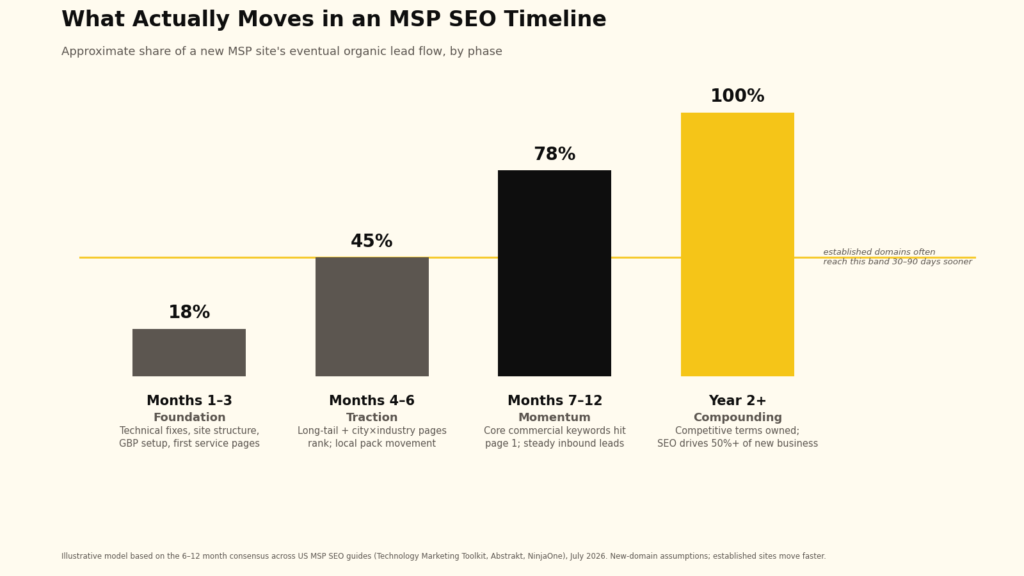
Illustrative model based on the 6-12 month consensus across US MSP SEO guides, July 2026. New-domain assumptions; established sites move faster.
| Phase | Focus | Progress |
|---|---|---|
| Months 1-3 | Technical fixes, site structure, Google Business Profile, and core service pages | The foundation is in place, but rankings may move slowly. |
| Months 4-6 | City and industry pages, plus problem-solution content | Long-tail rankings improve, and local visibility grows. |
| Months 7-12 | Content depth, internal linking, local links | Core commercial keywords reach page one, and leads become more consistent. |
| Year 2+ | Compounding authority, competitive terms | SEO becomes a major source of new business and supports stronger pricing. |
The single biggest accelerator is consistency. The MSPs that publish and optimize steadily reach these bands materially faster than the ones who sprint for a month and then go quiet for a quarter.
Should You Hire an MSP SEO Agency?
You can run MSP SEO in-house, but it is rarely one person’s job. Even a modest strategy can involve five to ten service pages, several industry and location pages, ongoing technical work, local SEO, content, links, and lead tracking.
| Area | Work Involved | Agency Advantage |
| Technical SEO | Crawl and indexation checks, redirects, canonicals, schema, page speed, JavaScript issues, and developer briefs | Technical specialists, paid tools, and experience diagnosing problems before they suppress the whole strategy |
| Site architecture | Mapping services, industries, locations, and content to separate search intents without creating cannibalization | Experience deciding which opportunities deserve a page and which should be consolidated |
| Local SEO | Google Business Profile optimization, review growth, citation cleanup, city pages, and local link acquisition | A repeatable process across all the signals that influence local visibility |
| Content | Building service pages and articles around commercial intent, then connecting them through internal links | Writers, strategists, and editors working from one keyword and conversion plan |
| Authority | Earning relevant local, industry, vendor, and editorial links | Existing prospecting systems and the capacity to do outreach consistently |
| Measurement | Tracking calls, forms, rankings, assisted conversions, and lead quality | Proper analytics setup and reporting that connects SEO work to enquiries rather than traffic alone |
So, unless you have or can hire a few people with experience, I’d recommend an agency.
You are competing in local results where site authority, service-page quality, Google Business Profile strength, reviews, links, and proximity all affect who gets seen. An agency’s advantage is that it can work on those areas at the same time.
Your team should still supply the service expertise, client proof, and insight into what buyers ask. The agency should turn that knowledge into search visibility and qualified enquiries.
Before you hire an agency, ask them to walk you through a specific MSP they helped, what they changed, and how they measured it. “We boosted visibility” is not an answer. You can easily evaluate an SEO provider with in-depth industry-specific questions. Your business is on the line; don’t be afraid to ask them.
Final Thoughts
If referrals are no longer giving your MSP enough predictable growth, SEO gives you another way to reach businesses already looking for the services, expertise, and local support you provide.
The strongest strategy connects every part of the work to the contracts you want. Service and industry pages define what you want to be hired for. Local SEO determines where you can compete. Site structure and internal links concentrate authority around those offers. Content reaches buyers before they search for a provider, while clear technical and on-page signals help Google and AI systems understand when to surface you.
Executed as one system, MSP SEO closes the gap referrals leave behind. It builds qualified demand around the services, industries, and locations you are best placed to win, then compounds as your rankings, authority, and market presence grow. For an MSP that wants a reliable route to more contracts, it is one of the few channels that becomes more valuable the longer you invest in it.
| If you want to apply this to your own site – or find out where your biggest MSP SEO gap is book a free 30-minute strategy call. I’ll look at your setup and tell you exactly where I’d focus first. |
FAQ
How long does SEO take to work for an MSP?
Most MSPs see early movement on long-tail and local terms within 3-4 months and steady lead flow within 6-12 months. A brand-new domain is at the longer end; an established site with existing authority can see meaningful results in 30-90 days. Consistency is the biggest variable.
How is MSP SEO different from regular local SEO?
The buyer is a B2B decision-maker with a long consideration cycle, and the services are technical and trust-heavy, so your content has to prove competence and security, not just proximity. You’re combining local search signals with industry-specific authority – a mix a restaurant or retailer never has to manage.
What is the biggest MSP SEO mistake?
Targeting broad terms like “managed IT services” before you have earned the authority to compete for them. Local service and industry-specific keywords usually give MSPs a much clearer path to rankings, qualified traffic, and enquiries. Build strength there first, then expand into broader terms.
Should an MSP create location pages for cities where it has no physical office?
Yes, if it genuinely serves businesses there and can add local evidence such as clients, technician coverage, partnerships, response arrangements, or case studies. The page can rank organically, but it will not give the MSP a local address or overcome distance in Google Maps.
Do managed IT and co-managed IT need separate landing pages?
Usually, yes. Managed IT targets businesses looking to outsource IT, while co-managed IT targets internal teams that need extra capacity or specialist support. Separate pages let you address each buyer, search intent, and sales conversation properly.
Does an MSP need to blog to rank?
You need buyer-intent content, which usually includes a blog – but quality and structure beat frequency. One well-targeted post a month that answers a real buyer question and links into your service pages will outperform ten shallow posts. Publishing for its own sake doesn’t move rankings.