The easiest way to sell AEO right now is to show you a screenshot of ChatGPT mentioning a brand.
The harder job is explaining why that answer appeared, whether it appears consistently, what the agency changed, and whether the visibility created a useful business result. That gap is where weak AEO, GEO, and AI SEO offers hide.
I reviewed 30 public community accounts and practitioner discussions, plus 22 current guidance and platform pages, to see what buyers should actually evaluate. This was a purposive sample collected on August 12, 2026, not a survey of the whole market. The Reddit and LinkedIn accounts are public, unverified self-reports.
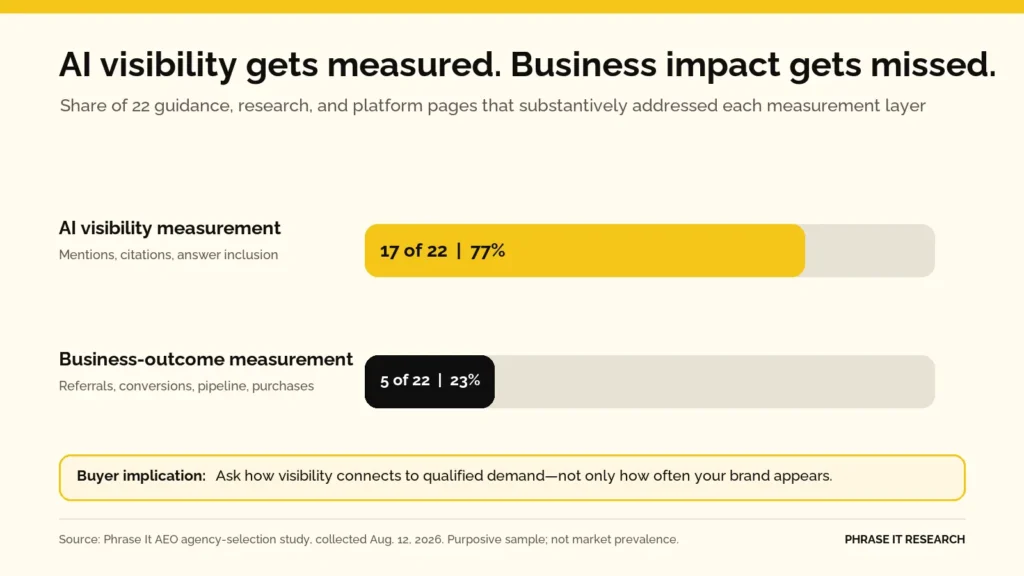
One result stood out. In the 22-page guidance sample, 17 pages discussed AI visibility measurement, but only five connected the work to referrals, conversions, pipeline, or another business outcome. Measuring whether you appear matters. It just is not the finish line.
Here is how I would choose an AEO agency when the labels are messy, the tools are imperfect, and everybody has a confident-looking dashboard.
Table of Contents
First, Decide What You Need the Agency to Own
Choose an AEO agency when you need strategy, implementation, and measurement across AI search, not just a visibility report. If your team can already execute technical SEO, content, digital PR, analytics, and site changes, a specialist consultant or audit may be enough. Buy the operating model that closes your actual gap.
This decision comes before the agency shortlist.
A monitoring tool can tell you that your brand appeared in six of 40 tracked prompts. It cannot automatically decide whether the next move is a pricing-page rewrite, a technical fix, a third-party comparison mention, better product data, original research, or no action at all.
An audit can diagnose the problem. It does not guarantee anyone will implement the recommendation.
An agency should be able to own more of the chain:
- Define the buyer questions and platforms worth tracking.
- Establish a repeatable baseline.
- Diagnose why your brand or pages are absent, misrepresented, or uncited.
- If you need the baseline and diagnosis before committing to ongoing implementation, a GEO audit can show how AI platforms currently describe, cite, and recommend your business, where the evidence is weak, and what should be prioritized next.
- Prioritize the work across your site and the wider web.
- Get the work shipped with your writers, developers, PR team, or its own delivery team.
- Measure what changed and decide what to test next.
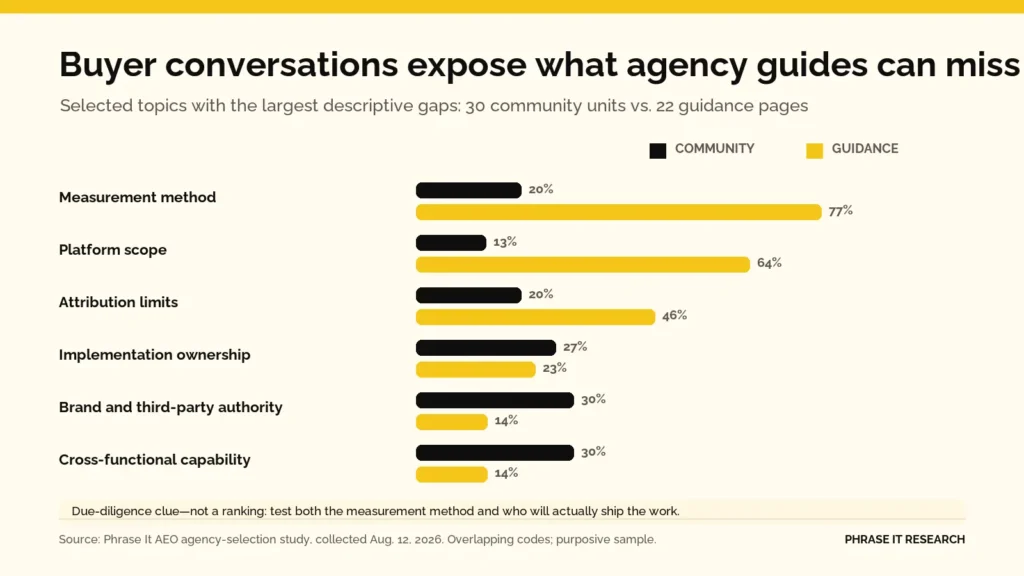
That implementation question appeared in eight of the 30 community units I reviewed. One buyer expected blog ideas and title changes, then discovered the engagement needed developers to fix loading, code, and internal linking. Another client in the same discussion said similar technical work dominated the first few months before traffic improved.
The lesson is simple: ask what your team will need to do before you approve the scope.
Make Sure the Agency Understands SEO Before It Sells You AEO
A credible AEO agency should build on technical SEO, useful content, site structure, and authority rather than replace them with AI-specific tricks. The additional work is platform-aware prompt research, answer and citation analysis, entity clarity, third-party source strategy, and measurement designed for variable AI responses.
Google now says this plainly. Its guide to generative AI features in Search explains that AI Overviews and AI Mode use core Search ranking and quality systems. Google also says you do not need special AI text files, microscopic content “chunks,” or a different writing style made only for machines.
That does not mean AEO is identical to traditional SEO across every platform. ChatGPT Search can rewrite one prompt into several web queries and can use location or memory context. Bing now reports citations across its supported AI experiences. Perplexity has its own citation behavior.
It means the foundation still matters.
In my own work, I track visibility and referrals from systems such as ChatGPT, Gemini, Claude, and Perplexity, but I do not separate that from the pages, internal links, technical access, sources, and proof those systems have available. If the site cannot be crawled, the content says nothing original, and nobody credible mentions the brand, an “AI-ready FAQ” is not a strategy.
Ask the agency to show you where its work is genuinely additive:
- How does its prompt research go beyond a traditional keyword export?
- How does it decide which platforms matter for your audience?
- How does it investigate sources that influence the answers?
- What does it do when the best opportunity sits on someone else’s website?
- Which technical and content recommendations are ordinary SEO fundamentals?
I prefer an agency that labels the overlap honestly. You should not pay an AI premium for routine title-tag changes presented as a new discipline.
Phrase It’s SEO services start with your strategy, search evidence, and implementation needs—not whichever AI-search acronym happens to be trending. We’ve seen a lot of clients asking for GEO, AI SEO or AEO (whatever you want to call it) without having SEO foundation, which is wrong. High-level strategies can’t give results without the solid foundation. We tell you that – we don’t charge retainers that only fill our pockets.
Explore SEO servicesAsk for Proof You Can Inspect, Not a Success Screenshot
Good AEO proof shows the starting point, work completed, measurement method, timeframe, and result by platform or prompt group. A screenshot of one favorable answer proves that the answer existed once. It does not prove repeatability, causation, commercial value, or that the agency produced it.
Proof was surprisingly underrepresented in the sample. Six of 30 community units and three of 22 guidance pages substantively addressed case studies or references.
That matters because this market is full of percentages with no denominator.
One LinkedIn “case study framework” in the sample displayed improvements across organic sessions, AI mentions, rankings, and leads, then disclosed that the metrics were examples to be replaced with real client data. The disclosure was responsible. A buyer skimming only the graphic could still mistake demonstration numbers for results.
When an agency presents a case study, ask for five things:
- The baseline: Which prompts, engines, competitors, locations, and dates were measured before the work?
- The intervention: What exactly changed on-site and off-site?
- The comparison: Did the agency keep the prompt set stable and repeat the runs?
- The result: Did mentions, citations, source inclusion, referrals, branded demand, or conversions change?
- The caveat: What else could explain the movement?
Anonymized cases can be legitimate. Confidentiality is not an excuse for a result that has no method, period, or denominator.
Ask to speak with a reference when the engagement is large enough to justify it. More importantly, ask the reference about the parts a polished case study will not show: who did the work, how quickly recommendations shipped, whether reporting led to decisions, and what happened when results were weak.
E.g., one of our long-term SaaS clients received 1,458 sessions from AI platforms, up 21% year over year. More importantly, AI-attributed key events increased 91% and free trials increased 118%, demonstrating that AI visibility is producing increasingly qualified, conversion-ready traffic. ChatGPT is the principal source, while Gemini and Perplexity are beginning to contribute measurable leads. Informational and commercial pages—including pricing, free access, and other in-depth resources—are all contributing to these results.
Make the Agency Explain Its Measurement Method in Plain English
An AEO agency should disclose the prompts it samples, how those prompts were chosen, which platforms and contexts it tests, how often it repeats them, what counts as a mention or citation, and how it handles normal answer variation. If you cannot reproduce the logic, the score is not evidence.
This was one of the clearest findings in the community discussions. Six of 30 units raised measurement transparency, and seven challenged dependence on a vendor score or tool. The guidance sample was even more measurement-heavy: 17 of 22 pages discussed methodology and 17 discussed visibility metrics.
The most useful Reddit exchange challenged a monthly visibility score at its source. If an agency invents a list of prompts, then a “63% visibility” score only describes performance against that list. Add three favorable prompts and the score changes without anything changing in the market.
That does not make prompt tracking useless. It makes the prompt set part of the methodology.
I would expect the agency to combine several inputs:
- Search Console and keyword data for established demand.
- Sales calls, support tickets, on-site search, and customer interviews for real language.
- Comparison, alternative, pricing, and use-case questions from the buying process.
- Competitor and cited-source analysis from the answer engines themselves.
- A documented reason for every platform included in the report.
Then I would ask it to freeze a core set long enough to measure a trend. New prompts can sit in a separate discovery panel instead of quietly changing the historical benchmark.
The agency should also repeat tests. Two 2026 research papers on AI visibility measurement make the same practical point: answers vary across runs, prompts, platforms, and time. One check is a snapshot, not a ranking.
Judge Results Across Three Layers, Not One Dashboard Score
Evaluate AEO results across visibility, owned performance, and business impact. Track mentions, citations, source pages, and competitor share within a defined sample; then review first-party referrals and site behavior; finally, connect the work to qualified demand, assisted conversions, pipeline, purchases, or another outcome your business already values.
The three layers answer different questions.
| Layer | What It Tells You | Useful Evidence | What It Cannot Prove Alone |
|---|---|---|---|
| Sampled AI visibility | Whether the brand or site appears in tracked answers | Mentions, citations, cited URLs, sentiment, competitor share by platform | Real impression volume or revenue |
| First-party site performance | Whether identifiable AI visitors reach and use the site | AI Assistant/referral sessions, landing pages, key events, assisted paths | The full no-click or dark journey |
| Business impact | Whether demand or revenue moved in a useful direction | Qualified leads, trials, purchases, pipeline, branded-search lift, self-reported source | That the agency caused every change |
Google Analytics introduced an AI Assistant channel in May 2026 for recognized referrals from services such as ChatGPT, Gemini, and Claude. Bing Webmaster Tools now reports citations and cited pages for supported Microsoft AI experiences. Those are useful first-party signals.
They still do not reveal every journey.
A person can see your brand in an AI answer, search your name later, type the URL directly, ask a colleague, or never visit the site. Referral traffic will miss those paths. A visibility dashboard may see the mention but cannot know how many real buyers saw that sampled answer.
I would listen for that nuance in the sales call. “We can measure everything” is not confidence. It is a warning.
Use These Questions to Compare AEO Agencies
The best questions force an AEO agency to reveal how it thinks, measures, implements, and responds when results are unclear. Ask every shortlisted provider the same core questions, take notes, and score the substance of the answer. A fluent pitch matters less than a method you can inspect.
Here are the 12 questions I would put in the brief:
- Which business result are you optimizing for, and what would make you tell us AEO is not the right spend yet?
- How will you build our prompt set from real customer and sales evidence?
- Which answer engines will you track for our audience, and why those?
- What counts as a mention, citation, recommendation, or source appearance in your reporting?
- How many runs do you collect, at what cadence, and how do you handle location, personalization, and model changes?
- Can we see the baseline, raw answers, prompt list, formulas, and historical data?
- Show us a case with the baseline, intervention, timeframe, denominator, and limitations.
- What work will you do on our site, and what work must happen through PR, reviews, publications, communities, or other third-party sources?
- Who creates and implements the recommendations, and who needs access to our developers, CMS, analytics, or subject-matter experts?
- Who will work on our account after the sale, and how often will we speak with the senior strategist?
- How will the report decide next month’s work, rather than only describe last month?
- If we leave, do we keep the prompt set, raw data, dashboards, content, schema, accounts, and documentation?
Do not score an agency on whether its answer matches a fashionable checklist. Score whether the answer is specific to your business and logically connected from evidence to action.
Watch for These AEO Agency Red Flags
Walk away from guaranteed citations, secret metrics, one-platform screenshots, vague “AI-optimized content,” and a scope with no implementation owner. Other warning signs include synthetic prompt lists with no customer evidence, reports that cannot be exported, junior handoffs hidden behind a senior salesperson, and AI claims that contradict platform guidance.
The most obvious red flags are easy to spot once you know where to look.
- Guaranteed ChatGPT rankings or citations: No agency controls a probabilistic answer engine. Google also says third-party services cannot access its internal ranking systems or guarantee performance.
- One blended visibility score: Your buyers do not use a blended engine. Ask for the results by platform, prompt group, run, and date.
- Screenshots instead of a trend: A favorable answer can disappear on the next run. You need repeated evidence.
- Only owned-site work: Content and technical improvements matter, but reviews, publications, comparison pages, communities, and earned mentions may shape recommendations too.
- A report with no next action: Monitoring is a scoreboard. You are hiring an agency to improve the game.
- AEO that ignores SEO: For Google’s generative features in particular, foundational Search quality and technical access still matter.
- Tool lock-in: You should retain your raw history, prompt panels, accounts, schema documentation, and published assets.
- Instant certainty: A credible agency can define early deliverables. It cannot promise an exact citation outcome on an exact date.
Also check claims against primary documentation. Google’s third-party SEO guidance specifically tells buyers to be wary of services claiming Google approval, internal metrics, or guaranteed results.
I’ll help you identify the questions that matter for your website, audience, and ability to implement—before you commit to an AEO, GEO, or AI SEO retainer.
Book a strategy callKnow What Changes When You Choose an AEO Agency Instead of an SEO Agency
The buying process is mostly the same: define goals, inspect proof, confirm scope, meet the delivery team, and agree on business reporting. The AEO difference is that you must also audit the prompt sample, platform coverage, citation evidence, answer variability, off-site sources, and limits of attribution.
| Selection Area | Traditional SEO Agency | AEO, GEO, or AI SEO Agency |
|---|---|---|
| Discovery unit | Keywords, pages, SERPs, technical issues | Buyer questions, prompt groups, answers, citations, sources, plus SEO evidence |
| Platform scope | Usually Google and sometimes Bing/local surfaces | ChatGPT, Google AI features, Perplexity, Gemini, Claude, Copilot, or the subset your buyers use |
| Leading visibility signals | Rankings, impressions, clicks, indexed pages | Sampled mentions, citations, cited pages, answer sentiment, competitor share |
| First-party outcomes | Organic sessions, leads, sales, revenue | AI referrals and behavior, plus organic, branded, direct, assisted, and self-reported paths |
| Main measurement risk | Rankings or traffic treated as the business outcome | A sampled visibility score treated as real market share or revenue |
| Execution scope | Technical SEO, content, links, local or ecommerce work | The same foundation plus answer analysis, entity clarity, cited-source strategy, and multi-platform monitoring |
The wrong conclusion is that you always need two agencies.
In most cases, integrated delivery is cleaner because the technical, content, authority, and measurement work overlaps. A separate specialist can make sense when your existing SEO agency lacks the capability, your category has a meaningful AI-search opportunity, and you have enough internal ownership to prevent duplicated work.
If two providers are involved, define the handoff in writing. Who owns the prompt map? Who changes pages? Who briefs PR? Who controls schema? Who reports the combined business result? Without that, you will pay two agencies to diagnose the same problem and nobody to ship the fix.
Evaluate the First 90 Days by What the Agency Learns and Ships
In the first 90 days, expect a defensible baseline, prioritized roadmap, implemented improvements, and reporting that changes the next sprint. Do not demand a guaranteed citation increase. Do demand evidence that the agency understood the business, fixed measurable constraints, shipped work, documented uncertainty, and learned from repeated checks.
A sensible early engagement has four parts.
- Baseline and business context: The agency maps buyer questions, platforms, competitors, existing citations, referrals, commercial pages, and analytics gaps.
- Diagnosis and prioritization: It separates technical access, content, entity, source, reputation, and measurement problems. Each recommendation has an owner.
- Implementation: Pages, structured data, internal links, source outreach, research, product data, or other prioritized assets go live.
- Re-measurement and decisions: The core panel runs again. The report distinguishes movement from noise and names what happens next.
I would review the agency on six questions at day 90:
- Can I see the baseline and reproduce the definitions?
- Did the team ship the agreed work?
- Did it explain where progress was absent?
- Did reporting change the priority list?
- Did I have access to the people making the strategic decisions?
- Do we know what we will keep, stop, or test next?
That is a much better evaluation than “Did ChatGPT mention us this morning?”
Choose the Agency That Makes Its Work Easier to Question
The best AEO agency is not the one with the loudest AI vocabulary. It is the one that can show you what it measures, why it measures it, what it will change, who will change it, and what the evidence cannot prove.
That standard is not unique to AEO. It is how you should choose any serious SEO provider.
The difference is that AI search gives weak agencies more places to hide: variable answers, private tools, unfamiliar metrics, and no complete attribution trail. Your selection process needs to remove those hiding places before the contract starts.
I’ll review your current search setup, AI-search opportunity, and implementation capacity, then tell you what I would evaluate first.
Book a free 30-minute strategy callFrequently Asked Questions About Choosing an AEO Agency
Choose an AEO agency by checking its SEO foundation, prompt methodology, platform scope, proof, implementation ownership, reporting, data access, and honesty about uncertainty. The right provider should make the work easier to inspect, not ask you to trust a proprietary score or a guaranteed placement claim.
What Is the Difference Between an AEO Agency, GEO Agency, and AI SEO Agency?
The market uses the labels inconsistently. AEO often refers to being selected in direct or AI-generated answers, GEO focuses on generative engines, and AI SEO can mean either optimizing for AI search or merely using AI in the SEO workflow. Evaluate the deliverables and measurement method, not the acronym.
How Much Does an AEO Agency Cost?
AEO agency pricing depends on the number of platforms monitored, the size and complexity of your website, the amount of content and technical implementation required, and whether the engagement includes digital PR or off-site authority work. Phrase It’s AI search services start at $2,000 per month.
Should I Hire a Separate AEO Agency If I Already Have an SEO Agency?
Start by asking whether your current agency can establish a multi-platform baseline, explain its prompt method, analyze cited sources, and implement the resulting work. If it can, integrated delivery is usually simpler. Add a specialist when there is a real capability gap and you can define ownership between the providers.
Can an AEO Agency Guarantee ChatGPT Citations?
No credible agency can guarantee a citation or recommendation from ChatGPT, Google AI Overviews, Perplexity, Gemini, Claude, or Copilot. It can improve the evidence and conditions that make inclusion more likely, then measure a repeated sample. A guarantee confuses influence with control.
How Do I Measure Whether an AEO Agency Is Working?
Use a basket of evidence: repeated mentions and citations across a stable prompt panel, cited-source changes, competitor share within that sample, first-party AI referral behavior, branded demand, and qualified business outcomes. Keep the limitations visible. No single score measures the entire AI-influenced buyer journey.
How Long Does AEO Take to Show Results?
There is no universal timeline. It depends on your starting visibility, technical access, authority, category competition, platform mix, publication speed, third-party sources, and what must be implemented. Ask for a 30-, 60-, and 90-day delivery plan, but reject a guaranteed citation date.