
Zero of the 26 SEO reports I analyzed proved that one isolated tactic caused a business to rank in ChatGPT.
That is really the most useful finding in this article.
You will find guides promising that schema, Reddit, llms.txt, fresh content, or one cleverly formatted comparison page will make ChatGPT recommend your business. The public evidence does not support that certainty.
But I did find a system. And I will tell you all about it.
I have worked in SEO and organic growth since 2019. The more AI visibility audits I conduct, the more convinced I become that “GEO” is the result of your technical SEO, content, brand positioning, authority, and measurement working together.
Table of Contents
What Does It Mean to Rank in ChatGPT?
Ranking in ChatGPT means appearing consistently and favorably across the questions your buyers ask. A business can be named, recommended, cited, compared, or placed near the top of a list. Each outcome measures something different, and all of them can change by prompt, model, location, and search mode.
There is no stable page-one result to defend.
ChatGPT creates a new answer for each user and can change that answer when the prompt gains one additional detail. A company recommended for “small ecommerce brands” may disappear when the user adds “with international inventory.”
That is why I separate six outcomes:
| Outcome | What it means |
| Mention | ChatGPT names the brand. |
| Recommendation | ChatGPT actively presents it as a suitable choice. |
| Citation | ChatGPT links to the company or a page discussing it. |
| Position | The brand appears first, second, or later in a list. |
| Sentiment | ChatGPT describes the brand positively, neutrally, or negatively. |
| Accuracy | The answer correctly explains the product, audience, price, and limitations. |
These signals do not always move together. You can get cited but not named, or you can get named but not recommended.
“ChatGPT cited our article” and “ChatGPT recommends our company” are not interchangeable achievements.
Actually, a lot of tactics to get cited backfire. For example, listicles are a “proven” way to get cited in LLMs, so every brand started writing them and putting themselves as the #1 choice.
But what happens when everyone puts themselves first? Who ranks in ChatGPT?
I saw this SEO tactic backfire for a lot of SaaS brands, as ChatGPT cites their listicle, but recommends a competitor based on their article. As a result, the competitor got the purchase.
Crazy, right?
If you take one thing from this article, it should be: don’t let your content fill competitors’ bank accounts.
How Does ChatGPT Find and Select Businesses?
ChatGPT can describe a business using patterns learned during model training or information retrieved through live web search. Training-influenced answers depend on how the brand has been discussed across the public web over time. Search answers retrieve current candidate pages, evaluate their relevance, and may attach clickable citations to the sources used.
The distinction affects what you can influence.
Training-Influenced Recall
A model may already associate a company with a product category, use case, or reputation because that relationship appeared repeatedly in its training data.
You cannot upload a revised brand description directly into a trained model. You can improve the public information future models may encounter, but that is a slow and indirect process.
This is influenced by:
- Your own website.
- News and editorial coverage.
- Product and company directories.
- Reviews and comparisons.
- Public community discussions.
- Partner and professional profiles.
ChatGPT Search
ChatGPT can also search the web for current information. When it does, it retrieves candidate sources, evaluates which ones help answer the question, and may display inline citations.
OpenAI uses different crawlers for different purposes. According to OpenAI’s official crawler documentation:
- OAI-SearchBot helps surface websites in ChatGPT search results.
- GPTBot crawls content that may be used to improve future generative models.
- ChatGPT-User may visit a page in response to an individual user action.
Allowing GPTBot does not make your pages available to ChatGPT Search. For search visibility, your site must allow OAI-SearchBot.
Most pages cited by ChatGPT are discovered through web search. That means many of the same factors that support traditional search visibility, including crawlability, relevance, and clear page titles, can help your content become a candidate source. However, appearing in that candidate pool does not guarantee that ChatGPT will select, cite, name, or recommend your business.
ChatGPT Mention Statistics
I reviewed 31 public reports from practitioners who had tested ways to improve or measure visibility in ChatGPT. A report qualified for the analysis if:
- The original source was publicly available.
- The author had participated directly in the experiment or campaign.
- The report included a result specific to ChatGPT.
- The report described at least one tactic used to improve or measure visibility.
Twenty-six reports met all four requirements. Of the five that did not qualify, three measured only crawler activity, one combined ChatGPT with other AI traffic, and one shared a result without explaining what had been done.
I also reviewed 12 larger empirical studies separately. They helped provide context but were not included in the results below.
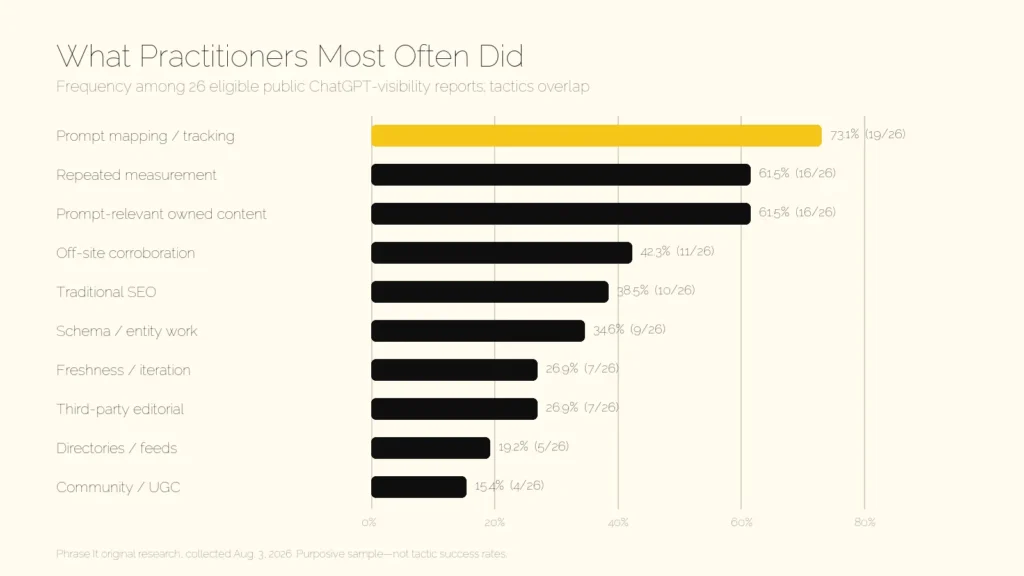
Here is how often each activity appeared across the 26 eligible practitioner reports:
| Reported action | Reports | Share of sample |
| Prompt mapping or tracking | 19 | 73.1% |
| Repeated measurement | 16 | 61.5% |
| Prompt-relevant owned content | 16 | 61.5% |
| Any off-site corroboration | 11 | 42.3% |
| Traditional SEO work | 10 | 38.5% |
| Schema or entity work | 9 | 34.6% |
| Freshness or iterative updating | 7 | 26.9% |
| Third-party editorial coverage | 7 | 26.9% |
| Directories or product feeds | 5 | 19.2% |
| Community or user-generated content | 4 | 15.4% |
What Can We Conclude From These Results?
The clearest pattern is that most practitioners started by identifying the prompts they wanted to appear for. They then checked those prompts repeatedly and created or revised content that answered the questions behind them. In other words, ChatGPT visibility was usually treated as something to research, build toward, and monitor over time.
Off-site mentions, traditional SEO, schema, and content updates also appeared, but less consistently. That does not mean they are less effective. It means fewer public reports included them, and the available evidence does not show how much each tactic contributed to the final result.
These findings should not be read as a ranking-factor study. Most campaigns used several tactics at once, so we cannot say that one change directly caused an increase in visibility.
There are also important limitations:
- Twenty-one of the 26 reports described positive results, suggesting that unsuccessful experiments may be underreported.
- Nineteen came from companies selling a related product or service.
- The reports covered different ChatGPT models, search modes, markets, prompts, and dates.
- Most campaigns made several changes at the same time.
- Public community reports could not always be independently verified.
To make the analysis more consistent, I reviewed 10 reports a second time using the same fixed criteria and resolved any differences by checking the original sources.
The evidence does not reveal a single ChatGPT ranking formula. It points to a practical starting order: map the prompts that matter, measure current visibility, create content that directly supports those prompts, and then strengthen that content through SEO and credible mentions elsewhere.
How to Get Mentioned in ChatGPT Step by Step
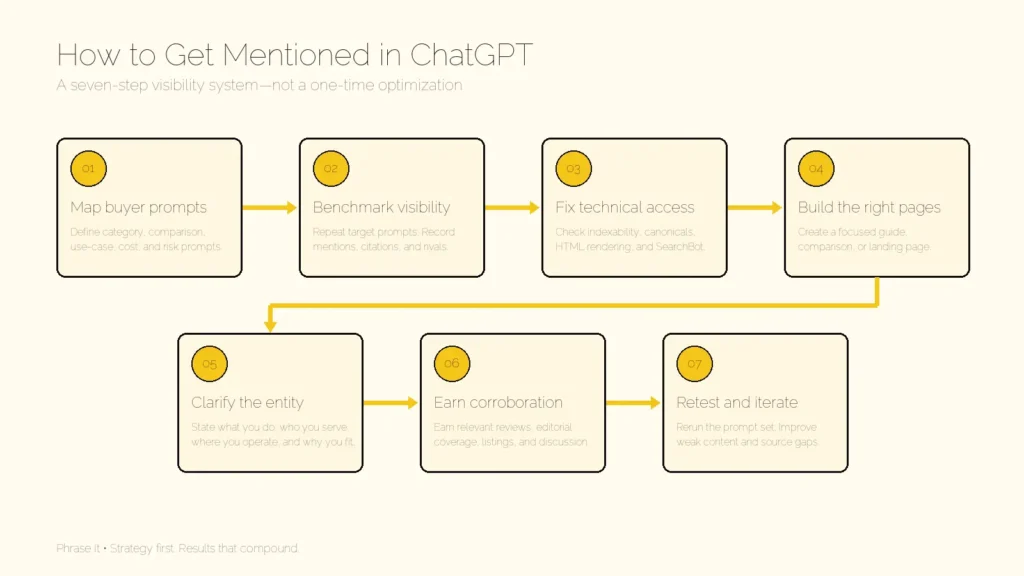
To get mentioned in ChatGPT, define the buyer questions where your company belongs, measure your current visibility, remove technical barriers, publish the right answer for each prompt, clarify what your business does, earn independent corroboration, and retest the same questions. Treat the work as a measured visibility program rather than a one-off content edit.
Step #1: Define the Questions You Want to Own
Do not start with “How do we rank in ChatGPT?”
Start with the questions potential customers ask when choosing a company like yours.
I make prompt sets around questions such as:
- “What are the best accounting tools for a US startup?”
- “Which ecommerce platform is best for a large catalog?”
- “What should I check before hiring an SEO agency?”
- “What are the best alternatives to [competitor]?”
- “Which provider is best for a non-technical team?”
- “What does this service usually cost?”
Include category, comparison, alternative, use-case, cost, risk, and implementation prompts.
Semrush tracked five related prompts across 1,094 US categories and found that only 15.2% had a clear topic owner. Brands with a lead of at least five percentage points retained first place in 90% of month-over-month comparisons. One prompt is not the same as owning a topic.
Step #2: Establish a Repeatable Baseline
Run every prompt more than once. ChatGPT can produce different answers to the same question, so repeated tests show how consistently your brand appears.
For each answer, record:
- Model and interface.
- Search mode.
- Date and market.
- Whether your brand appears.
- Whether it is recommended.
- Its position in the answer.
- Which sources are cited.
- How the brand is described.
- Which competitors appear instead.
If your brand appears in two of five answers, its observed mention rate is 40% for that specific test. This is a baseline for comparison, not a permanent ranking. ChatGPT’s answers can change as its sources, models, and search results change.
Step #3: Remove Technical Barriers
Before improving the content, make sure ChatGPT Search can access and understand the correct page. Technical problems can prevent a strong page from entering the pool of sources considered for an answer.
The page should:
- Return an HTTP 200 status, confirming that it loads successfully.
- Be indexable, without a noindex directive blocking search engines.
- Use the intended canonical URL, so search systems know which version of the page to consider.
- Allow OAI-SearchBot to access it.
- Include its important content in the rendered HTML, rather than hiding it behind scripts or interactions that crawlers may not process.
- Receive relevant internal links that help establish its subject and importance.
- Avoid competing with near-duplicate pages that answer the same question.
These elements solve different problems and cannot replace one another. A sitemap can help a crawler discover a page, but it cannot override a noindex directive. Schema can describe the page, but it cannot correct a canonical pointing elsewhere. An llms.txt file cannot resolve several pages competing for the same topic.
Step #4: Match Every Prompt to the Right Page
Different buyer questions require different kinds of evidence. A general service page may explain what you offer, but it is unlikely to provide enough detail to answer questions about pricing, comparisons, risks, or implementation.
Match each priority prompt to the type of page best equipped to answer it:
| Buyer prompt | Most useful page |
| “What are the best tools for X?” | Category guide with selection criteria. |
| “Company A vs. Company B” | Honest comparison page. |
| “How much does X cost?” | Cost guide with units and assumptions. |
| “How do I do X?” | Ordered implementation guide. |
| “Is X safe?” | Risk guide with named controls and sources. |
| “What works for X?” | Original research with transparent methodology. |
| “Who is X best for?” | Use-case page with clear qualification criteria. |
ChatGPT may break a broad prompt into several narrower searches before producing an answer. A question about the “best” tool, for example, may lead it to look for pricing, integrations, limitations, reviews, and suitability for particular users.
This is why matching a keyword is not enough. The page must provide the information someone would need to evaluate the options and make the decision behind the prompt.
Step #5: Make It Clear Who You Are and What You Offer
State what your company does in plain language.
Include:
- The product or service category.
- The customers you serve.
- The countries or locations you cover.
- The use cases where you are strongest.
- The limitations buyers should understand.
- Current pricing or a clear pricing model.
- The legal company and brand relationship.
- Named founders or experts where relevant.
Keep those facts consistent across your website, LinkedIn, review platforms, directories, partner pages, and editorial coverage.
Schema can reinforce the relationship, but the visible page must say it too.
Step #6: Earn Independent Corroboration
Your website can explain what you offer. It cannot neutrally prove that you are one of the best choices.
That is why you need independent sources.
In my sample, 11 of 26 reports included some form of off-site corroboration. Seven involved third-party editorial coverage, five included directories or feeds, and four included community content.
Look for:
- Reputable category roundups.
- Review platforms buyers use.
- Partner directories.
- Trade publications.
- Expert commentary opportunities.
- Podcasts with published transcripts.
- Industry studies.
- Genuine community questions.
Relevance matters more than collecting mentions everywhere.
Step #7: Repeat, Diagnose, and Improve
Rerun the original prompts after making changes.
When a competitor appears and you do not, examine:
- Which source supported the recommendation.
- What attributes the competitor is associated with.
- Whether your page covers the same decision.
- Whether the source is accessible and current.
- Whether third parties describe your business differently from your website.
- Whether ChatGPT is retrieving your page but citing something else.
The answers show you what may be missing. You might need a more useful page, clearer information about your offer, stronger supporting evidence, or credible third-party coverage.
Make the next change based on that diagnosis, record what you changed, and rerun the same prompts. ChatGPT visibility is not something you optimize once and consider finished. It is a repeated process of measuring the answers, identifying why other sources are selected, and improving the information available to support your inclusion.
| If you want me to diagnose this for your website, my SEO services start with the technical, content, and authority gaps most likely to affect the business. |
How We Turned AI Visibility Into 118% More Free Trials
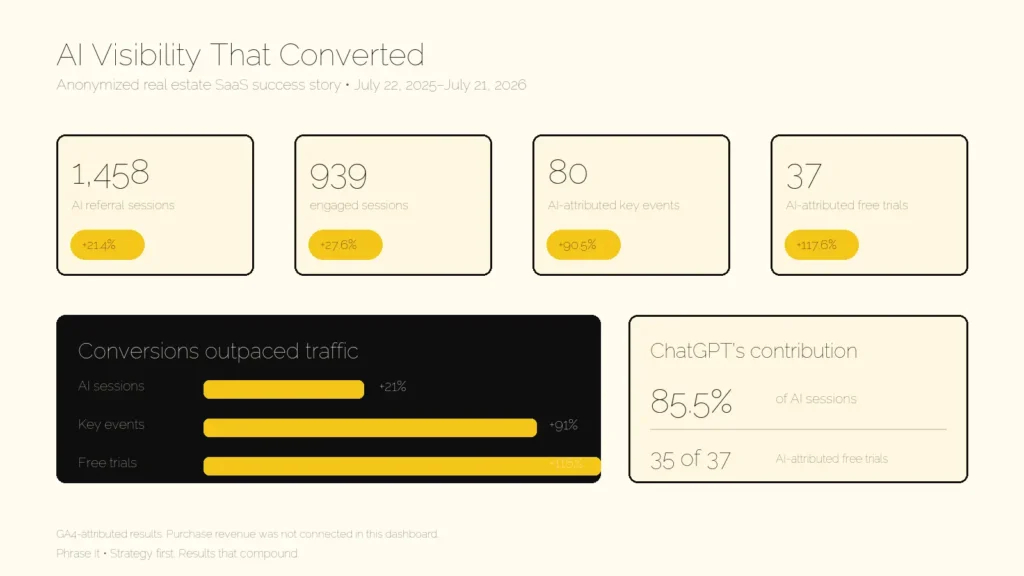
For one real estate SaaS company, our content and AI-visibility work produced more than additional referral traffic. It brought increasingly qualified, conversion-ready visitors.
We achieved:
- 1,458 AI referral sessions, up 21.4% from the preceding period.
- 939 engaged sessions, up 27.6%.
- 80 AI-attributed key events, up 90.5%.
- 37 AI-attributed free trials, up 117.6%.
- A 5.49% session key-event rate, up from approximately 3.5%.
Conversions grew much faster than traffic. AI sessions increased 21%, while key events increased 91% and free trials increased 118%. That is the result I care about: not simply appearing more often in AI search, but reaching people who were ready to evaluate the product.
ChatGPT generated 85.5% of the company’s AI referral sessions, 69 of 80 key events, and 35 of 37 free trials. Perplexity and Gemini also began producing measurable conversions, giving us opportunities to expand visibility beyond ChatGPT.
The results came from both commercial and informational pages. Pricing, free-access, and signup pages received conversion-bearing AI traffic. An educational article answering a common question generated key events from both ChatGPT and Perplexity.
This is why I connect AI visibility work to landing pages, engagement, free trials, forms, and revenue paths. A growing mention count looks encouraging. Qualified visitors taking meaningful action prove that the work is contributing to the business.
I’ll identify the prompts, content gaps, technical issues, and third-party sources affecting your visibility – then show you how to connect ChatGPT mentions and citations with trials, leads, and revenue.
Book an AI visibility strategy callHow Do You Create Content ChatGPT Can Retrieve and Cite?
Citation-ready content answers one specific question clearly, supports its claims with inspectable evidence, and exposes the answer in accessible HTML. Use descriptive titles, self-contained passages, definitions, consistent comparison fields, named sources, and visible dates. The goal is not to write for a robot; it is to remove the ambiguity that makes your page risky to use.
I use a simple test when reviewing a section:
If someone copied only the first paragraph beneath this heading, would it still answer the question accurately?
If not, the section probably needs a better opening.
Lead With the Answer
Do not spend four paragraphs introducing a straightforward answer. State the conclusion first. Then explain the mechanism, conditions, exceptions, and evidence.
Use Specific Language
“Comprehensive business solutions” tells neither the buyer nor ChatGPT what the company does.
“Monthly bookkeeping and tax support for US ecommerce companies” establishes a category, service, audience, and location.
Specific beats clever.
Publish Evidence Other Pages Cannot Copy
Useful evidence includes:
- Original research.
- Anonymized implementation data.
- Customer-support patterns.
- Benchmarks with visible samples.
- Expert commentary.
- Calculators and tools.
- Documented failure points.
- Before-and-after examples with context.
This material gives ChatGPT something specific to learn from and reference. A page is more useful when it explains why something happens, shows how it works in practice, or provides evidence that other sources do not have.
That does not guarantee a citation. The information still needs to be relevant to the prompt, accessible to search systems, and presented clearly enough to support the answer.
Use Tables Only for Real Comparisons
Tables are useful when every row shares the same fields.
Good candidates include:
- Pricing plans.
- Feature comparisons.
- Eligibility requirements.
- Timelines.
- Risks and controls.
- Tactic evidence.
Do not put ordinary paragraphs into a table simply because someone called tables “AI-friendly.”
How Do You Get ChatGPT to Recommend Your Business?
To get ChatGPT to recommend your business, establish a clear fit between your company and the buyer’s situation, then support that fit with evidence beyond your own website. Reviews, comparisons, directories, editorial coverage, customer discussions, and consistent positioning help corroborate who the business serves, where it is strongest, and when another option may be better.
Recommendation prompts require a point of view.
If someone asks for the “best project management tool,” ChatGPT needs criteria. Best for whom? At what company size? With which integrations? Under what budget?
Your content and third-party coverage should associate your business with specific attributes:
- Best for a defined customer type.
- Strong for a particular workflow.
- Suitable for a certain budget.
- Easier for non-technical users.
- Better for complex or enterprise requirements.
- Available in a particular location.
Analyze the Sources ChatGPT Already Uses
Run the unbranded recommendation prompt and list every source.
Then ask:
- Which publishers appear repeatedly?
- Which competitors do they include?
- What selection criteria do they use?
- Is your business genuinely eligible?
- What proof would make your inclusion useful to readers?
- Can you contribute original data or expert commentary?
Your content competitors may not sell the same product. They could be news sites, government pages, professional associations, review platforms, consultants, YouTube channels, or Reddit threads.
Use Community Marketing Ethically
Community content appeared in four of the 26 practitioner reports I analyzed. That is enough to justify careful participation, not enough to call Reddit a ranking shortcut.
Reddit discussions contain the experiences, comparisons, objections, and product language that rarely appear on company websites. This can help search and AI systems understand how people talk about a category or brand, even when the original discussion is not cited in the final answer.
Participate by answering real questions and contributing useful firsthand knowledge. Disclose commercial relationships when relevant. Do not buy accounts, manufacture recommendations, or coordinate fake customer conversations. Any short-term visibility gain would be outweighed by the risk to your reputation.
Why Does Technical SEO Come Before AI Visibility?
Technical SEO comes first because search and AI systems need to access, interpret, and consolidate the correct version of a page before its content can compete reliably.
Indexability, canonicalization, rendering, duplication, internal links, schema, and performance are not all direct ChatGPT ranking factors, but serious failures can undermine retrieval and authority before GEO work begins.
I saw this in a GEO audit I did for a client.
The company wanted to improve its AI visibility, but one of the pages most relevant to its target prompts was marked noindex.
Elsewhere, multiple campaign and partner pages reused the same commercial content. Those pages competed with the main service page and made it harder to identify which URL should become the canonical source.
I also found:
- Duplicate and inappropriate schema.
- Multiple body elements in the HTML.
- Conflicting subfolder structures.
- Generic headings that did not explain the service.
- Reused FAQs across pages with different intent.
- Redirected backlinks pointing to outdated URLs.
- Two audited commercial pages weighing approximately 12.8 MB.
- Mobile Lighthouse performance scores of 30 and 45.
Publishing more “AI-optimized” articles would not have fixed those issues.
The company first needed to decide which pages should rank, consolidate or exclude duplicates, repair indexability, improve internal links, clarify page intent, clean up schema, and address the worst performance problems.
I would give the same advice for traditional SEO. If your strongest page is duplicated 15 times, more content is not the answer. This is why I treat site structure and internal linking as part of AI visibility. They help search systems understand which pages matter and how those pages relate.
If your site has serious indexation, duplication, schema, or performance problems, fix the source of confusion before spending heavily on GEO content or digital PR.
Do Schema, llms.txt, Reddit, and Fresh Content Work?
Schema, llms.txt, community content, and freshness can support parts of the visibility process, but none is a proven standalone ChatGPT ranking switch. Schema clarifies entities, crawler controls affect access, community discussions provide context, and updates maintain accuracy. Their impact still depends on relevance, technical eligibility, authority, competition, and the prompt being tested.
| Tactic | Role | Verdict |
| Accurate schema | Clarifies entities and page relationships. | Useful support, not an independent ranking switch. |
| llms.txt | Offers a voluntary machine-readable content guide. | No strong evidence that ChatGPT requires or ranks from it. |
| OAI-SearchBot access | Makes pages eligible for ChatGPT Search. | Necessary for search inclusion, insufficient for citation. |
| GPTBot access | Allows possible use in future model training. | Separate from ChatGPT Search eligibility. |
| Reddit participation | Creates community context and real opinions. | Potentially useful, but direct citation evidence is inconsistent. |
| Fresh updates | Keeps facts and offers accurate. | Helpful when substantive; a changed date alone adds little. |
| FAQ formatting | Exposes concise answers. | Useful structure, not a guaranteed citation tactic. |
| Comparison tables | Presents shared fields clearly. | Useful when the underlying comparison is substantive. |
Schema appeared in 9 of the 26 practitioner reports, but those reports do not show that adding it improves ChatGPT visibility on its own.
Some businesses saw better results after updating their schema, review profiles, website content, technical SEO, and external mentions. Because all those changes happened together, we cannot know how much schema contributed. Other tests added FAQPage or HowTo schema and saw no improvement.
I think that you should use schema to describe your business and content accurately, especially when it helps connect your company with its products, services, founders, or profiles elsewhere. But do not make it the center of your ChatGPT visibility strategy.
If your pages are inaccessible, unhelpful, or poorly matched to the questions buyers ask, schema will not rescue them. Fix those larger problems first. Treat schema as supporting information that makes an already strong page clearer.
How Long Does It Take to Appear in ChatGPT?
There is no fixed timeline for appearing in ChatGPT. A technically accessible and highly relevant page may enter search citations within days, while another may remain absent after months. Indexing, authority, prompt competition, third-party corroboration, model selection, location, and search mode all affect when or whether a page or business appears.
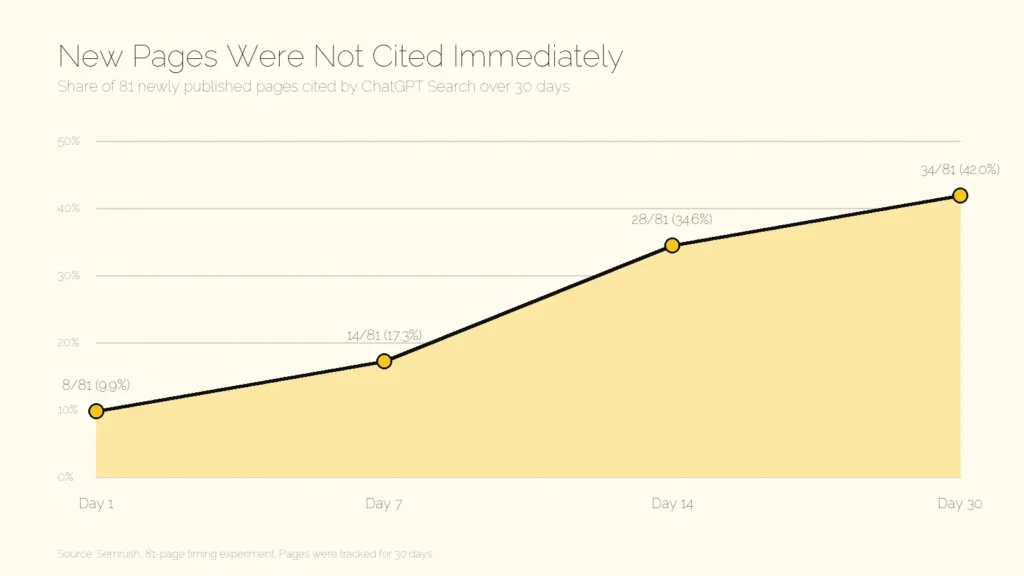
Semrush published 81 new pages and tracked them for 30 days.
ChatGPT Search cited:
- Eight pages on day one.
- Fourteen pages after seven days.
- Twenty-eight pages after 14 days.
- Thirty-four pages, or 42%, after 30 days.
The study shows that new pages can appear quickly, but most do not. Visibility increased throughout the month, yet 58% of the pages were still not cited after 30 days. Publishing a page starts the process, but it does not provide a reliable deadline for inclusion.
ChatGPT also does not automatically prefer the newest source. An older page can remain the better choice if it answers the question more directly, provides stronger evidence, or has clearer support elsewhere on the web.
Update content when prices, features, recommendations, or other important facts change. A new publication date alone does not make a page more useful or more likely to be cited.
How Should You Track ChatGPT Visibility?
Track ChatGPT visibility with a fixed set of buyer prompts and separate metrics for mentions, recommendations, citations, position, accuracy, sentiment, referral sessions, and conversions. Preserve the model, mode, market, and collection date with every answer. A combined score may support reporting, but it should never hide the underlying outcomes or sample size.
My preferred scorecard is:
| Metric | Definition |
| Mention rate | Percentage of repeated answers naming the brand. |
| Recommendation rate | Percentage actively recommending the brand. |
| Citation rate | Percentage linking to the brand or a page discussing it. |
| Average position | Average placement when the brand appears in a list. |
| Accuracy | Whether product, price, audience, and positioning are correct. |
| Sentiment | Positive, neutral, mixed, or negative description. |
| Source share | Which owned and third-party sources shape the answers. |
| Referral sessions | Visits attributed to visible AI referrers, |
| Key-event rate | Percentage of sessions producing selected conversions. |
I build AI-referral reporting alongside GA4, Search Console, SEO data, and conversion dashboards because AI visibility without commercial context can become another vanity metric.
In a ChatGPT traffic SEO report I built, I tracked visits from ChatGPT and the key actions they produced, including sign-ups and purchases. Up to 25% of those sessions resulted in a key action.
This is one result from my own analysis, not a universal benchmark. It shows why ChatGPT traffic is worth tracking even when referral numbers are small.
Its influence may also be larger than analytics show. Someone can discover a company through ChatGPT, then return later through branded search or a direct visit. In that case, the final traffic source receives the credit, while ChatGPT’s role remains hidden.
What Should You Avoid When Trying to Rank in ChatGPT?
Avoid tactics that create the appearance of AI optimization without improving accessibility, relevance, trust, or measurement. Fake community discussions, unsupported statistics, mass-produced comparison pages, decorative schema, date-only updates, keyword stuffing, and screenshots of one favorable response provide weak evidence. They can also obscure which legitimate changes caused an improvement.
I would not prioritize:
- Publishing dozens of near-identical “best” articles.
- Buying Reddit posts or fake customer endorsements.
- Adding every schema type a plugin offers.
- Changing publication dates without updating the content.
- Treating llms.txt as a replacement for search accessibility.
- Reporting one favorable answer as a ranking win.
- Promising a guaranteed ChatGPT position.
- Publishing more content before resolving serious duplication.
- Trying to replace official sources for facts they should own.
For legal, tax, safety, or regulatory questions, official sources will often deserve the citation.
Your opportunity is to become the best practical layer: cite the official rule, explain what it means, show what the reader should do, document the cost or risk, and connect that work to the product or service you provide.
Getting Mentioned in ChatGPT Is a System, Not a Hack
The businesses most likely to build durable ChatGPT visibility are technically accessible, easy to understand, useful, independently corroborated, and measured across real buyer prompts. No single page element creates that position. The advantage comes from making every part of the public evidence tell the same accurate, useful story about the business.
Start with the questions buyers ask. Make sure the correct page can be retrieved. Give that page specific evidence. Earn support elsewhere. Then measure whether the answer changes.
That is slower than installing a schema plugin and announcing that you have “done GEO.”
It is also much harder for a competitor to copy.
If buyers are using ChatGPT to compare businesses like yours, we can help you become part of the answer. Book a call, and we will identify the prompts that matter, the evidence you are missing, and the work needed to earn more visibility.
FAQ
How Do I Get Mentioned in ChatGPT?
Define the buyer prompts where your business belongs, create pages that answer those prompts precisely, resolve search-access problems, and earn credible third-party mentions. Repeat the same prompts over time and measure how frequently the brand appears rather than relying on one favorable answer.
How Do I Rank in ChatGPT?
ChatGPT does not provide a fixed public ranking comparable to a traditional search results page. Measure your brand’s frequency, position, sentiment, and accuracy across a related group of prompts. Improve topic coverage and corroboration instead of trying to hold one permanent result.
How Do I Get Cited in ChatGPT?
Make the correct page indexable, accessible to OAI-SearchBot, relevant to the prompt’s supporting questions, and easy to quote. Use descriptive titles, direct answers, original evidence, and named sources. Search visibility can help a page enter the retrieval pool but does not guarantee a citation.
How Do I Get ChatGPT to Recommend My Business?
Explain who your business serves, the situations where it is strongest, its pricing basis, and its limitations. Support those claims with reviews, comparisons, editorial coverage, partner profiles, and genuine customer discussions. Recommendation prompts usually require stronger independent corroboration than factual citation prompts.
How Do I Appear in ChatGPT?
Build a consistent public relationship between your brand, its category, target customers, and strongest use cases. Maintain an accessible website, accurate company profiles, relevant third-party mentions, and content that answers real buyer questions. Then monitor whether ChatGPT describes that relationship correctly.
Can I Submit My Business Directly to ChatGPT?
There is no general organic submission form that guarantees inclusion in ChatGPT answers. You can improve eligibility for ChatGPT Search by allowing OAI-SearchBot and making pages indexable, but OpenAI still decides which eligible sources are relevant to each answer.
Does Ranking in Google Help Me Appear in ChatGPT?
Traditional search performance can help because search retrieval supplies many of ChatGPT’s cited URLs. Google position alone is neither necessary nor sufficient. ChatGPT may use different search indexes, supporting queries, source types, and selection criteria.
Do I Need an llms.txt File?
No public OpenAI documentation states that llms.txt is required for ChatGPT Search inclusion. It may provide a useful machine-readable guide, but it should not replace robots controls, indexability, internal links, clean HTML, XML sitemaps, or focused content.
How Long Does It Take to Appear in ChatGPT?
There is no fixed timeline. In one experiment, ChatGPT Search cited eight of 81 new pages after one day and 34 after 30 days. Results depend on indexing, relevance, authority, third-party coverage, competition, model, market, and search mode.
Can I Pay to Appear in Organic ChatGPT Answers?
Paying an agency, directory, or publisher does not guarantee an organic ChatGPT recommendation. Sponsored visibility and organic answers are different. Treat any provider promising a fixed ChatGPT ranking or guaranteed recommendation with caution.