
You do not need a second website for AI search. You do not need to rewrite every page for a robot, add an llms.txt file, or buy mentions from people pretending to like your brand on Reddit.
You need stronger evidence: accessible, easy to interpret, worth citing, and supported beyond your own sales copy. Then you need measurement that distinguishes a mention from a citation, visit, or customer.
Table of Contents
What Is LLM SEO?
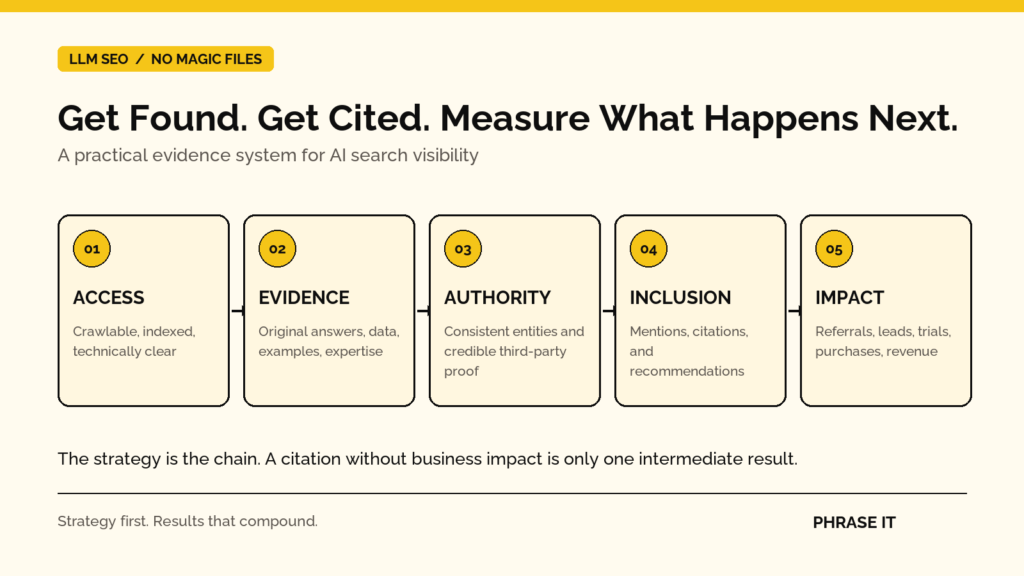
LLM SEO is the work of making your brand and content easier for large language model systems to retrieve, understand, cite, mention, and recommend in generated answers. It combines technical access, useful content, explicit entity information, independent authority signals, and measurement across platforms such as ChatGPT, Google AI features, Perplexity, Gemini, and Copilot.
You may also see LLMO, GEO, AEO, AI SEO, or AI search optimization. The useful business question is the same: when a buyer asks for an explanation, comparison, or recommendation, does your evidence make it into the answer?
I use LLM SEO for how language-model products retrieve information, AEO for direct-answer selection, and GEO for inclusion in a generated response. I do not build three disconnected strategies around those acronyms.
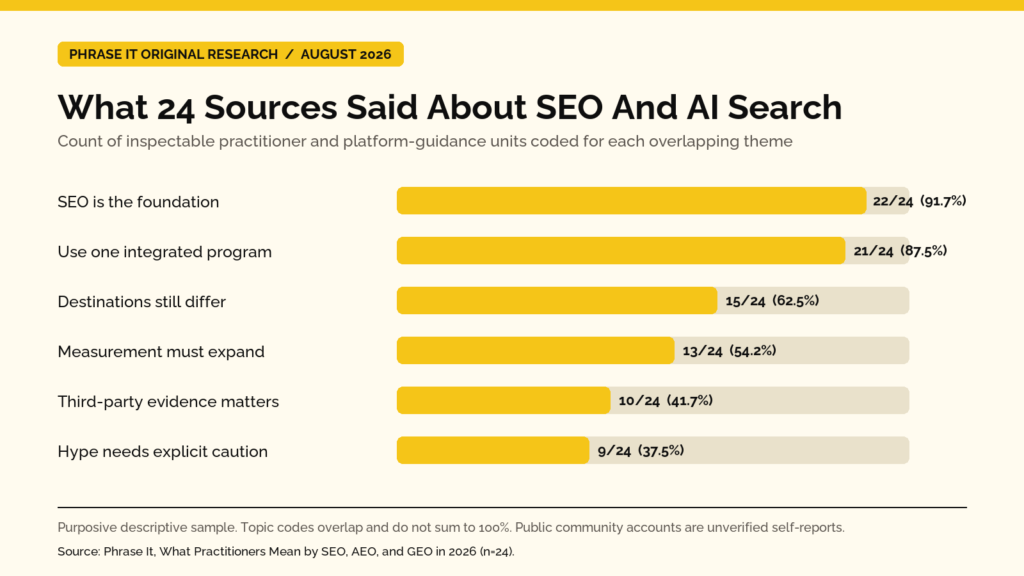
In a purposive Phrase It review of 24 inspectable practitioner and platform-guidance units collected on August 19, 2026, 22 treated SEO as the foundation and 21 favored an integrated strategy. The sample does not represent every search professional, but the operational advice converged despite disagreement over terminology.
Phrase It’s AI SEO services use the same integrated model: technical access, prompt and competitor research, content, entities, authority, and reporting belong in one prioritized program.
Is LLM SEO Different From Traditional SEO?
LLM SEO extends traditional SEO rather than replacing it. Both depend on accessible pages, relevant information, credible sources, and a technically sound site. The difference is the visibility target: traditional SEO competes for ranked links and clicks, while LLM SEO also competes for passage retrieval, citations, brand mentions, accurate descriptions, and recommendations inside generated answers.
| Dimension | Traditional SEO | LLM SEO |
|---|---|---|
| Primary visibility | Ranked search result | Generated mention, citation, or recommendation |
| Retrieval unit | Page and result | Page, passage, fact, entity, or third-party source |
| Off-site evidence | Links and authority | Links, mentions, reviews, discussions, and corroboration |
| Measurement | Rankings, clicks, leads, and revenue | Prompt coverage, mentions, citations, referrals, leads, and revenue |
Google’s 2026 guidance says AI Overviews and AI Mode use Search ranking and quality systems. A page needs to be indexed and eligible to appear with a snippet. Crawlability, useful non-commodity content, technical structure, and page experience still matter.
Google also says it does not use llms.txt, require tiny content chunks or AI-only prose, or offer special schema for generative search.
Other systems have different retrieval paths, so I would not reduce LLM SEO to Google rankings. In the Phrase It sample, 15 of 24 units still found the labels useful for distinguishing ranked links, extracted answers, and generated brand inclusion. The destinations differ. The foundation overlaps.
A GEO audit shows which buyer prompts you are losing, which sources shape the answer, and whether the first fix belongs in technical SEO, content, entities, or authority. You get a prioritized roadmap, not a vanity score.
See The GEO Audit ScopeHow Do LLM Search Systems Find And Select Sources?
LLM search systems can combine model knowledge with live retrieval from search indexes, crawlers, or partner sources. A prompt may trigger several related searches, retrieve passages from multiple pages, and synthesize an answer. Because each product uses different data, retrieval logic, context, and citation behavior, one universal “AI ranking” does not exist.
Google describes query fan-out as generating related searches to collect the information needed for a complex question. ChatGPT Search can also reformulate a prompt and retrieve current web sources. Perplexity is built around cited retrieval, while Copilot and Bing use Microsoft’s search infrastructure and supported partner surfaces.
A page does not have to answer the entire original prompt to contribute. It may supply one definition, comparison point, statistic, limitation, or step. Clear passages help, but clarity is not permission to strip a useful article into robotic fragments.
Platform results are also unstable. Semrush tested query fan-out optimization on four articles. Tracked citations rose from two to five and briefly reached nine before dropping. The direction is interesting; four pages and small counts cannot support a universal guarantee.
Freeze a core prompt set, state the platform and market, repeat runs, and keep discovery prompts separate from the benchmark. Otherwise, the score can improve simply because someone changed the questions.
How To Do LLM SEO In Seven Steps
Start LLM SEO by defining valuable buyer questions and measuring the current answers. Then fix technical access, improve the evidence on owned pages, build independent corroboration, and track what changes. The order matters: prompt tracking cannot repair a noindexed service page, and perfect schema cannot make recycled advice worth citing.
1. Define The Buyer Questions That Matter
Build prompts from sales calls, support tickets, on-site search, keyword data, comparison behavior, and customer interviews. Cover category, problem, alternative, pricing, risk, and decision questions.
Start with 20 to 40 questions that could realistically affect a shortlist or purchase, not 500 tool-generated prompts. Label them by journey stage and business value.
2. Record A Platform-Specific Baseline
Run the same core prompts across the platforms your audience uses. Record whether your brand appears, whether your site is cited, which competitors appear, which URLs support the answer, and whether your positioning is accurate.
A URL can appear as a source without the answer naming the brand, and a brand can be mentioned without receiving a link. Record those outcomes separately.
3. Fix Technical Access And Eligibility
Check indexation, canonicals, robots rules, rendering, HTTP status codes, duplicate URLs, internal links, and page performance. OpenAI’s publisher guidance specifically says that sites should allow OAI-SearchBot if they want content eligible for ChatGPT search summaries and citations.
Technical SEO work that protects discovery belongs here. A crawler file is not a visibility strategy, but blocking the crawler you want to reach is an avoidable failure.
4. Make The Important Evidence Easy To Extract
Answer the section’s question early. Use descriptive headings, short definitions, comparison tables when fields genuinely match, and lists when sequence or grouping matters.
Semrush compared 304,805 AI-cited URLs with Google-ranking pages across 11,882 prompts. Clarity and summarization, visible expertise signals, Q&A formatting, and section structure were more prevalent in its cited sample. The study found associations, not causal ranking factors, but the pattern supports content that communicates without making the reader hunt for the point.
5. Publish Information That Deserves A Citation
Original research, first-person testing, expert commentary, transparent methodology, calculators, templates, and concrete examples give an answer engine something it cannot get from another summary. Google calls this non-commodity content. I call it earning the citation.
6. Strengthen Entity Clarity And Independent Evidence
Keep names, services, authors, locations, product details, and positioning consistent across your site and credible external profiles. Earn relevant reviews, expert mentions, editorial coverage, community discussion, and comparison inclusion.
Google explicitly warns against inauthentic mentions. Useful participation and earned corroboration can clarify a brand; astroturfing creates moderation, reputational, and spam risk.
7. Measure Visibility And Business Impact Separately
Track prompt-level presence, brand mentions, citations, cited URLs, referral sessions, assisted behavior, leads, trials, purchases, and revenue where attribution allows. Document the denominator behind every percentage.
The goal is not to collect a prettier visibility score. The goal is to learn which evidence moves qualified demand and which activity only moves a dashboard.
Phrase It’s AI SEO service connects prompt research, technical fixes, answer-ready content, entity work, authority recommendations, and reporting. The work stays tied to the buyer questions and outcomes that matter.
Explore AI SEO ServicesWhat Content Is Most Likely To Earn LLM Citations?
Content becomes more citable when it offers a clear, self-contained answer backed by specific evidence and a trustworthy source. Definitions, comparisons, original data, expert observations, methodology, and decision rules give retrieval systems useful material. Formatting supports that substance, but it cannot turn generic or promotional copy into authoritative evidence.
The strongest content types have a reason to be referenced:
- An original study publishes a result with its denominator and method.
- A practitioner guide explains what happened during a real implementation.
- A comparison defines shared criteria instead of declaring a winner without evidence.
- A calculator or template helps the reader complete a job.
- A service page states who the offer is for, what it includes, and what it does not promise.
- A case study connects the starting point, work, measurement window, result, and limitation.
Authorship matters when it changes the substance. I have worked in SEO and organic growth since 2019 across technical SEO, content strategy, reporting, ecommerce, WordPress, and B2B SaaS. That helps me recognize when an AI-search problem is actually an indexation, positioning, or measurement problem.
I place a concise answer after a question-led heading because it helps readers scan and creates a complete passage. The answer still needs to belong in the article; I do not hide a second version or publish dozens of near-duplicate prompt pages.
For a worked example, Phrase It’s guide to getting mentioned in ChatGPT combines practitioner evidence, a sequence of actions, and platform-specific limitations rather than presenting one citation screenshot as proof.
Do Brand Mentions And Third-Party Sources Matter?
Third-party sources matter when they provide credible evidence that a brand cannot establish through its own claims alone. Reviews, industry publications, comparison pages, expert commentary, YouTube, and relevant community discussions can clarify reputation and category fit. Their influence varies by platform and query, so treat them as evidence sources, not guaranteed ranking levers.
Ten of the 24 units in Phrase It’s practitioner sample emphasized reviews, communities, publications, profiles, or other external corroboration. Ahrefs also found that YouTube mentions had the strongest correlation with AI visibility in its 75,000-brand study. Correlation does not prove that adding YouTube mentions causes inclusion, but it reinforces a broader point: brand understanding is built across the web.
Reddit deserves caution. Public discussions contain direct experience and buyer language, but also attract spam, undisclosed promotion, deleted posts, and reputational risk.
If a relevant conversation exists and you can add a useful answer, participate as a person. Disclose material affiliations. Do not drop a brand into unrelated threads, outsource fake recommendations, or treat community members as training-data props.
Digital PR, listicle inclusion, and distribution can increase retrieval surface area. The test is whether the placement adds independent value and accurate context, not simply another copy of the claim.
Which LLM SEO Tactics Are Overhyped?
The most overhyped LLM SEO tactics promise a deterministic shortcut through systems that are variable, platform-specific, and partly opaque. llms.txt, schema, content chunking, prompt-page scaling, paid community mentions, and one-off citation screenshots may support a narrow task or observation, but none replaces accessible pages, original value, credible authority, and repeated measurement.
llms.txt As A Universal Visibility Switch
An llms.txt file may be used by particular tools or experiments, but Google says it ignores the file for Search and its generative features. Maintain one only when a defined system uses it and the maintenance cost makes sense.
Schema As A Direct AI Ranking Factor
Use accurate structured data to clarify entities and qualify for supported search features. Google says there is no special generative-search schema and that structured data is not required for AI visibility. Incorrect markup creates confusion rather than authority.
Artificial Content Chunking
Readable sections and complete passages are useful. Arbitrarily cutting every answer into tiny blocks is not a Google requirement, and it can make the page worse for the person expected to trust or buy from you.
A Page For Every Prompt Variation
Google’s systems understand synonyms and related meaning. Publishing scaled, low-value pages for every long-tail variation can cross into scaled content abuse. Build one useful resource when the underlying intent is shared.
Fake Mentions And Community Seeding
Inauthentic mentions may be removed, ignored, or exposed. The commercial downside is larger than an algorithmic risk: a buyer who discovers the manipulation has learned something real about the brand.
A Guaranteed ChatGPT Ranking
Answers change with platform updates, prompt wording, location, personalization, retrieval availability, and repeated runs. No agency controls those systems. A credible provider can define the test and improve the available evidence, not guarantee a permanent recommendation.
How Should You Measure LLM SEO?
Measure LLM SEO across four layers: sampled prompt visibility, mentions and citations, first-party referral behavior, and commercial outcomes. Each layer answers a different question. A citation is not a visit, a visit is not a lead, and a lead is not revenue. Keep the definitions and denominators visible so movement remains interpretable.
1. Sampled Prompt Visibility
Track whether the brand appears across a frozen set of relevant prompts, platforms, markets, and dates. Report the sample size and repetition method. Call it sampled visibility, not market share, unless you have defensible prompt-volume data.
2. Mentions And Citations
A mention places the brand in the answer. A citation links or attributes evidence to a source. Semrush’s 2026 study of 3,981 domain appearances found that 62% of citations were “ghost citations” where the cited site was not named in the answer. The pattern varied substantially by platform and country.
A brand can supply evidence without recognition, or receive recognition without a click. One combined visibility number hides that difference.
3. Referral And On-Site Behavior
Use analytics to separate visits from ChatGPT, Perplexity, Gemini, Copilot, Claude, and other relevant sources. Normalize known source variants and document the rule. Review engaged sessions, landing pages, conversion paths, and assisted behavior rather than stopping at session totals.
4. Leads, Trials, Purchases, And Revenue
Phrase It’s anonymized AI-referral case study covered an exact 365-day period. AI referral sessions reached 1,458, up 21.4%; key events reached 80, up 90.5%; and free trials reached 37, up 117.6% against the preceding dashboard period. The data did not include closed revenue, so I do not turn it into a revenue claim.
The full AI referral traffic case study also documents source concentration and attribution limitations. That is the standard I want: the impressive number and the reason not to overread it.
If your current report mixes mentions, citations, referrals, and conversions into one score, I can help you separate the signals and decide what to improve next. Bring your current setup and I will tell you where I would start.
Book A 30-Minute Strategy CallWhen Should You Invest In LLM SEO?
Invest in LLM SEO when your buyers use answer engines during research, your business has credible expertise or evidence, and your website can support implementation and measurement. Fix ordinary SEO first when important pages are blocked, duplicated, unclear, or weak. Start with an audit when you cannot explain the gap; use ongoing support when several teams must close it.
A focused GEO audit fits when you need buyer-prompt testing, competitor and citation analysis, technical and entity review, and a prioritized roadmap. Phrase It’s live packages currently start at $1,200 one-time.
Ongoing AI SEO fits when the findings require continuous content, technical, entity, authority, monitoring, and reporting work. Phrase It’s live packages currently start at $2,000 per month, plus placement costs where applicable.
Buy the operating model that closes the real gap:
- Choose a tool when your team can define the prompts, interpret the output, and implement the work.
- Choose an audit when you need a defensible baseline and prioritized diagnosis.
- Choose consulting when your team can execute but needs senior direction.
- Choose ongoing delivery when content, technical, analytics, and authority work need coordinated ownership.
Phrase It’s guide to choosing an AEO agency goes deeper into proof, scope, implementation ownership, and measurement questions before signing a provider.
Build Evidence That AI Search Can Actually Use
The strongest LLM SEO strategy is not a pile of AI-specific tricks. It is a better evidence system: technically accessible pages, direct and useful answers, original expertise, consistent entities, independent corroboration, and measurement that reaches the business outcome instead of stopping at a visibility score.
Start with the questions that can affect a buying decision. Find out what the systems currently say, which sources shape the answer, and whether the gap sits on your site or across the wider web. Then fix the highest-impact constraint first.
That is less exciting than a guaranteed ChatGPT ranking. It is also work you can defend.
Tell me which AI answers, competitors, or measurement gaps are causing concern. I will review your situation and recommend the clearest next step, whether that is an audit, ongoing work, or fixing the SEO foundation first.
Discuss Your AI Search PrioritiesFrequently Asked Questions About LLM SEO
LLM SEO questions usually concern definitions, technical requirements, timing, and measurement. SEO remains the foundation, no special file or schema guarantees inclusion, and meaningful reporting connects sampled visibility to first-party behavior and commercial outcomes. Results also vary by platform, prompt wording, market, and repeated run.
What Is LLM-Driven SEO?
LLM-driven SEO is another name for optimizing a brand’s web presence for discovery and use by large language model systems. It includes technical access, clear and useful content, entity information, third-party authority, and measurement of mentions, citations, referrals, and outcomes. It should build on conventional SEO rather than replace it.
Does LLM SEO Replace Traditional SEO?
No. Traditional SEO creates much of the discovery, indexation, relevance, and authority foundation used by AI search systems. LLM SEO adds platform-aware prompt research, answer and citation analysis, entity clarity, off-site corroboration, and expanded measurement. The work overlaps heavily even though the visibility outputs are not identical.
Does Schema Help With LLM SEO?
Accurate schema can clarify entities and relationships and support eligible search features, so it remains useful. It is not a guaranteed LLM ranking factor. Google says structured data is not required for its generative search features and there is no special schema markup that unlocks AI inclusion.
Do I Need An llms.txt File?
Not for Google Search or Google’s generative search features. Google says it ignores llms.txt. Another service may choose to use the file, so implement it only for a documented use case. Do not treat it as a substitute for crawlability, indexation, useful content, or authority. We still add it to our and clients’ sites because it’s a structured markdown file and it’s not very hard to make + it doesn’t have any disadvantages.
How Long Does LLM SEO Take?
It depends on the gap. A crawler-access fix can be implemented quickly, while new research, authority building, content production, and reliable trend measurement take longer. Platform recrawling and answer volatility also affect timing. Establish a baseline first, then report changes across a consistent prompt set and meaningful business metrics.
How Do I Track Whether ChatGPT Cites My Website?
Track a frozen set of buyer prompts and record the cited URLs across repeated ChatGPT runs. Allow OAI-SearchBot, monitor ChatGPT referral sources in analytics, and compare citation data with mentions, visits, and conversions. One favorable answer is evidence of one result, not a stable ranking.