
Google crawled the page. It returned a 200 status. You submitted it in a sitemap. And Google still decided not to index it.
That combination sends teams hunting for a broken setting. In many audits, I find a different problem: the page works, but it has not earned a place in a selective index. Repeatedly requesting indexing cannot change that judgment.
The fix is not “make every URL indexable.” It is to decide which URLs deserve search visibility, remove the ones that do not, and materially improve the pages that remain.
Table of Contents
What Does Crawled Currently Not Indexed Mean?
“Crawled – currently not indexed” means Googlebot fetched the URL but Google did not add it to its searchable index at the time Search Console recorded the status. The URL may be indexed later, but the label is not a promise. It also does not identify one universal error.
Google separates Search into crawling, indexing, and serving. Its How Search Works documentation says indexing is not guaranteed and lists low content quality, indexing directives, and site design among common reasons a processed page may not enter the index.
This is different from “Discovered – currently not indexed.” Discovered means Google knows the URL but has not crawled it yet. Crawled means the fetch already happened, so blindly adding the URL to another sitemap usually misses the point.
Why Are More Pages Showing as Crawled but Not Indexed?
More teams are seeing this bucket grow because publishing volume has become cheap while indexing remains selective. AI tools can create thousands of plausible pages faster than organizations can add expertise, demand, or distinct value. Google does not need every accessible URL in its index, especially when many pages repeat answers it already stores.
I would not state that Google has announced its index is “full.” It has not. The more accurate explanation is economic and algorithmic: storing, rendering, refreshing, deduplicating, and serving web documents consumes resources, while an index is useful only if its pages improve results.
Google calls its index a large database and explicitly says not every processed page is indexed. Its crawling guidance adds that pages may stay out even after crawling when they lack sufficient value or user demand. From those statements, it is reasonable to infer that Google allocates processing and storage selectively. It is not evidence of a fixed storage ceiling.
The supply side changed quickly. Ahrefs analyzed 900,000 newly created English-language pages from April 2025 and estimated that 74.2% contained some AI-generated text. Detection is imperfect, and “contains AI” does not mean low quality, but the scale helps explain why mere existence is a weaker reason to index a page than it used to be.
Google’s position is tool-neutral. Its AI-content guidance focuses on accuracy, quality, relevance, and added value. The risk appears when automation makes it easy to publish unoriginal pages at scale.
AI Content Is Not the Problem; Scaled Sameness Is
Google does not ban content because AI assisted with it. The risk is publishing many pages primarily to capture rankings when those pages add little value. Google defines that pattern as scaled content abuse whether the pages came from AI, humans, or a mixture of both.
The spam policy names generative AI pages without added user value, scraped or stitched pages, and keyword-targeted pages that make little sense as examples. The method is not the deciding factor. Purpose and usefulness are.
A polished AI draft can still be thin. It may contain 1,800 words while contributing no original example, tested process, first-party data, expert judgment, or clearer decision than the five pages already ranking. Word count measures length, not information gain.
This is why programmatic location pages, near-identical software comparisons, templated glossary entries, and one-page-per-query strategies often inflate the excluded count. Each URL is technically unique. The substance is not.
A technical SEO review should separate broken pages from pages that should be merged, removed, or rebuilt. I turn the indexation report into a prioritized action list, not another export.
See the Technical SEO ServiceInformation Gain Is the Real Indexing Test
Information gain is the useful difference your page contributes beyond what searchers can already find. Google does not give publishers a public “information gain score,” but its people-first guidance asks whether a page provides substantial value compared with other search results. That is the practical standard I use.
Before I expand a page, I compare it with the current result set and ask: does this provide substantial value beyond competing pages? More words are not automatically more value.
A page can gain information through firsthand evidence: original data, screenshots from a real process, a worked example, failure modes, expert interviews, templates, calculators, or a decision rule the reader can apply. A strong synthesis can also add value when it resolves contradictions instead of paraphrasing them.
For this specific topic, “check your sitemap and add internal links” is table stakes. A higher-gain page explains why resubmission fails, distinguishes index eligibility from index worthiness, and gives a triage model for keeping, consolidating, or removing URLs.
Thin and Duplicate Content Create Site-Wide Risk
Thin and duplicate pages are dangerous because they force Google to choose among weak or overlapping candidates, dilute internal signals, and waste your team’s maintenance effort. A few excluded utility URLs are normal. A growing pattern across important templates suggests your publishing system is producing inventory without enough search value.
Duplicate does not mean word-for-word copying only. Pages can be functionally duplicative when they answer the same intent with swapped cities, industries, products, or prompt-generated phrasing. Google clusters similar pages and selects a representative canonical, so your preferred URL may lose that contest.
On ecommerce sites, filters and parameter combinations can multiply this problem. My guide to ecommerce pagination SEO explains how crawlable architecture and canonicals should work together instead of creating endless low-value URL variants.
The danger is not a mythical duplicate-content penalty for ordinary overlap. It is opportunity cost and loss of clarity: links scatter across versions, writers maintain competing pages, and Google sees fewer reasons to keep each one. If a URL has no distinct intent or value, consolidation is usually stronger than expansion.
How to Fix Crawled Currently Not Indexed in 7 Steps
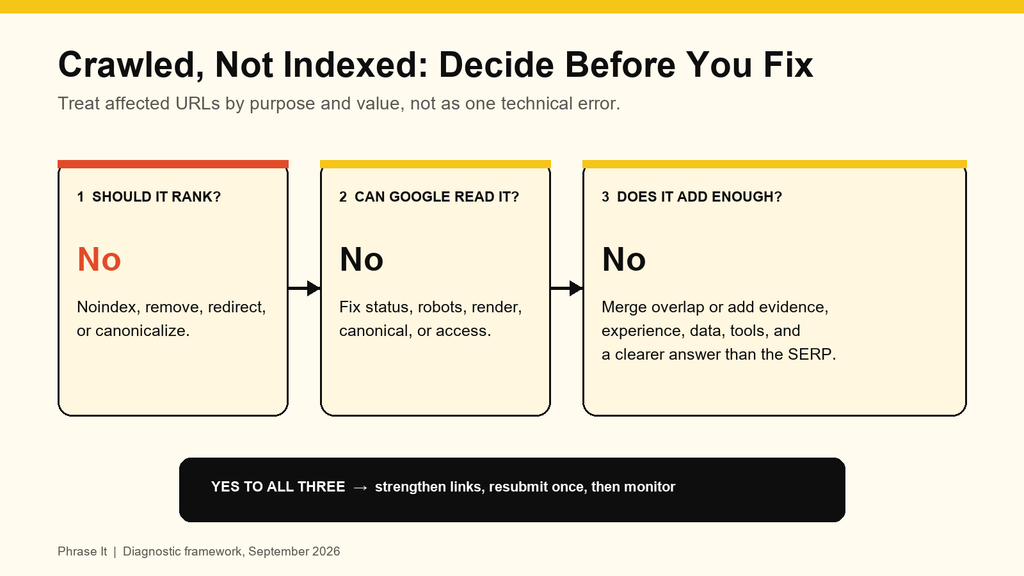
Fix the status by classifying affected URLs, confirming which ones should be indexed, eliminating technical blockers, comparing duplicates, measuring information gain, strengthening site signals, and then requesting indexing once. Work by URL pattern rather than opening random examples. The correct outcome may be indexing, consolidation, redirection, noindex, or deletion.
1. Export and segment the affected URLs
Export the Search Console examples, then group them by template and purpose: blog posts, products, categories, filters, tags, search pages, location pages, or parameter URLs. Search Console samples are not a complete crawl, so combine the export with a Screaming Frog crawl and your XML sitemap.
2. Decide whether each pattern should rank
Do not fix URLs that exist only for users, sorting, tracking, or navigation. Remove them from the sitemap and use the appropriate noindex, canonical, redirect, or status code. The goal is a clean indexable set, not a 100% indexed ratio.
3. Test the rendered page and indexability
Use URL Inspection’s live test. Confirm a 200 response, no noindex directive, an intended self-canonical, accessible main content, and a rendered screenshot that shows the page. Check that JavaScript, consent overlays, login states, or HTML size do not hide the substantive content.
4. Compare near-duplicates and Google’s selected canonical
Search distinctive passages, crawl titles and headings, and inspect canonical signals. If two pages serve the same intent, choose the stronger destination and merge useful material. Redirect obsolete URLs or set a consistent canonical when alternate versions must remain accessible.
5. Add information competitors do not have
Rewrite around the reader’s decision, not a longer keyword outline. Add a tested workflow, original evidence, examples, screenshots, constraints, or a tool. Delete sections that merely restate the consensus. If you cannot name the unique contribution in one sentence, the page is probably not ready.
6. Strengthen internal importance and topical context
Link from relevant, indexed pages using descriptive anchors. Make sure the page is reachable through normal crawlable links and belongs in a coherent topic cluster. Internal links cannot rescue an empty page, but they help Google discover context and understand that you consider it important.
7. Resubmit once and monitor the pattern
Update the sitemap lastmod when the page materially changes, request indexing for a small number of priority URLs, and monitor over days or weeks. Google says a crawl request does not guarantee inclusion. Judge progress by priority URLs entering the index and the affected template shrinking, not by clicking Request Indexing repeatedly.
If the problem spans templates, JavaScript rendering, canonicals, and content overlap, it belongs in a prioritized technical SEO engagement rather than a writer-only refresh queue.
What Not to Do
Do not treat every excluded URL as an emergency or assume that one plugin setting will fix the set. Search Console is reporting an outcome. Your job is to identify the reason at the template or content-system level.
- Do not request indexing every day; Google says submission does not guarantee inclusion.
- Do not add 500 generic words to “make the page longer.” Add a useful difference or consolidate it.
- Do not put every parameter, tag, search result, or filtered page in the sitemap.
- Do not canonicalize unrelated pages to a convenient category; canonicals should represent true duplicates or close alternates.
- Do not assume AI detection caused exclusion. Diagnose usefulness, duplication, intent, and technical access instead.
- Do not chase a perfect indexation percentage. Some URLs should remain out of search.
If your content library has grown faster than its organic results, I can map what to keep, merge, remove, and rebuild. The outcome is a smaller, stronger publishing plan with a clear reason for every URL.
Review SEO Content WritingHow to Measure Whether the Fix Worked
A successful fix increases the indexation and performance of priority pages; it does not force every known URL into Google. Track affected URL patterns, the number of indexable sitemap URLs that enter the index, impressions on repaired pages, and whether Google selects the intended canonical. Allow for reporting lag.
I also compare the outcome with publishing behavior. If the excluded bucket grows every time a new template or AI workflow launches, the workflow needs a quality gate before publication. Indexation is then a content-operations problem, not only an SEO ticket.
Connect the indexation review with content performance metrics so a page has to earn ongoing investment through visibility, qualified traffic, engagement, or a commercial role.
The Goal Is a Smaller Set of Pages Worth Indexing
“Crawled – currently not indexed” is often Google telling you that accessibility and index worthiness are different things. Fix the technical exceptions, but spend most of your effort making priority pages distinct, useful, and supported—or remove the overlap.
Your next question should not be “How do I submit all of these again?” It should be “Which of these URLs gives Google and the reader a reason to keep it?”
Book a free 30-minute strategy call. I will look at your affected URL patterns and tell you where I would fix, consolidate, remove, or investigate first.
Discuss Your Indexing ProblemFrequently Asked Questions About Crawled Currently Not Indexed
Why Is My Page Crawled but Not Indexed?
Google may exclude a crawled page because it is low value, duplicative, rendered poorly, weakly signaled, or unlikely to satisfy search demand. The status alone does not identify which cause applies. Inspect the live render, canonical, page purpose, overlap, and unique value.
Can I Force Google to Index a Page?
No. You can request indexing in URL Inspection and submit an accurate sitemap, but Google explicitly says those actions do not guarantee inclusion. Improve the page or its signals first, then request indexing once.
How Long Does Crawled Currently Not Indexed Last?
There is no guaranteed timeline. Google says most sites should expect discovery and processing to take at least several days, and Search Console can lag. If an important URL remains excluded after a material improvement and recrawl, recheck the pattern instead of waiting indefinitely.
Does Crawled Currently Not Indexed Mean a Penalty?
No. The label is an indexing status, not proof of a manual action or penalty. Check Search Console’s Manual Actions report separately. A large affected set can still expose quality, duplication, or scaled-content problems that deserve attention.
Does Google Reject AI-Generated Content?
Not simply because AI helped create it. Google focuses on whether content is helpful, accurate, original, and made for people. Generating many unoriginal pages primarily to manipulate rankings can violate the scaled content abuse policy.
Should Every Page on My Site Be Indexed?
No. Account pages, internal search results, filters, duplicate variants, and other utility URLs often should not appear in search. Prioritize indexation for pages with a clear audience, distinct purpose, and enough value to compete.