
Your listicle can earn an AI citation while sending the recommendation to a competitor. That makes “we published a best-of list” a weak success metric.
I want a listicle to do a more useful job: help the right buyer understand the options, recognize your fit, and make a defensible decision. That takes research, shared comparison criteria, and enough honesty to say when another company is the better choice.
This guide covers both sides of the work: publishing useful comparisons on your website and earning inclusion in relevant lists published by other people.
Table of Contents
What Are SEO Listicles?
SEO listicles are articles organized around distinct items that answer a search question, such as which product to buy, which agency to shortlist, or which approach to try. Each entry adds useful explanation. Commercial listicles go further by comparing options against criteria that matter to a defined buyer.
A numbered list of company names is a starting point. A buying guide explains who each company serves, what supports the recommendation, what it costs where verifiable, and what the reader should check before committing.
| Format | Reader’s Job | What Each Entry Needs |
|---|---|---|
| Best products or software | Find a product that fits a workflow | Tested capability, limitations, pricing basis, integration needs |
| Best agencies | Shortlist a delivery partner | Relevant work, delivery ownership, minimum engagement, trade-offs |
| Best B2B service providers | Evaluate an operational supplier | Scope, industry fit, service coverage, onboarding and contract questions |
| Examples or inspiration | Understand what good execution looks like | Real example, explanation, transferable lesson |
| Tips, tools, or resources | Complete a task or solve a problem | Specific action, conditions, supporting example |
The number should follow the research. If six options offer meaningfully different choices, publish six. Adding four weak entries to reach ten makes the article harder to trust.
Why Do Listicles Matter For SEO And AI Search?
Listicles can match searches where people want several options rather than one answer. Their structure also gives retrieval systems identifiable products, providers, use cases, and comparison facts. That makes them a useful source format, but their visibility depends on relevance, access, evidence, and the behavior of each search platform.
The evidence supports paying attention to listicles. It does not support treating them as an AI ranking switch.
| Evidence | What The Source Observed | What You Can Reasonably Take From It |
|---|---|---|
| Ahrefs’ December 2025 study | Across 750 ChatGPT recommendation prompts in software, products, and agencies, best-of blog lists represented 43.8% of the source-link page types analyzed | Comparison articles were prominent in that recommendation-focused sample; this is not the share of all AI answers |
| Ahrefs’ July 2026 experiment | Researchers published 34 promotional pages on five domains and analyzed 9,886 answers across four assistants | Publishing promotional content can affect observed visibility, but results varied by brand, query, and platform |
| The same 2026 experiment | Of answers citing conference-promoting pages, 43% omitted the promoted conference; the corresponding omission rate for tool-promoting pages was 11% | A citation and a brand mention are different outcomes; neither alone proves a recommendation or sale |
The two omission rates use different subsets of answers. Ahrefs does not state their subgroup counts in the article, so I would not turn the difference into a universal performance benchmark.
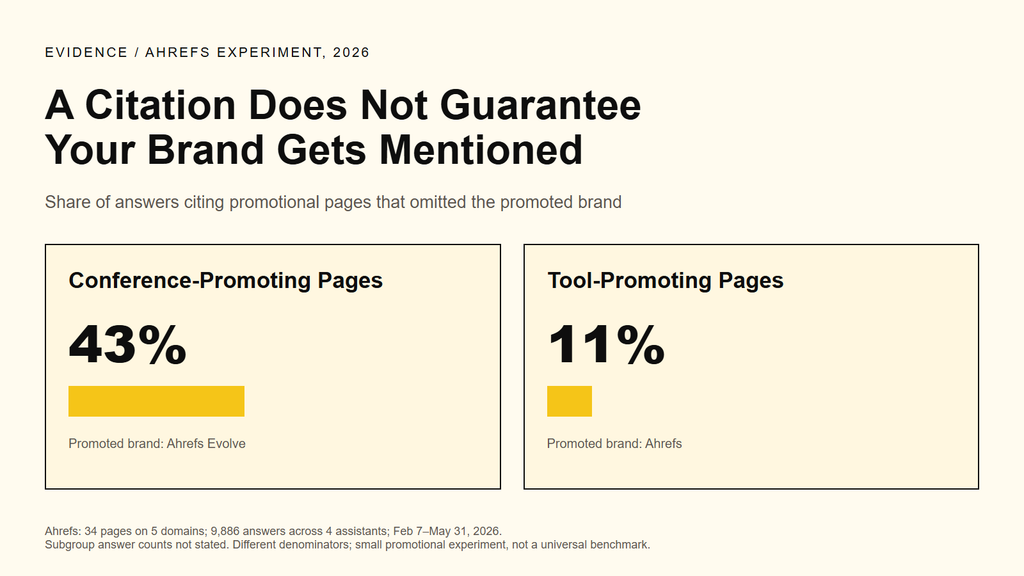
Source: Ahrefs, July 2026. Collection: February 7–May 31, 2026. The study covered promotional listicles, reviews, and opinion pieces, rather than listicles alone.
For Google specifically, AI Overviews and AI Mode use the existing SEO foundations. Google requires supporting pages to be indexed and eligible for a Search snippet; it does not require special AI schema or a new machine-readable file.
That is why I treat getting found and cited in AI search as a connected content, access, and evidence problem. Formatting helps readers understand the comparison. It cannot make an unsupported recommendation true.
Which Listicle Use Cases Fit Your Business?
Choose a listicle use case by starting with the buyer’s decision and the evidence your business can contribute. SaaS comparisons should reflect workflows and product constraints. Agency lists should explain delivery models. B2B provider lists should address operational fit, industry requirements, and what happens after the contract is signed.
| Business | Broad Starting Point | More Useful Editorial Angle | Evidence That Makes It Distinct |
|---|---|---|---|
| CRM SaaS | Best CRM software | CRM options for a small sales team with complex handoffs | Routing tests, integration requirements, administration burden |
| Proposal SaaS | Best proposal software | Proposal tools for agencies managing client approvals | Approval workflow, version control, pricing permissions |
| SEO agency | Best SEO agencies | SEO agencies for B2B companies with an internal content team | Implementation ownership, technical depth, collaboration model |
| Creative agency | Best creative agencies | Creative partners for B2B product launches | Relevant launch work, research process, production scope |
| Managed IT provider | Best MSPs | Managed IT providers for multisite manufacturers | Onsite coverage, operational continuity, supported systems |
| Outsourced finance provider | Best accounting firms | Outsourced finance partners for SaaS businesses preparing to scale | Reporting scope, systems experience, onboarding and handover |
SaaS Product Listicles
A useful SaaS list compares the job people need to complete. “Has AI” is rarely enough to separate the options.
For proposal software, I would investigate approval steps, collaboration, CRM connections, export behavior, and the plan required for each feature. If I test a trial account, I record that limitation rather than implying I evaluated the enterprise deployment.
Commercial comparisons belong inside a broader SaaS SEO strategy: category pages explain the product, comparisons resolve selection questions, and use-case pages show how the workflow fits a particular team.
Agency Listicles
An agency list should help buyers compare the people and operating models behind the pitch. Two agencies can sell “SEO content” while offering very different research depth, senior involvement, publishing support, and measurement.
Choose three to five criteria that belong to the service. For an SEO agency, technical implementation and commercial page strategy may matter; for an influencer agency, creator vetting and campaign operations would require different evidence.
If your agency is included, disclose the relationship and apply the same qualification rules. Give another provider a fair recommendation when it better matches the buyer.
B2B Service Provider Listicles
B2B services need scrutiny beyond a logo, location, and review average. Buyers may need to understand service hours, escalation, onboarding, reporting, subcontracting, and exit terms.
An industry modifier must change the research. A manufacturer’s IT needs differ from a fully remote consultancy’s; writing “for manufacturing” in the title without comparing relevant delivery requirements adds little value.
A use case is a selection rule. It should affect which providers qualify and which questions the article answers.
Listicle Examples: What To Borrow And What To Improve
Good listicle examples demonstrate useful choices in research, organization, and explanation. Borrow the principle behind those choices rather than copying the wording or layout.
1. Zapier’s CRM Comparison: Give Each Option A Distinct Job
Zapier’s CRM roundup organizes its recommendations around different needs and supplies an at-a-glance comparison. Its entry format includes product screenshots, strengths, drawbacks, and pricing context, making the shortlist easier to investigate.
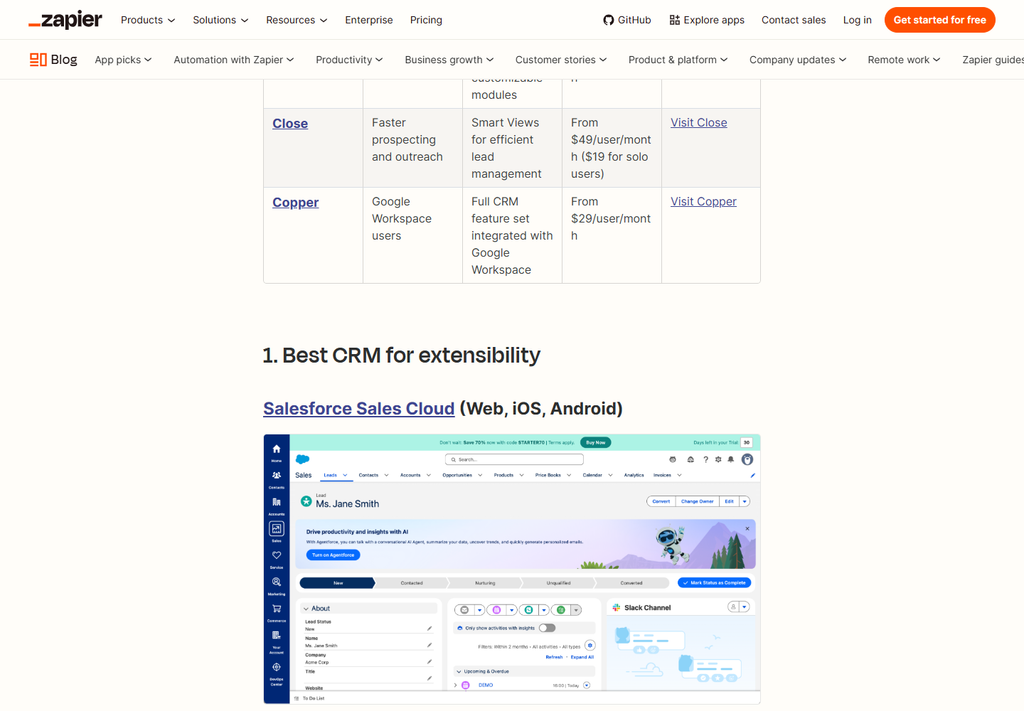
Screenshot: Zapier’s CRM roundup, captured October 8, 2026. Prices are part of the source-page snapshot, not independently verified current offers.
| Observed Element | Why It Helps | How I Would Apply It |
|---|---|---|
| Different use cases for different tools | Readers can narrow options by their actual constraint | Explain a specific workflow rather than awarding every entry “best overall” |
| Shared comparison fields | Readers can compare equivalent information | Keep pricing units, plan gates, and feature definitions consistent |
| Product screenshots within entries | Readers can see the interface behind the description | Capture the task being evaluated, with the plan and test date recorded |
| Benefits and drawbacks | Recommendations acknowledge trade-offs | Explain when an otherwise strong option is unsuitable |
My improvement would be to make the test record easy to inspect at the feature level: which plan, which task, and which observation supported the verdict. A screenshot alone does not establish that the writer tested every claim.
2. Phrase It’s MSP SEO Agency List: Compare Delivery Models
Our MSP SEO agency comparison connects recommendations to a defined industry and explains best-fit buyers, evidence, pricing signals, and diligence questions. Phrase It appears alongside specialist alternatives rather than automatically taking first place.
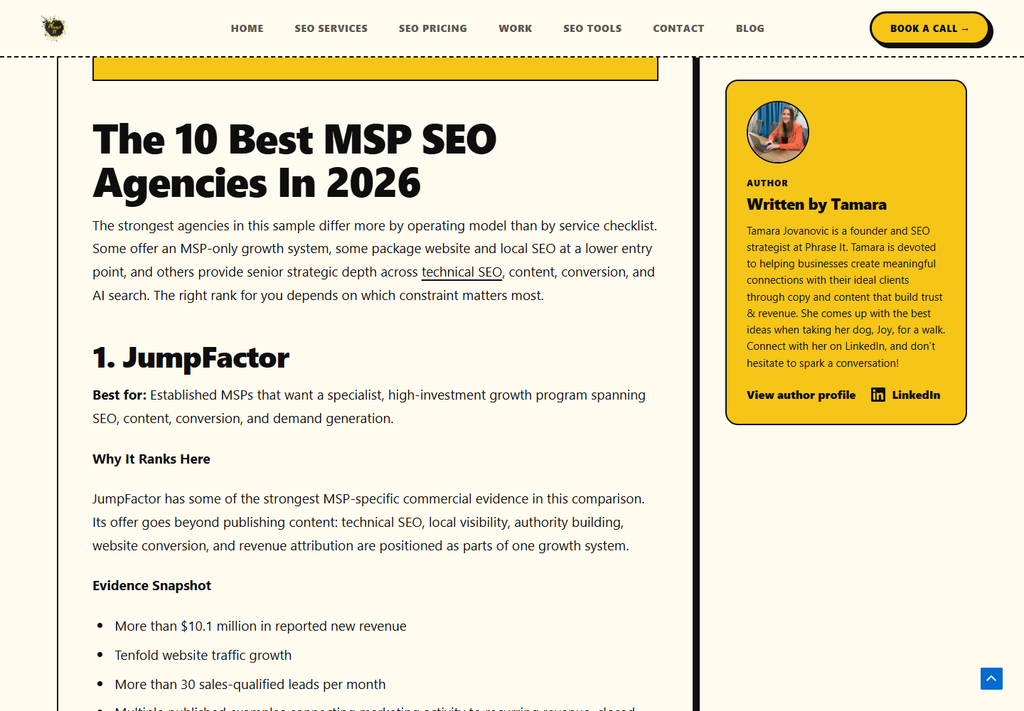
Screenshot: Phrase It’s MSP SEO agency article, captured October 8, 2026. This is our own publication, so treat the teardown as an explanation of editorial choices rather than independent validation.
| Observed Element | Why It Helps | What I Would Tighten |
|---|---|---|
| MSP-specific buyer context | An industry lens changes the shortlist | Confirm that every specialization claim has relevant work behind it |
| Separate evidence and pricing fields | Readers can distinguish proof from positioning | Keep directory minimums separate from direct monthly retainers |
| Questions tied to evidence gaps | Missing information becomes a practical next step | Ask the same core questions across shortlisted providers |
| Publisher is not ranked first | Readers receive credible alternatives | Maintain an explicit disclosure and consistent criteria |
The live article also contains a public score column. For new comparisons, I prefer publishing the evidence and trade-offs without a composite score unless the inputs and calculation are transparent enough for readers to reproduce.
3. MSSP Alert: An Industry List With An Explicit Edition
MSSP Alert’s Top 250 hub links annual managed security provider lists and associated research. It shows how a narrowly defined B2B category and a dated research edition can make a provider list useful beyond a generic company roundup.
As checked, the hub linked the 2025 list and marked the 2026 PDF as coming soon. I would preserve that distinction rather than present an unreleased edition as current evidence.
| Element To Borrow | Why It Matters | Limitation To Preserve |
|---|---|---|
| A specific provider category | Readers know which type of business belongs | MSSPs and general IT providers are not interchangeable |
| Annual editions | Readers can identify the evidence period | The latest announced edition may not yet be available |
| Links to supporting research | A list can lead into market context | An industry ranking still does not resolve individual buyer fit |
For a buyer-focused article, I would add the missing decision layer: supported environments, customer size, response responsibilities, and what to verify directly. An industry list can help discover candidates; it does not replace diligence.
Directory contrast: Clutch’s managed IT directory exposes review counts, service mix, location, and budget signals. Those are useful fields, but a filterable directory is a different format from an editorial comparison, and paid placement disclosures deserve attention.
A Closer Look At Zapier: What Its Listicles Get Right
The CRM example is worth a closer look because Zapier applies a similar approach across very different software categories. The useful pattern is a shortlist organized around buyer needs, supported by category-specific evaluation and a relevant next step. To see how that translates into search visibility, I checked three more of its listicles: cloud storage, SEO tools, and note-taking apps.
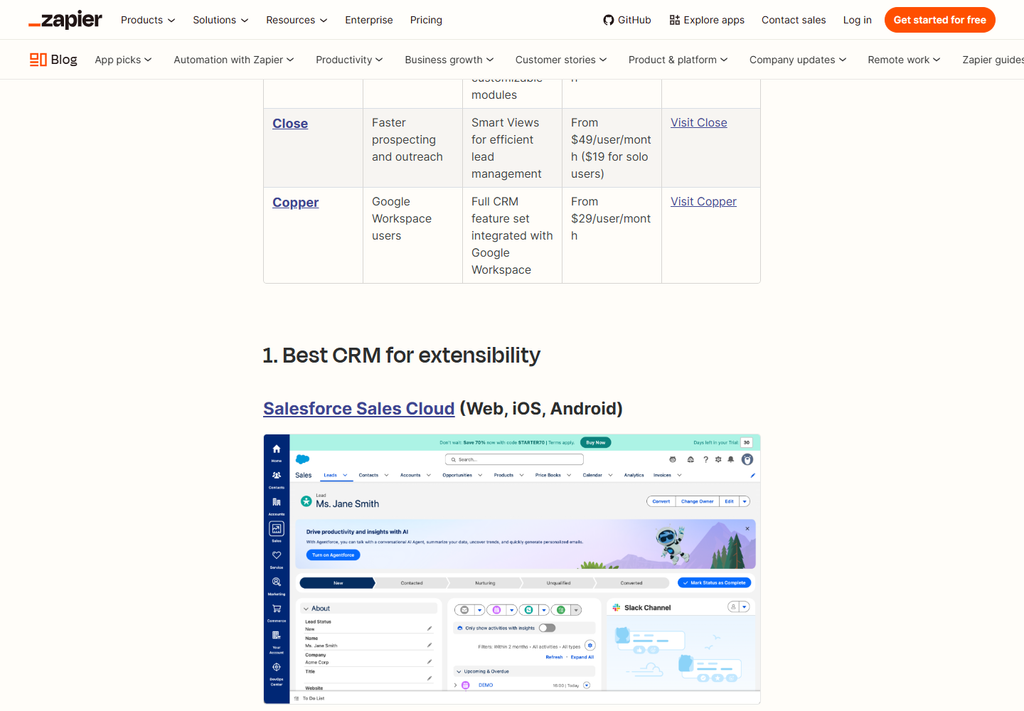
Figure 1. Zapier’s CRM comparison table shows buyer fit, features, and pricing in shared fields. Source: Zapier.
How Much Traffic Do Zapier’s Listicles Bring?
In DataForSEO’s Google US database, retrieved on October 15, 2026, these three pages had a combined 544,452 estimated monthly organic visits. Each also had hundreds of keywords in the top 10 organic positions.
| Zapier Listicle | Ranking Keywords In The Page Report | Keywords In Organic Positions 1–10 | Share In The Top 10 | Estimated Monthly US Organic Visits |
| Best cloud storage apps | 703 | 569 | 80.9% | 479,420 |
| Best SEO tools | 446 | 319 | 71.5% | 33,871 |
| Best note-taking apps | 399 | 274 | 68.7% | 31,162 |
Source: DataForSEO Google Relevant Pages report, United States, English, organic results only. Top-10 counts combine positions 1, 2–3, and 4–10.
What Makes The Content Useful?
The shortlist helps readers eliminate unsuitable options. The cloud-storage comparison separates recommendations by device ecosystem, team context, and storage needs. A reader can narrow the field before reading every entry. Its summary table then puts fit, distinguishing features, and pricing together. That is a practical way to serve someone who wants a quick answer and someone who needs a detailed comparison.
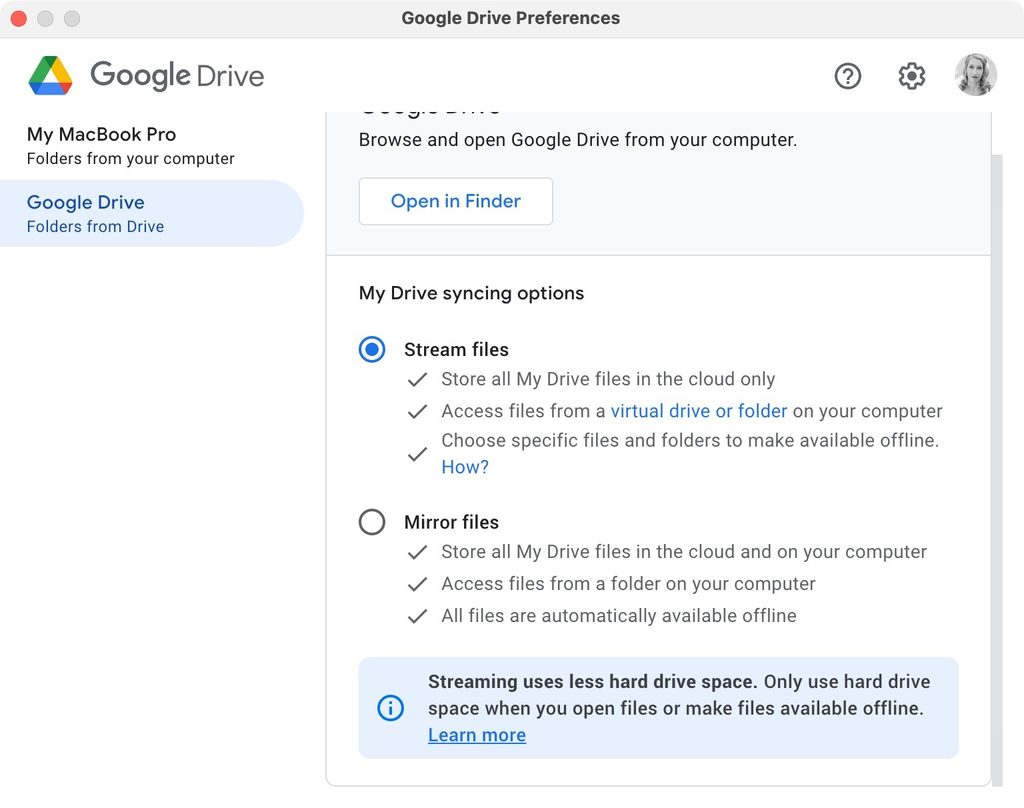
Figure 2. Google Drive product screenshot reproduced from Zapier’s cloud-storage roundup, accessed October 15, 2026. This illustrates the use of product visuals inside individual recommendations. Source: Zapier.
The research scope changes with the category. In the note-taking roundup, the writer says he tested more than 50 apps and limits the comparison to general-purpose personal note-taking. Cross-device access, offline use, and speed affect qualification. Those criteria give the recommendations boundaries. The transferable lesson is to explain which job the list covers and which apparently similar products fall outside it.
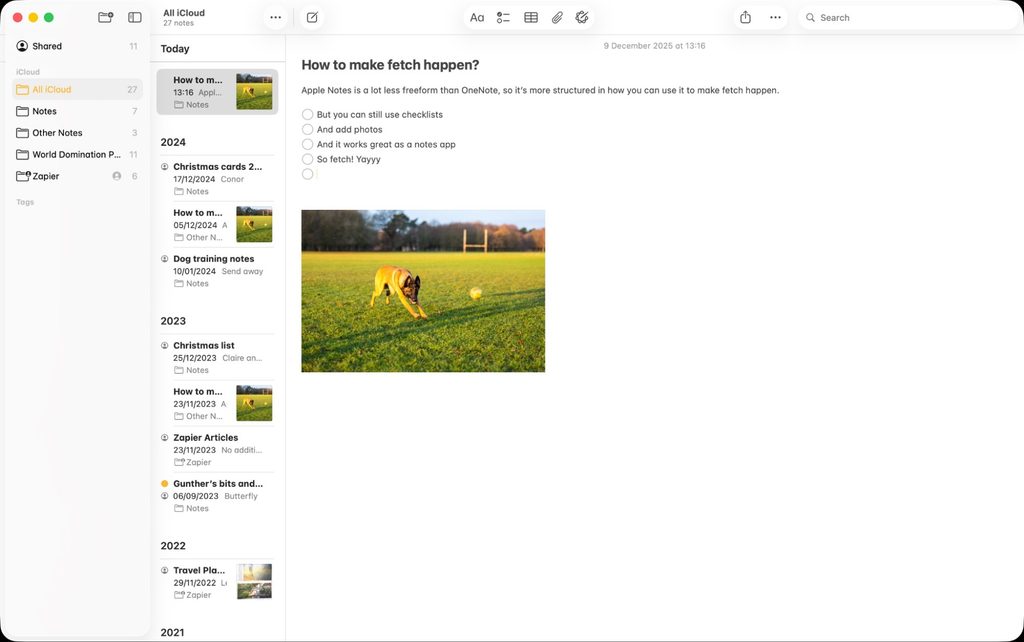
Figure 3. Apple Notes product screenshot reproduced from Zapier’s note-taking roundup, accessed October 15, 2026. It illustrates the interface behind one recommendation. Source: Zapier.
The writer distinguishes direct experience from supporting research. The SEO-tools article explicitly acknowledges that the author could not personally test every candidate and used additional sources. That distinction helps readers judge the evidence. I would take this further by labeling the evidence for each recommended product, so a reader can see which conclusions came from direct testing.
The business connection follows the reader’s task. In the CRM comparison, the next step connects the selected CRM with the rest of the reader’s software. That gives Zapier a commercial role even when the recommendation is another company’s product. For a SaaS business, the useful question is what the reader needs to do immediately after choosing an option. For an agency, it might be validating the shortlist or planning implementation.
Zapier also publishes its app-selection process, explaining how it defines criteria, researches candidates, and evaluates them. A documented process gives readers something more concrete to assess than an unsupported claim that a list was “expert reviewed.”
What Could Be Better?
Strong visibility does not make a comparison immune to editing or evidence problems. These are the changes I would prioritize:
| Improvement | What I Observed | How I Would Improve It |
| Correct misplaced pricing | The cloud-storage article places a line labeled “Box pricing” at the end of the Dropbox entry | Check every price against the correct provider, then reconcile the table and entry |
| Make prices comparable | The cloud-storage table mixes consumer storage tiers, per-user business prices, and lifetime offers | Show billing terms, minimum seats, and comparable storage requirements where relevant |
| Expose the test record | The selection policy explains the general process, but a reader would benefit from a compact record beside each verdict | Publish the task, plan, test date, result, and evidence source |
| Distinguish different kinds of SEO tools | The SEO list spans several software categories | Add a decision guide that separates complementary tools from direct substitutes |
| Turn personality into clearer buyer guidance | The note-taking shortlist describes Evernote through its return to form | Pair that editorial angle with a specific user need and a reason to choose it over alternatives |
What I would borrow is the connection between a defined decision, useful evidence, and a relevant next action. A smaller business can apply that approach to a narrower category without needing Zapier’s publishing volume. Start with a comparison your team can substantiate, then measure whether it attracts the right searchers and helps them move forward.
How To Write A Listicle That Helps Buyers Choose
Write a useful listicle by defining the decision, checking search intent, setting comparison criteria, collecting evidence, and organizing qualified options around meaningful differences. Then write each entry so it stands on its own and supports the wider comparison. Finish with factual verification, usable visuals, internal links, and a maintenance plan.
Our B2B agency listicle case study shows how listicles can target different buyer needs within the same industry. We created 27 comparison and buyer-education articles covering agency types, specialist services, and location-specific searches, adapting each article’s research and comparison criteria to its audience. In a July 2026 audit of DataForSEO’s Google US database, the portfolio recorded 134 first-page rankings, 23 top-three rankings, and 63 Google AI Overview reference records. These results show the visibility potential of a focused listicle strategy built around commercially relevant searches.
Another case study covers ten agency listicles comparisons with service explanations and selection guidance. In the October 2026 review, the set had 50 US top-10 keyword variants and source citations across 43 stored Google AI Overview questions.
1. Define One Buyer Decision
Write a one-sentence brief before opening a blank document:
“This article helps [buyer] choose [category] for [job], given [constraint].”
For example:
“This article helps a B2B marketing lead shortlist an SEO agency that can work with an internal writer and implement technical fixes.” That brief determines the candidate set and the criteria.
If your article promises all industries, budgets, and use cases, segment the options or narrow the scope. One universal winner is rarely useful.
2. Research Keywords And Inspect The Results
Start with terms people actually search, then inspect the pages answering them. A phrase containing “best” might return editorial comparisons, directories, vendor pages, or a mixture; those formats serve different needs.
For this article, DataForSEO’s US English estimates checked on October 8, 2026 showed 10 monthly searches for “seo listicles,” 720 for “listicle examples,” and 70 for “how to write a listicle.” These are estimated Google keyword volumes, not AI prompt counts, and the phrases should not be added together as independent demand.
I chose the narrower SEO angle because it fits the business question. A higher-volume definition query would invite a different article.
Before creating another comparison, check which existing page already owns the decision. New wording alone does not justify a new URL; consolidate overlapping intent and preserve a clear route from the comparison to the relevant commercial page.
3. Set Criteria Before Choosing The Winner
Define the criteria before detailed evaluation. Otherwise, it is easy to reward whichever facts make your own offer look strongest.
| Category | Useful Criteria | Weak Substitute |
|---|---|---|
| SaaS product | Task completion, integrations, plan restrictions, administration | A copied feature list |
| SEO agency | Relevant outcomes, delivery ownership, implementation, reporting | “Award-winning team” |
| Managed IT provider | Coverage, escalation, supported stack, onboarding and exit | “Works with all businesses” |
| Outsourced finance partner | Reporting scope, systems fit, team responsibilities, handover | “Trusted by leading brands” |
Use a ranked list when the same criteria support a defensible order. Use an unranked, segmented list when different buyers would reasonably choose different winners.
4. Collect Comparable Evidence
Build a research sheet with one row per candidate and separate fields for the source, observation, date, and limitation. A company’s case study, an independent review, and a directory estimate are different evidence types.
| Evidence Type | What To Capture | What To Avoid |
|---|---|---|
| Product test | Task, plan, environment, date, result, screenshot | Claiming hands-on experience from a demo video |
| Case study | Baseline, work, timeframe, outcome, attribution limits | Turning one selected result into an expected return |
| Customer reviews | Platform, rating, count, recency, specific feedback | Averaging unlike platforms or hiding small samples |
| Published pricing | Currency, unit, billing term, minimum, included scope | Comparing per-seat software with a project minimum |
| Expert account | Direct experience, role where relevant, context, source | Treating a promotional comment as independent proof |
| Missing information | What could not be verified and what to ask | Converting missing evidence into a negative verdict |
Google’s review-writing guidance supports original evidence, meaningful comparison factors, and benefits and drawbacks. My practical standard is simple: the reader should be able to understand why an entry belongs without trusting the adjective “best.”
5. Write Entries With The Same Useful Fields
Each entry needs enough substance to support the recommendation. Consistency makes comparison easier, but it does not mean repeating the same generic paragraph ten times.
| Entry Field | Question It Answers | Example Of Useful Specificity |
|---|---|---|
| Best fit | Who should investigate this option? | A sales team that needs approvals before proposals leave the business |
| Differentiator | What separates it from the next option? | Approval routing covers pricing changes as well as document edits |
| Evidence | What supports that statement? | Observed in a named plan during a recorded test |
| Limitation | When is another option better? | Advanced routing requires a higher plan |
| Price or buying context | What must the reader budget or verify? | Published per-seat fee, billing term, and implementation cost |
| Next diligence question | What remains uncertain? | Can an external approver participate without a paid seat? |
Illustrative entry, not a real product review:
“Proposal Tool A suits agencies that need internal pricing approval before sending client documents. In a test scenario, the writer should verify whether changing a discount restarts approval and whether that workflow requires a higher plan. Teams needing only document signatures may prefer a simpler option.”
Notice how the example identifies what to test without pretending the test happened. In the finished comparison, replace the scenario with an actual observation and source.
6. Add Visuals And Tables That Answer Questions
Use a screenshot to demonstrate an interface, workflow, or editorial pattern. Use a table when the reader needs to compare shared fields, and a chart when actual numbers benefit from a visual relationship.
Keep important conclusions in crawlable text as well as images. Add descriptive alt text, credit the source, and record when the screenshot was captured; old interfaces and pricing screenshots can mislead even when the surrounding copy is current.
Avoid a giant table with fifteen columns. A shortlist table, a criteria table, and a focused pricing or evidence table each answer a different question more clearly.
7. Edit, Link, Publish, And Maintain
Check every company name, product feature, price, result, source, and limitation against the evidence. Make the title’s item count match the page, remove repetitive entries, and use headings that help readers navigate.
Natural links should complete the reader’s research path. A SaaS comparison can connect to a workflow page or product demo; an agency comparison can connect to relevant proof and a scoped service explanation.
Our SEO content writing work includes the research, structure, and internal connections behind those decisions. The value is a page that helps a buyer move forward, rather than a completed word-count assignment.
Assign an owner and review date. Recheck sooner when products change plans, providers change ownership, a source disappears, or evidence contradicts a recommendation.
A Few Phrase It Pro Tips for Listicles
We keep the detailed evaluation process behind the scenes, but three habits are useful to borrow:
- Let the buyer constraint shape the list. Industry, budget, delivery model, and implementation capacity should affect who qualifies.
- Keep uncertainty visible. We distinguish published claims, independent validation, and information we could not verify.
- Write the trade-off before the sales pitch. If you cannot say who should choose another option, the recommendation needs more work.
Why Inclusion In Other People’s Listicles Matters
External listicles can introduce your brand where buyers are already comparing options and where search systems may retrieve supporting evidence. They also let someone outside your company describe your category fit. The useful opportunity is accurate, relevant coverage with editorial value, rather than accumulating mentions on any website willing to sell them.
Your own comparison explains your perspective. An independent publication can add a different source of evaluation, and its page may appear in a buyer’s search even when yours does not.
What Practitioners Are Saying On LinkedIn And Reddit
In a LinkedIn discussion about listicles, Niklas Buschner describes disclosing publisher bias and including strong alternatives. A commenter challenges estimated competitor pricing, a useful reminder that transparency about ownership does not excuse weak comparison facts.
In a public Reddit discussion about AI recommendations, a practitioner reports tracing citations to third-party discussions and listicles and checking a fixed prompt set over time. This is an unverified self-report, not an audited result or an algorithm rule.
I use community accounts to identify questions to investigate: which sources appear repeatedly, whether the brand description is accurate, and what buyers find unconvincing. I do not use them as proof that removing a rank or buying a mention causes a visibility change.
| Source | Useful Contribution | Verification Needed |
|---|---|---|
| LinkedIn practitioner post | Named method, trade-off, disagreement | Check the underlying page and evidence rather than relying on the post |
| Reddit account | Buyer language and reported operational experience | Treat identity, outcomes, and causal explanations as unverified |
| Publisher research | Defined observations and methodology | Preserve the sample, date, platform, and limits |
| Your analytics | Referral behavior and tracked actions | Verify source rules, attribution, event definitions, and missing visits |
Useful Reddit participation for search visibility begins with answering the actual conversation and disclosing relevant affiliations. Fake customer recommendations give readers a reason to distrust the brand.
How To Earn Relevant Listicle Inclusions
Earn inclusion by finding publications that cover your buyer’s decision, checking their qualification criteria, and providing evidence that makes your fit clear. Give editors accurate facts, useful access, and permission to reach their own conclusion. Prioritize audience relevance and editorial standards before reach, authority metrics, or a promised position.
1. Find The Pages Buyers And Answer Engines Use
Search category, industry, alternative, and use-case queries. Run a consistent set of relevant AI prompts on the platforms your buyers use, then open the cited pages instead of stopping at the answer.
Record the exact URL, buyer fit, competitors included, current content, source of discovery, and date. Repeated citation observations are useful prioritization evidence; one screenshot is a lead to investigate.
| Inclusion Opportunity | Why It May Be Worth Pursuing | What To Check |
|---|---|---|
| Editorial comparison already citing competitors | It covers a real selection decision | Does your business meet the published criteria? |
| Industry-specific provider shortlist | It reaches a relevant buyer group | Is industry fit supported by actual work? |
| Specialist newsletter or publication roundup | An editor can evaluate a useful new option | Is the coverage relevant and maintained? |
| Partner ecosystem list | A real integration or relationship creates context | Is the description accurate and the relationship disclosed? |
| Paid sponsored feature | It may reach an appropriate audience | Is it clearly labeled, fairly described, and free of ranking guarantees? |
This source-level work belongs within AI search optimization, alongside technical access, owned content, and measurement. More placements cannot compensate for an unclear product or a service page that leaves basic buyer questions unanswered.
2. Prepare A Short Evidence Pack
Send a clear category description, best-fit customer, relevant proof, current pricing or buying context, and an honest limitation. For software, offer product access and a reproducible workflow; for services, offer an attributable reference or scoped case study where permissions allow.
Make correction easy. If an existing list gets your pricing or service scope wrong, identify the exact statement and provide its current source.
3. Pitch The Missing Fit
Your comparison covers several tools for solo users. We may be relevant to the agency approval workflow you mention: [product] supports [verified capability], documented at [source]. If that fits your selection criteria, I can provide test access and a short workflow walkthrough. One limitation to consider is [specific limitation].
The editor needs a reason the article would become more useful. “Please add us because we want AI visibility” gives them your goal without giving their reader any value.
4. Preserve Editorial Independence
Do not ask an editor to hide sponsorship, fabricate a product test, or guarantee first place. If coverage is paid, keep the disclosure clear and follow the publisher’s process for qualifying sponsored links.
Keep a placement register with the URL, inclusion date, description, disclosure, link destination, and next review date. Check whether the page still exists and whether it describes your offer accurately.
How Should You Measure Listicle Results?
Measure listicles across search visibility, sampled AI visibility, referral behavior, and business outcomes. A ranking, citation, brand mention, website visit, and qualified lead each describe a different event, so one attractive percentage should not stand in for the whole journey.
| Layer | What To Track | What It Cannot Establish Alone |
|---|---|---|
| Google visibility | Relevant queries, impressions, clicks, CTR, landing pages | Whether the visitors became qualified buyers |
| AI source visibility | Citation observations across fixed prompts and repeated runs | Whether your brand was recommended |
| Brand representation | Mentions, recommendations, accuracy, stated use cases | Whether anyone visited or purchased |
| Referral behavior | Source, landing page, engaged visits, next actions | Complete influence across all AI discovery |
| Commercial outcomes | Qualified inquiries, trials, opportunities, attributed revenue | That one listicle caused the change |
Define the rate before reporting it. For example, recommendation rate can mean observed runs recommending your brand divided by all valid runs in a fixed prompt set. Record the platform, market, date, prompt wording, repetitions, and failed runs so the number remains interpretable.
Our AI referral case study recorded 37 AI-attributed free trials, up 117.6% against the preceding dashboard period, during July 22, 2025–July 21, 2026. The broader SEO and AI visibility engagement did not isolate listicle impact, and the dashboard did not establish closed revenue.
In a separate B2B content engagement, Phrase It wrote 11 articles for a specialist service provider. Checks on October 1, 2026 found a comparison article at organic number one and cited in Google AI Overviews in both the UK and US. That is a dated observation of a broader content program, not proof that every listicle will earn the same visibility.
Choose The Buyer Decision Before The Listicle Title
Your next listicle needs a specific buyer, a meaningful comparison, and evidence strong enough to support the recommendation. Your outreach needs a publication whose readers would benefit from including you. Start with those decisions and the article, visuals, and distribution plan become much easier to justify.
Before commissioning the work, answer three questions: Which buyer decision are we helping? What can we verify that another generic roundup cannot? Which business action will tell us the comparison was useful?
When those answers are clear, plan your content package around the listicles and supporting pages you need, then review the estimated cost before we agree the scope.
Bring your category, current content, and the buyers you want to reach. We’ll identify whether the next priority is a stronger comparison, better supporting proof, or relevant external coverage.
Discuss Your Content And AI Search PrioritiesFrequently Asked Questions About SEO Listicles
How Long Should A Listicle Be?
A listicle should be long enough to support its recommendations and answer the buyer’s remaining questions. The number of credible options and the complexity of the decision determine the length; there is no universal item count or word count that guarantees performance.
Can I Include My Own Product Or Agency?
Yes, when it qualifies for the category and you disclose the publisher relationship. Use the same criteria and source standards for your own entry, describe its limitations, and allow another option to lead when the evidence supports that choice.
Can AI Write The First Draft?
AI can help organize research, compare recorded fields, and draft from verified notes. A human still needs to check sources, test product claims where applicable, evaluate trade-offs, and approve the recommendation. Never let the draft imply firsthand experience that did not happen.
Do Listicles Need Special Schema For AI Search?
No special schema guarantees listicle inclusion in AI answers. Google says there is no special schema required for AI Overviews or AI Mode. Use accurate markup supported by the page and keep it consistent with visible content.
How Often Should I Update A Listicle?
Set a review cadence based on how quickly the category changes, then review sooner after material pricing, feature, ownership, or service changes. Update the recommendations and evidence before changing the date; a fresh timestamp is not a substitute for fresh research.