
Most SaaS SEO plans are keyword lists wearing strategy clothes.
I have worked in SEO and organic growth since 2019, across agency, freelance, and in-house B2B SaaS roles. I have built keyword architectures and reporting systems from zero, managed content and technical priorities across multiple SaaS products at once, and created hundreds of SaaS SEO programs for individual software brands. The recurring problem has rarely been a shortage of ideas.
It is a shortage of decisions.
An effective SEO strategy for SaaS fixes that disconnect. It turns organic search into a system that helps the right buyer discover a problem, understand the product, evaluate the evidence, and take a measurable next step.
Table of Contents
What Is a SaaS SEO Strategy?
A SaaS SEO strategy is a set of choices about where a software company will compete in organic search, which pages will answer each buyer need, what must be fixed before those pages can perform, and how success will be measured through trials, demos, pipeline, or revenue. It is not a publishing calendar.
I build the strategy as one connected chain:
Business outcome -> acquisition model -> buyer demand -> page architecture -> technical access -> evidence and authority -> conversion path -> measurement -> next 90-day priority.
If one link is missing, the plan becomes unreliable. A keyword without a suitable page creates a content mismatch. A strong page behind a rendering problem creates no useful visibility. Traffic without a conversion path creates a report, not growth.
This is why I disagree with the idea that SaaS SEO strategy begins with keyword research. Keywords are evidence of demand. Before deciding what to target, I need to know which customer, product, market, and business outcome the company wants organic search to support.
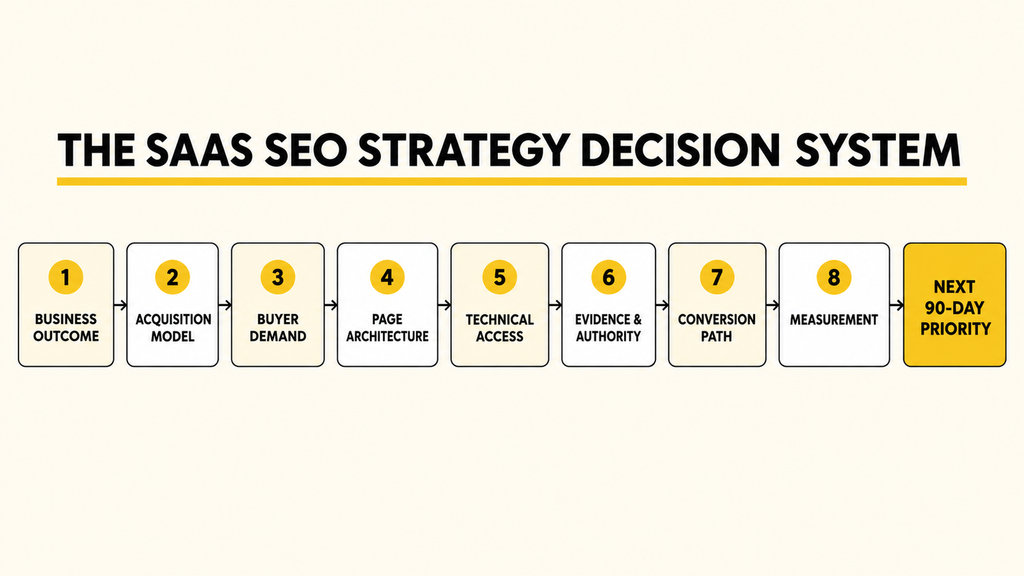
Figure 1. The SaaS SEO strategy decision system. Each stage constrains the next.
Decide Whether SEO Is the Right Priority Right Now
SEO is a strong SaaS investment when buyers search for the problem, category, capability, integration, or alternative you sell and your team can maintain stable, useful pages. It should not lead the acquisition plan when the product, ideal customer, or positioning changes so quickly that today’s search architecture will be obsolete next quarter.
I look for five conditions before recommending meaningful investment:
- The company has a reasonably stable ideal customer profile and understands why that customer buys.
- Search demand exists around the problem, category, workflow, feature, integration, competitor, or adjacent education.
- The product can make defensible claims and supply evidence stronger than generic summaries.
- The marketing site can publish, update, and internally link indexable pages.
- Analytics can record at least one meaningful step after an organic visit.
An early SaaS startup does not need perfect product-market fit to learn from search. It does need enough stability to avoid building a large library for an audience it may abandon. When positioning is still moving, a few high-intent pages can test buyer language without creating a backlog of overlapping, obsolete URLs.
Start With the SaaS Acquisition Model, Not a Keyword Tool
Your acquisition model determines what an organic conversion means. Product-led SaaS should connect discovery to signup, activation, and paid use; sales-led SaaS should connect it to qualified demos, opportunities, and revenue. A hybrid business needs both paths reported separately so one cannot hide the weakness of the other.
| SaaS Model | Primary Organic Action | Important Page Types | Measurement Path |
|---|---|---|---|
| Product-led | Start a trial or create an account | Feature, template, free-tool, integration, and use-case pages | Landing page -> signup -> activation -> paid account |
| Sales-led | Request a qualified demo | Solution, industry, comparison, security, implementation, and case-study pages | Landing page -> demo -> opportunity -> revenue |
| Hybrid | Start self-serve or enter a sales conversation | A connected mix of product and evaluation pages | Separate self-serve and sales-assisted paths |
This changes prioritization and keyword value. A PLG company may benefit from a free calculator that creates a natural signup path, while a sales-led platform may need implementation and security pages. A term with 40 monthly searches can matter more than one with 4,000 when it names a required integration or evaluation criterion.
I document the conversion path before production. If the team cannot agree whether success is a signup, activated workspace, qualified demo, or sales opportunity, it is too early to declare which keywords matter most.
Map Buyer Demand Before Mapping Keywords
Buyer-demand mapping identifies the questions and decisions that occur before someone searches for your brand. It covers the problem they are trying to name, the requirements they must satisfy, the options they compare, the risks they need to resolve, and the evidence they need before choosing a product. Keywords are then assigned inside that model.
I map demand through the jobs the page must perform:
1. Define the problem. Help the buyer name the operational, financial, or technical issue.
2. Frame the solution. Explain the category, approach, or workflow that can solve it.
3. Establish requirements. Cover features, integrations, use cases, security, data, and implementation constraints.
4. Support evaluation. Provide comparisons, alternatives, pricing context, proof, and trade-offs.
5. Enable action. Give the buyer a sensible route to try, book, calculate, configure, or contact.
This prevents a common mistake: building five educational articles around a problem but no commercial page that explains how the product solves it. The cluster earns attention, yet the product remains an afterthought.
Turn Demand Into a SaaS Page Architecture
A SaaS page architecture gives every important search intent one clear destination and connects related pages according to how buyers learn. Product pages explain what the software is; feature, use-case, integration, comparison, and educational pages answer narrower questions. The architecture prevents cannibalization while moving authority and people toward evaluation.
I do not default every keyword to a blog post. I choose the page type from the job:
- A feature page explains a capability and the problem it solves.
- A use-case page shows how a specific audience completes a job with the product.
- An integration page answers compatibility, setup, data-flow, and limitation questions.
- A comparison or alternative page helps an informed buyer evaluate trade-offs honestly.
- An educational article develops understanding where the product page cannot carry the full explanation.
- A template, calculator, or free tool lets the visitor solve part of the problem immediately.
Suppose a reporting platform wants to own demand around SaaS revenue attribution. One article can define attribution models, integration pages can cover HubSpot and Salesforce, a comparison can address spreadsheets versus dedicated software, and the product page can explain the workflow. Each page answers a different question and links to the buyer’s next likely decision.
That is the principle behind my SaaS SEO and consulting work: product, feature, use-case, integration, alternative, comparison, and educational pages operate as one acquisition system.
Audit the Existing Inventory Before Creating More Content
Before creating a page, determine whether the opportunity is genuinely missing. The existing site may already have a relevant URL that is weak, technically blocked, poorly positioned, competing with another page, or disconnected from conversion. Improving or consolidating that asset is often faster and safer than adding another URL to the problem.
For each important query group, I check:
1. Does a suitable page exist?
2. Is it crawlable, renderable, canonical, and indexable?
3. Does its format match the current search intent?
4. Does another internal URL compete for the same intent?
5. Does the page provide product-specific evidence?
6. Can a qualified visitor reach the next useful step?
7. What has Google Search Console already revealed about it?
My approach to an SEO audit is to separate missing-page, relevance, authority, indexation, and conversion problems before recommending work.
Prioritize Opportunities by Revenue, Evidence, and Dependency
Prioritize SaaS SEO opportunities using commercial proximity, confirmed demand, ranking feasibility, available evidence, technical dependencies, implementation effort, and measurement quality. Search volume is one input, not the score. The best first project is the valuable opportunity your team can support, ship, and evaluate without pretending every assumption is proven.
I ask seven questions:
1. How close is the search to a trial, qualified demo, expansion, or retention outcome?
2. Do search results and customer conversations confirm the intent?
3. Does the site already have authority or useful partial visibility?
4. Can the product and subject-matter experts supply evidence competitors cannot easily copy?
5. Is another technical or page-level fix required first?
6. Can marketing, product, and development ship the work in the proposed period?
7. Will the analytics show whether the change helped?
One SaaS client had content selected for optimization that later produced a 10x average increase in clicks. The lesson was not that refreshing pages always creates that result. It was that evidence-led selection matters: the content already had a valid purpose, and the opportunity was stronger than starting another broad publishing program.
Low-effort work is not automatically a quick win. Changing 100 title tags may be easy, but fixing one noindexed comparison page can protect more commercial value.
If your keyword list, product pages, and technical backlog are pulling in different directions, Phrase It can turn them into one prioritized SaaS SEO roadmap tied to trials, demos, and revenue.
Explore SaaS SEO servicesBuild a 90-Day Roadmap Your Team Can Actually Ship
A useful 90-day SaaS SEO roadmap sequences work around dependencies and team capacity. It fixes blockers on valuable pages, improves assets already showing demand, builds missing commercial destinations, connects them with supporting content, and defines how results will be reviewed. It is a rolling priority system, not a miniature annual plan.
My default sequence is:
1. Fix material blockers. Address indexation, rendering, canonical, migration, template, or internal-link problems affecting priority pages.
2. Improve existing demand. Update pages already earning relevant impressions, rankings, referrals, or conversions.
3. Build missing commercial pages. Cover high-value features, use cases, integrations, comparisons, and alternatives.
4. Add supporting authority. Create educational content, research, tools, templates, and expert evidence that strengthen the commercial cluster.
5. Measure and resequence. Use query, page, conversion, sales, and AI-referral evidence to set the next priorities.
I also assign an owner and a verification step. “Improve JavaScript SEO” is not a roadmap item. “Ensure the pricing comparison renders in the initial or rendered HTML, test it in URL Inspection, and confirm the canonical 200 URL remains indexable after release” is work a team can execute and verify.
Build One SaaS SEO Strategy for Traditional and AI Search
A SaaS SEO strategy should make your product discoverable wherever buyers research: Google, AI Overviews, ChatGPT, Claude, Gemini, and Perplexity. You do not need separate SEO and AI-search content machines. You need one commercially focused system that connects buyer language, suitable pages, credible evidence, technical access, external authority, and revenue measurement.
The buying journey has changed, but traditional search has not disappeared. A prospect may discover the problem through Google, compare vendors in ChatGPT, validate the shortlist through review sites and YouTube, return through a branded search, and finally book a demo directly.
Analytics may record only the last step. Your strategy still needs to influence the entire sequence.
Research Keywords and AI Prompts Together
I treat keywords and prompts as two expressions of the same buyer demand. A keyword compresses the need into a few words. An AI prompt adds the buyer’s industry, constraints, current tools, budget, desired outcome, and follow-up questions.
Map:
- Solution categories: Every accurate way buyers describe the product category, platform, or tool.
- Industries: The verticals that already convert, retain, and receive meaningful value from the product.
- Competitors: The products buyers compare with yours, including the specific reasons customers switch.
- Integrations: The systems buyers need your product to connect with.
Combining these dimensions produces more commercially useful searches than looking at keyword volume alone. “Presentation software” may be competitive and vague. “Real estate presentation software with MLS integration” describes the category, audience, requirement, and buying context.
The same logic creates realistic AI prompts:
We manage a 30-person real estate brokerage and need listing presentation software with MLS integration and fast onboarding. Which platforms should we compare?
That prompt may never appear in a conventional keyword tool. It still represents qualified demand.
The inputs should come from sales calls, customer-success conversations, support tickets, CRM data, product reviews, and recorded objections. I want the words customers actually use, the competitors they genuinely evaluate, and the reasons they choose or reject a product. Generic keyword suggestions cannot provide that commercial context.
Choose the Page Type From the Buyer’s Need
Once I have the demand map, I check which formats Google ranks and which sources AI assistants cite for each priority query. The objective is not to copy the current results. It is to understand what kind of answer the buyer expects before creating a materially better one.
Different needs require different pages:
- Category searches may need a strong product or solution page.
- Competitor searches may need a fair comparison or alternatives guide.
- Industry-specific requirements may belong on an industry or use-case page.
- Compatibility questions usually need an integration page.
- Pain-oriented workflow searches may justify a detailed how-to guide.
- “Best software” searches often return evaluated lists and comparison resources.
- Recurring calculations or assessments may be better served by a free tool.
This is where traditional SEO and AI visibility converge. Both systems need to identify the page, understand the subject, retrieve the relevant facts, and decide whether the source deserves visibility. The page format should serve that task.
Make Every Priority Page Easy to Understand and Verify
A page that targets traditional and AI search needs more than an optimized title. It needs a clear answer, explicit product positioning, useful evidence, and a route toward the next buyer decision.
For a commercially important SaaS page, I usually look for:
- A concise summary that answers the primary question near the beginning.
- Clear language about who the product suits and who may need another option.
- Specific features, limitations, integrations, pricing conditions, and implementation requirements.
- First-party evidence such as product data, screenshots, demonstrations, customer results, or expert explanations.
- Comparison tables when several options genuinely share comparable fields.
- Page-specific questions drawn from sales and customer conversations.
- Contextual links to relevant features, integrations, use cases, documentation, and proof.
- A trial, demo, calculator, or contact option that matches the reader’s stage.
The goal is not to add an FAQ and call the page “AI optimized.” It is to make the information buyers care about visible, consistent, and defensible.
This also applies off-site. If your website positions the product for mid-market SaaS teams but reviews and comparison articles describe it as a small-business tool, search and AI systems receive conflicting signals. Your product positioning should remain consistent across your site, case studies, review platforms, interviews, listicles, and other credible mentions.
Refresh Existing Commercial Pages Before Scaling Production
For an established SaaS site, some of the fastest opportunities often sit in pages that already rank, convert, or attract relevant impressions. Before commissioning another large content batch, I identify commercially valuable pages that have declined, stalled near the first page, or remain absent from relevant AI answers.
A useful refresh does more than change the publication date. It may:
- Correct an outdated intent or page format.
- Improve the opening answer and product positioning.
- Add missing pricing, integration, implementation, or comparison details.
- Replace repeated FAQs with questions specific to that page.
- Add recent first-party evidence.
- Strengthen internal links from relevant authority pages.
- Resolve cannibalization or technical indexation problems.
- Update genuinely outdated information and show the accurate revision date.
After the change, I track the page for 30, 60, and 90 days. Rankings, organic clicks, AI citations, referral sessions, trials, demos, and assisted pipeline help determine whether the refresh worked and what should move next.
Measure Direct Referrals and Branded Traffic
AI referral traffic is only the visible part of AI-assisted discovery. A buyer can research your category inside an assistant, note three vendors, speak to colleagues, watch product videos, and return through a branded Google search or direct visit. Standard last-click attribution may give the assistant no credit.
I therefore combine several evidence sources:
- Direct referrals from ChatGPT, Claude, Gemini, Perplexity, Copilot, and other assistants.
- The landing pages and conversion events associated with those sessions.
- Visibility across a defined set of commercially relevant AI prompts.
- The sources assistants cite when answering those prompts.
- Branded-search and direct-traffic trends.
- A free-text or multiple choice “How did you hear about us?” field on signup, demo, and contact forms.
- Sales discovery notes recording the buyer’s complete research path.
- CRM stages, qualified opportunities, customers, and revenue where attribution permits.
I do not treat every rise in branded traffic as proof that AI caused it. The self-reported and sales-recorded evidence helps identify journeys analytics cannot observe, while direct referral and conversion data show what can be measured more confidently.
Sequence the Work Over 90 Days
The 90-day structure is useful because it sequences research, existing-page improvements, new production, authority, and measurement instead of launching everything at once.
During weeks one and two, I would build the keyword-and-prompt matrix, analyze sales and customer conversations, audit technical access, define priority conversions, normalize AI referral sources, and establish prompt tracking.
During weeks three and four, I would find existing commercial pages with the strongest improvement potential. The team can refresh content, correct intent mismatches, strengthen product evidence, repair internal links, and fix material technical problems.
During month two, I would create the missing product, feature, use-case, integration, comparison, alternative, or educational pages with the highest commercial priority. The publishing pace should match the company’s research and review capacity.
During month three, I would strengthen the external evidence surrounding those pages through legitimate reviews, editorial coverage, expert contributions, partnerships, relevant video, and other authority-building work. I would then compare search visibility, AI answers, referrals, conversions, sales feedback, and pipeline evidence before choosing the next priorities.
That creates one feedback loop for traditional and AI search. Buyer research shapes the demand map. The demand map shapes the pages. Technical access and authority help those pages get retrieved. Conversion and revenue evidence determine what the team should improve next.
Treat Technical SEO as Acquisition Infrastructure
Technical SEO for SaaS protects the pages and journeys that create demand. Prioritize JavaScript rendering, duplicate application routes, canonicals, status codes, staging exposure, localization, internal links, and Core Web Vitals according to the rankings and conversions at risk. A sitewide warning is not automatically a sitewide business priority.
Google processes JavaScript through crawling, rendering, and indexing, and notes that server-side or pre-rendering remains useful because it improves access for users and crawlers that cannot execute JavaScript. That matters on SaaS sites built with client-side frameworks, where a page can return 200 while its decisive product content depends on a delayed API response.
The same discipline appears in my agentic browsing troubleshooting framework: diagnose access before rendering, rendering before understanding, and understanding before interaction. Adding schema or llms.txt cannot repair a blocked request or an empty page shell.
The dedicated technical SEO article in this series will go deeper into JavaScript, multi-tenant routes, app and marketing subdomains, documentation, internationalization, migrations, release QA, and agent accessibility.
Free Download: The 100-Point SaaS SEO Audit Checklist
A crawler can flag hundreds of issues without telling you which one is costing you trials, demos, or revenue.
I turned this audit framework into a practical 33-page checklist covering 100 revenue-influencing SaaS SEO mistakes. Every check includes the revenue risk, the fix, and the evidence you should use to verify the work.
Use it to audit:
- Revenue-relevant demand and page architecture
- Search intent, content relevance, and product evidence
- Crawling, rendering, indexation, and canonicalization
- Internal links and external authority
- AI mentions, citations, and message accuracy
- Trial, demo, and signup paths
- Analytics, CRM attribution, and implementation priorities
This is not another list of technical warnings to clear indiscriminately. It helps you find the earliest failure in the path from buyer demand to revenue—and decide what deserves fixing first.
Build Authority From Evidence Your SaaS Already Owns
SaaS authority grows when a company publishes useful evidence that comes from its product, customers, experts, and operating data. Original research, implementation guidance, technical documentation, templates, tools, and honest comparisons give people and retrieval systems a reason to use the brand as a source. Generic summaries do not create that advantage.
Phrase It’s published work shows the difference. One technical guide for an industrial SaaS platform recorded at least 100 organic page-keyword records, including 59 top-20 records and 22 Google AI Overview reference records in a July 2026 DataForSEO audit.
Another 27-article buyer-education portfolio produced 134 first-page records and 63 AI Overview references. That result came from adapting a consistent research and editorial system to the decision criteria of each market, not cloning one template 27 times.
Use the evidence your competitors cannot manufacture cheaply:
- Product usage patterns and original datasets.
- Subject-matter expert explanations with real constraints.
- Implementation processes, templates, and checklists.
- Comparisons based on transparent criteria.
- Customer questions, objections, and workflows.
- Free tools that solve a meaningful part of the job.
Design for Google and AI-Assisted Discovery Together
SaaS SEO and AI-search visibility should share one foundation: crawlable pages, explicit answers, consistent product facts, credible evidence, and a useful next step. AI-specific work adds prompt testing, citation analysis, entity review, and referral attribution. It should not replace technical SEO or become a separate library of thin “AI-optimized” pages.
Google’s guidance says its generative Search features use core Search systems and do not require special schema, tiny content chunks, or a rewritten version of every page. It recommends crawlable technical structure and unique, non-commodity content based on real experience.
For SaaS, that means stating decisive facts where the buyer needs them: which plan includes the feature, which systems integrate, what a workflow requires, who the product suits, and where limitations apply. Structured data can corroborate visible facts, but it cannot rescue vague product copy.
I also test realistic buyer prompts in ChatGPT, Gemini, Perplexity, Claude, and Google AI experiences. I record whether the brand is mentioned, whether its own page is cited, which competing sources shape the answer, and whether measurable referral traffic completes a business action.
One SaaS client’s exact 365-day comparison showed why the last step matters. AI referral sessions increased 21.4% to 1,458, while AI-attributed key events increased 90.5% to 80 and free trials increased 117.6% to 37. The traffic increase was useful; the conversion evidence made it commercially meaningful.
The full AI referral traffic case study documents the measurement window and its limitations. For the broader methodology, my guide to LLM SEO and AI citations explains how content, entities, third-party corroboration, and tracking fit together.
Connect Every Content Cluster to the Product
Internal links should move a SaaS buyer toward the next relevant decision while clarifying relationships between pages. Supporting articles can lead to feature, use-case, integration, comparison, pricing, or trial pages, but only where that destination advances the reader’s task. A repeated “book a demo” button does not substitute for architecture.
I map internal links during the page-planning stage. The source page, target page, anchor, and reason for the link are part of the brief, not a cleanup task after publication.
In the revenue-attribution example, a guide can link to HubSpot and Salesforce integration pages when it discusses data collection. Those pages can lead to the reporting feature workflow, while a spreadsheet comparison can support a reader who is ready to evaluate the product.
I use CTAs more selectively. A commercial comparison may justify a product CTA; a technical explanation may need a documentation link instead. Contextual links do most of the navigational work, which is why this article links to relevant methods, services, and proof without turning every section into a pitch.
If your commercial pages, supporting content, and AI visibility look like three separate programs, I can help you turn them into one measurable acquisition system. Bring your current roadmap, and I’ll show you where I would focus first.
Book a 30-minute strategy callDefine Measurement Before Production Begins
Define SaaS SEO measurement before publishing so every page has a leading indicator, a conversion path, and an honest business outcome. Rankings and citations show discoverability; trials, demos, activation, qualified opportunities, and revenue show commercial progress. Report AI referrals separately and document attribution limits instead of combining unlike signals into one growth claim.
I use four measurement layers:
| Layer | Examples | Decision It Supports |
|---|---|---|
| Technical availability | Crawl status, indexation, rendered content, canonical state | Can the page compete? |
| Search visibility | Relevant queries, rankings, clicks, AI mentions, citations | Is qualified discovery improving? |
| Conversion behavior | Trial starts, demos, forms, activation, product-qualified leads | Are visitors taking a useful next step? |
| Business outcome | Opportunities, customers, MRR, ARR, attributable revenue | Is the channel contributing commercially? |
The layers stop teams from making causal leaps. A ranking increase is not revenue. An AI mention is not a referral. A referral is not a customer.
For one SaaS client, I have observed a ChatGPT session key-event rate as high as 25%, with key events including signups and purchases. That is an observed account result, not a benchmark other companies should paste into a forecast.
I normalize AI sources in analytics because the same assistant may appear through multiple source and medium values. I then connect sessions to events and, where the stack permits, CRM or subscription outcomes.
SEO revenue reporting covers how to move beyond traffic-only dashboards.
How SaaS SEO Strategy Changes as the Company Grows
SaaS SEO priorities should change with product maturity, authority, market coverage, and team complexity. Early-stage companies need focus and demand validation; growth-stage companies need repeatable commercial and content systems; established companies need governance, consolidation, international controls, and measurement across products. Reusing the same roadmap at every stage creates waste.
| Stage | Primary SEO Job | Typical Priorities | Common Mistake |
|---|---|---|---|
| Early stage | Validate and capture focused demand | Technical basics, core product pages, high-intent use cases, selective comparisons | Publishing dozens of broad articles before positioning stabilizes |
| Growth stage | Expand qualified acquisition | Feature and integration architecture, content clusters, original assets, conversion reporting | Scaling production without cannibalization or ownership |
| Established | Protect and compound visibility | Consolidation, internationalization, migrations, programmatic systems, cross-product governance | Treating every product and market as an independent website |
For startups, I would rather see five connected pages with clear jobs than 50 disconnected posts. At scale, multiple products, subdomains, documentation systems, locales, and release teams require shared standards for templates, canonicals, internal links, measurement, consolidation, and release QA. The framework stays the same; the dependencies grow.
Build a Strategy Your Team Can Defend
A SaaS SEO strategy is complete when your team can explain why each priority exists, which buyer decision it supports, what must happen before it ships, where the visitor should go next, and how the result will be judged. That shared logic keeps content, technical work, product pages, and measurement moving in the same direction.
Which buyer need does the page serve? Why is this the right format? What technical or organizational dependency comes first? Where should the reader go next? Which evidence will determine whether the company should invest more?
If the plan cannot answer those questions, adding more keywords will not make it strategic.
I have seen SaaS SEO work compound when technical, content, product, conversion, and reporting decisions share one priority system. I have also seen good articles underperform because the commercial destination was missing, the page was noindexed, or nobody tracked what happened after the click.
Strategy makes those dependencies visible. Then execution has a chance to work.
Tell me what you sell, how customers buy, and where organic growth is currently stuck. I’ll reply with the clearest next step for your marketing, product, and development teams.
Discuss your SaaS SEO prioritiesFrequently Asked Questions About SaaS SEO Strategy
These answers cover the decisions SaaS founders and marketing leaders most often need to make before committing resources. They also clarify where this strategy article ends and where the dedicated audit, technical SEO, and KPI guides in this series begin.
How Do You Create an SEO Strategy for a SaaS Product?
Start with the business outcome and acquisition model, then map buyer demand to product, feature, use-case, integration, comparison, and educational pages. Audit what already exists, fix technical blockers, prioritize by commercial value and feasibility, and define how trials, demos, pipeline, or revenue will be measured before production begins.
What Should a SaaS Startup Do First for SEO?
Confirm that the ideal customer and positioning are stable enough to support lasting pages. Then make the core product site crawlable, build a small set of high-intent pages around real customer problems and use cases, connect them clearly, and track whether organic visitors start trials or request qualified demos.
Which SaaS Pages Should Be Prioritized First?
Prioritize pages closest to valuable buyer decisions, especially product, feature, use-case, integration, comparison, and alternative pages with confirmed demand. Existing pages already earning relevant impressions often deserve improvement before new content. Search volume should not override commercial relevance, technical dependencies, available product evidence, or the team’s ability to ship.
How Long Does SaaS SEO Take to Produce Results?
Technical fixes and updates to established pages can produce leading signals within weeks, while competitive non-branded visibility and authority usually compound over several months. Timing depends on the site’s existing authority, technical condition, market competition, content gap, release capacity, and whether buyers use search for the problem you solve.
How Should a SaaS Company Measure SEO?
Measure technical availability, qualified search visibility, conversion behavior, and business outcomes separately. Track indexation, relevant queries, organic and AI referrals, trials, demos, activation, qualified opportunities, customers, and attributable revenue where the stack permits. Document attribution limits so an assisted interaction is not presented as a closed customer without evidence.