
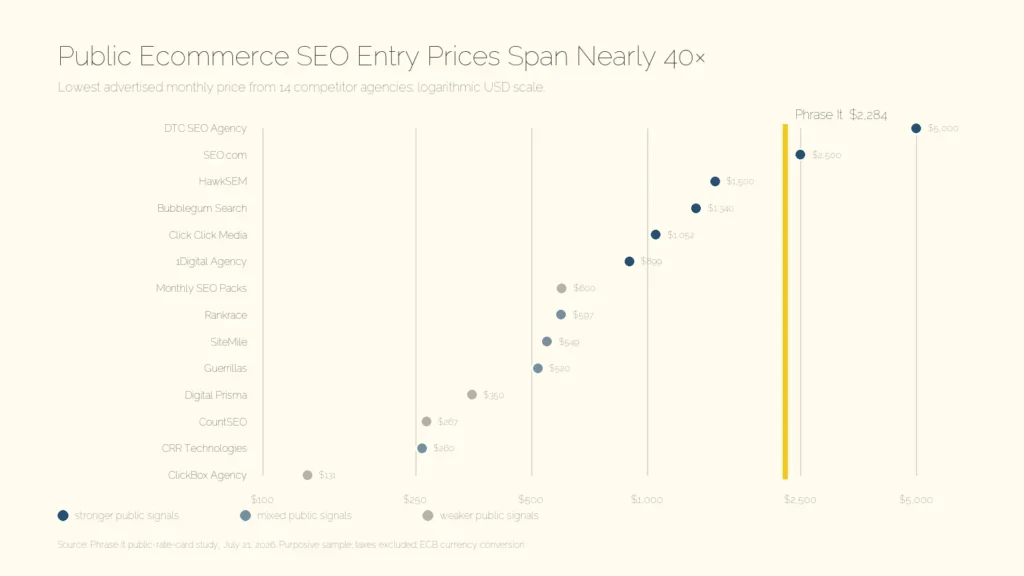
The cheapest ecommerce SEO package I found cost the equivalent of about $131 per month.
The most expensive entry price was $5,000.
That does not mean you can buy the same work for 38 times less. It means agencies use “ecommerce SEO” to describe wildly different combinations of audits, content, technical implementation, reporting, link building, and strategic ownership.
I wanted a better answer than another enormous range followed by “it depends.” So I analyzed 40 public offers from 15 agencies, including Phrase It, and recorded the prices, billing models, deliverables, contract terms, and visible credibility signals.
The result is a more useful answer: serious ongoing ecommerce SEO generally requires a budget of $1,500 to $5,000 per month. Smaller packages exist, but you need to examine exactly what is being delivered and who is responsible for implementing it.

Table of Contents
How Much Does Ecommerce SEO Cost Per Month?
Ecommerce SEO typically costs $1,500 to $5,000 per month for a serious ongoing engagement. Public entry prices can fall below $600, while established specialists and larger agencies often begin around $1,500 to $5,000. Large catalogs, competitive markets, content production, technical implementation, and digital PR can push the monthly cost much higher.
That range is narrower than some current guides. WebFX reports that 71% of the 250 US marketing and sales professionals it surveyed spend between $500 and $7,500 per month. AdNabu places growing stores around $3,000 to $10,000, while WebyKing gives a broader $800 to $5,000 range.
Those numbers answer slightly different questions.
A business can technically buy something labeled ecommerce SEO for $300 per month. But that does not tell you whether the package includes category strategy, product-page work, technical fixes, content production, internal linking, analytics, or implementation.
Here is the range I would use for planning:
| Monthly Budget | What It Usually Represents | Best Fit |
|---|---|---|
| Under $600 | Productized checklists, limited keywords, templated on-page work, basic reporting, or offshore execution | Very small stores with narrow requirements and internal implementation capacity |
| $600–$1,500 | Broader on-page work, technical audits, reporting, limited content or links, and some implementation | Small or early-stage stores with a defined catalog |
| $1,500–$5,000 | Ongoing strategy, category and product optimization, technical implementation, content planning, reporting, and senior oversight | Growing ecommerce brands |
| $5,000–$10,000+ | Larger teams, more content, digital PR, international SEO, complex technical work, and faster execution | Competitive or multi-market brands |
| Custom enterprise scope | Large catalogs, migrations, multiple storefronts, headless platforms, and international architecture | Enterprise ecommerce operations |
The price is only useful when you put it next to the scope.
What Did The Public Pricing Study Find?
Across 14 competitor ecommerce agencies, the median advertised entry price was $598.50 per month. However, this figure is pulled down by low-cost productized sellers. Agencies with stronger visible credibility signals had a median entry price of $1,420, compared with $308 among agencies with weaker public signals.
I classified agencies using six visible signals:
- Named leadership or a substantive team page.
- A coherent and verifiable business identity.
- Ecommerce case studies with concrete outcomes.
- Named client evidence or traceable testimonials.
- Recognized third-party validation.
- Clear scope, process, and commercial terms.
These labels describe public evidence. They do not prove that one agency delivers good work or another delivers bad work.
| Public-Signal Group | Agencies | Median Entry Price | Observed Range |
|---|---|---|---|
| Stronger public signals | 6 | $1,420 | $899–$5,000 |
| Mixed public signals | 4 | $534 | $260–$597 |
| Weaker public signals | 4 | $308 | $131–$600 |
| Phrase It benchmark | 1 | $2000 equivalent | $2,000 monthly |
The finding is not that a high price guarantees good SEO.
It does not.
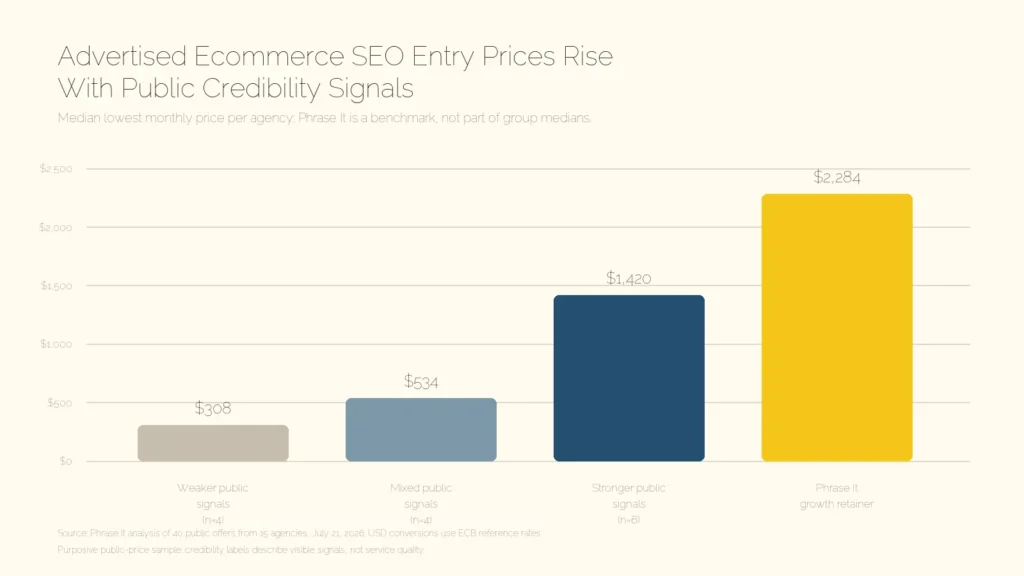
The more useful conclusion is that a very low price often leaves less room for senior research, implementation, content, technical work, and ongoing decision-making. You need to find out which of those responsibilities remain with your team.
What Do Ecommerce SEO Agencies Publicly Charge?
The 14 competitor agencies in my sample advertised monthly entry prices from approximately $131 to $5,000. Prices were converted to US dollars using the European Central Bank’s July 21, 2026 reference rates. Original currencies remain visible because exchange rates and local operating costs affect direct comparisons.
| Agency | Lowest Public Monthly Price | Approximate USD | Public-Signal Group |
|---|---|---|---|
| ClickBox Agency | ₹12,599 | $131 | Weaker |
| CRR Technologies | ₹25,000 | $260 | Mixed |
| CountSEO | £199 | $267 | Weaker |
| Digital Prisma | $350 | $350 | Weaker |
| Guerrillas | ₹50,000 | $520 | Mixed |
| SiteMile | $549 | $549 | Mixed |
| Rankrace | $597 | $597 | Mixed |
| Monthly SEO Packs | $600 | $600 | Weaker |
| 1Digital Agency | $899 | $899 | Stronger |
| Click Click Media | A$1,500 | $1,052 | Stronger |
| Bubblegum Search | £1,000 | $1,340 | Stronger |
| HawkSEM | $1,500 | $1,500 | Stronger |
| SEO.com | $2,500 | $2,500 | Stronger |
| DTC SEO Agency | $5,000 | $5,000 | Stronger |
Taxes are excluded. “Starting from” prices are recorded at the published floor.
This is a purposive sample of agencies that publish prices. It is not a representative survey of every ecommerce SEO provider.
In fact, public pricing likely overrepresents lower-cost and highly productized services. Many established agencies only provide a quote after examining the store.
Why Does Ecommerce SEO Pricing Vary So Much?
Ecommerce SEO pricing varies because agencies are not pricing the same workload. Catalog size, faceted navigation, platform limitations, content production, implementation ownership, competition, and link requirements all change the number of specialist hours required. A quote without those inputs is usually a package price, not a considered ecommerce growth plan.
Since 2019, I have worked across technical SEO, content strategy, site architecture, internal linking, reporting, and implementation planning. The biggest pricing differences rarely come from access to one secret tool.
They come from how much thinking and execution the store actually needs.
Catalog Size And Indexable Pages
A store with 75 products does not create the same workload as a store with 7,500 products.
But the raw SKU count is not enough. I also want to know:
- How many categories and subcategories exist?
- How many filters generate crawlable URLs?
- Do product variants create duplicates?
- How often does inventory change?
- Are discontinued products removed without redirects?
- How many markets and languages are involved?
Large catalogs should not be optimized manually one product at a time. They need templates, prioritization rules, scalable metadata, intentional indexation, and a clear category architecture. Ecommerce site structure is the reason why category and filter decisions should come before bulk product-page work.
That strategic layer costs more upfront. It also prevents you from paying someone to “optimize” thousands of pages that should never have been indexed.
Your Store’s Technical Condition
A technically healthy store gives an SEO team more time for growth.
A messy store consumes the first months with repairs.
Common cost drivers include:
- Faceted navigation that creates crawl traps.
- Duplicate product and collection URLs.
- Broken canonical tags.
- JavaScript rendering problems.
- Poor Core Web Vitals.
- Incomplete product schema.
- Migration or redirect issues.
- Weak internal-link architecture.
Recommendations are not the same as fixes. Ask whether the agency will implement changes, write developer-ready tickets, work with your developers, or simply place each issue in an audit document.
That distinction changes the price.
Content Production
“Content included” can mean one AI-assisted article or a full research, writing, editing, publishing, and optimization process.
It can also mean category copy, product templates, comparison pages, buying guides, digital PR assets, or content briefs for your internal writers.
These outputs have different costs because they do different jobs.
For ecommerce, I would rather see a useful buying guide supporting a profitable category than four generic posts created to satisfy a monthly quota.
Competitive And Authority Requirements
A technically clean website can still struggle if every ranking competitor has stronger brand authority, better category pages, and years of relevant coverage.
That gap may require:
- Original research.
- Digital PR.
- Linkable tools or calculators.
- Product-led editorial content.
- Expert commentary.
- Third-party mentions.
- Strategic link acquisition.
Link costs should be transparent. If the proposal promises a fixed number of “high-DA backlinks” without explaining the sites, editorial standard, relevance, or acquisition method, keep asking questions.
Planning your own budget? Use the free ecommerce SEO ROI calculator to estimate the revenue, contribution margin, and break-even point your investment would need to support.
What Should An Ecommerce SEO Package Include?
A credible ecommerce SEO package should connect technical health, commercial page optimization, content, internal linking, measurement, and implementation. The exact quantities can vary, but the proposal should tell you which pages matter, what will change, who will make those changes, and how the work connects to organic revenue.
At minimum, I would expect clarity across these areas:
| Workstream | What You Should Look For |
|---|---|
| Technical SEO | Crawl and indexation controls, canonicals, schema, Core Web Vitals, redirects, and template issues |
| Keyword Strategy | Mapping search demand to categories, subcategories, products, guides, and comparisons |
| Commercial Pages | Category, collection, and priority product-page optimization |
| Content | Research, briefs, writing responsibilities, editing, and publishing quantities |
| Internal Linking | A plan for moving authority toward commercially important pages |
| Implementation | Who changes the CMS, theme, templates, schema, redirects, and page copy |
| Authority | Digital PR, outreach, brand mentions, or clearly explained link acquisition |
| Measurement | Rankings, non-branded traffic, organic revenue, assisted conversions, and completed work |
| Communication | Named owner, meeting cadence, response expectations, and roadmap updates |
Reporting deserves particular attention.
A ranking chart is not a revenue report. I want to see whether qualified shoppers are landing on the right pages, what they do next, and whether organic visibility contributes to purchases.
What Can Go Wrong With Cheap Ecommerce SEO?
Cheap ecommerce SEO becomes expensive when you pay for activity that cannot change performance. The biggest risks are generic checklists, guaranteed rankings, low-quality links, bulk content, and reports with no implementation. A low price is not automatically a problem, but unclear ownership and implausible promises are.
Four of the 14 competitors displayed at least one visible warning signal in the inspected pricing material.
Examples included:
- A percentage guarantee for keywords reaching the top 10.
- Aggressive expected traffic or sales-growth figures.
- Approximate traffic promises attached to package tiers.
- Material ambiguity about the company identity shown on the page.
These signals do not prove misconduct. They tell you where to investigate.
I would ask a low-cost provider to show:
- A real ecommerce deliverable.
- A redacted implementation ticket.
- A reporting example connected to revenue.
- A relevant case study with starting context.
- Their link-acquisition process.
- Who will personally work on the account.
If the answer is another feature checklist, you still do not know what you are buying.
How Does Phrase It’s Ecommerce SEO Pricing Compare?
Phrase It’s core Ecommerce SEO Growth Retainer costs $2,000 per month. That placed it above 12 of 14 competitor entry prices, but below the published minimums from SEO.com and DTC SEO Agency. It sits in the specialist, higher-touch portion of the sample.
I do not want Phrase It to compete with a $300 checklist.
That is not the work I sell.
The live Phrase It ecommerce SEO service currently offers three levels:
| Phrase It Package | Public Price | Best Fit |
|---|---|---|
| Managed SEO Core | $2000 / month | Stores that need an audit, structural diagnosis, quick wins, and a prioritized roadmap |
| Managed SEO Growth | $3000 / month | Brands that need monthly strategy, content, on-page work, implementation support, and reporting |
| Managed SEO Scale | $5000 / month | Competitive brands that need topic clusters, comparisons, AI-search visibility, authority work, and deeper execution |
The point of the €2,000 retainer is not to produce the longest monthly task list.
It is to decide what should move first, get the work implemented, and connect the output to qualified traffic and revenue.
Large catalogs, migrations, complex faceted navigation, page-speed work, and unusually heavy content requirements are scoped separately. That protects both sides from pretending the same package can fit every store.
How Much Should You Budget For Ecommerce SEO?
Start with the outcome your store needs, then work backward through contribution margin, realistic organic growth, and the time required to reach it. A useful budget must be affordable for at least six months, cover the work your store genuinely needs, and have a plausible route to generating more profit than it costs.
Here is a simple calculation.
Suppose you invest $2,000 per month. Your average order value is $80, and your contribution margin after product and fulfillment costs is 40%.
Each additional order contributes approximately $32:
$80 × 40% = $32
You would need about 63 additional monthly orders to cover a $2,000 retainer:
$2,000 ÷ $32 = 62.5
That does not mean SEO must create 63 orders in month one. Technical work, content, and authority compound over time.
It gives you a break-even target you can test against the size of the opportunity.
I would evaluate the budget in this order:
- Estimate the non-branded organic demand available in your market.
- Identify the categories and products capable of turning that demand into revenue.
- Calculate contribution margin rather than using gross sales alone.
- Estimate the additional qualified sessions and orders required.
- Model at least six to twelve months, not one reporting cycle.
- Decide whether the expected upside justifies the investment and execution risk.
If the numbers only work with an instant traffic jump and a perfect conversion rate, the budget does not work.
Is Ecommerce SEO Worth The Cost?
Ecommerce SEO is worth the cost when your store has proven demand, profitable products, enough margin, and the capacity to implement improvements. It is less attractive when the catalog has weak product-market fit, margins are extremely thin, or the business expects SEO to compensate for poor products, pricing, or fulfillment.
SEO can build an acquisition asset that continues producing visibility after an individual campaign ends.
But it is not free traffic.
You pay for research, technical decisions, content, implementation, authority, measurement, and the time required for those assets to mature.
I would be cautious if:
- Paid traffic has not yet shown that people want the products.
- The store cannot identify its profitable categories.
- Developers cannot implement technical changes.
- Inventory changes faster than the website can be maintained.
- The business needs immediate returns to survive.
- Nobody owns conversion rate, merchandising, or retention.
SEO works best when it strengthens a functioning business.
It cannot rescue every commercial problem.
How Should You Compare Ecommerce SEO Proposals?
Compare proposals by ownership, prioritization, implementation, and measurement rather than counting deliverables. The strongest proposal should explain what the agency believes is holding the store back, what it will address first, who will execute each change, and how progress will be connected to commercially important pages and revenue.
Ask every provider the same questions:
- Which pages would you prioritize first, and why?
The answer should reference demand, intent, revenue potential, and current visibility. - Who implements your recommendations?
“We provide guidance” is different from editing the store or managing developers. - How do you handle filters, variants, and faceted navigation?
Generic on-page answers are not enough for complex stores. - What exactly does content production include?
Confirm research, writing, editing, publishing, and revision responsibilities. - How are links or digital PR placements acquired?
You need to understand relevance, editorial control, and risk. - Which metrics will you use?
Rankings matter, but the reporting should reach qualified traffic, key pages, conversions, and organic revenue. - What would make you recommend against SEO?
A trustworthy strategist should be able to explain when the channel is not ready.
Choosing the right SEO agency goes deeper into the evidence and questions I would use before signing.
The Bottom Line
Plan on $1,500 to $5,000 per month for credible, ongoing ecommerce SEO, then adjust for catalog size, competition, content, technical implementation, and authority requirements. The cheapest offer is rarely comparable with a senior-led engagement. Judge the work, ownership, and commercial logic before judging the headline price.
You do not need the biggest package.
You need a scope that matches the store, a team that can implement it, and a realistic path from search demand to profitable orders.
If you want to apply this to your store, book a free SEO strategy call. I’ll look at your catalog, structure, current visibility, and commercial priorities, then tell you where I would focus first.
Frequently Asked Questions About Ecommerce SEO Cost
Ecommerce SEO buyers usually want to know what monthly work costs, whether a smaller store can start cheaply, how long results take, and whether Shopify or WooCommerce changes the price. The honest answers depend on scope, but each question has a useful decision rule that can prevent a bad proposal.
How Much Does Ecommerce SEO Cost Per Month?
Most growing stores should budget approximately $1,500 to $5,000 per month for ongoing ecommerce SEO. Smaller public packages begin below $600, while competitive, enterprise, or international programs can exceed $10,000 per month.
How Much Does Ecommerce SEO Cost For A Small Store?
A small store may spend $600 to $1,500 per month if its catalog and technical requirements are limited. A focused one-time audit or strategy sprint can be more appropriate when the internal team can implement the resulting recommendations.
Is Ecommerce SEO A One-Time Or Ongoing Cost?
Audits, migrations, and technical cleanups can be one-time projects. Sustainable ecommerce growth usually requires ongoing work because inventory changes, competitors publish new content, technical issues reappear, and category, product, and editorial opportunities continue developing.
Does Shopify SEO Cost More Than WooCommerce SEO?
Not automatically. Shopify may require work around collection URLs, duplicate variants, apps, and theme limitations, while WooCommerce can require more plugin, database, hosting, and performance work. Platform condition and implementation complexity matter more than the platform name.
How Long Does Ecommerce SEO Take To Work?
Initial technical or on-page improvements may affect visibility within weeks, but meaningful traffic and revenue growth commonly require six to twelve months. The timeline depends on current authority, competition, implementation speed, content quality, and how quickly search engines recrawl and reassess the site.
Can An Ecommerce SEO Agency Guarantee Rankings?
No credible agency can control Google well enough to guarantee a specific organic ranking. A provider can guarantee its process, deliverables, communication, and reporting, but percentage-based top-10 promises should trigger closer scrutiny.
Is $500 Per Month Enough For Ecommerce SEO?
It can cover a narrow, productized scope or a small amount of specialist time. It is unlikely to fund senior strategy, technical implementation, original content, authority work, and detailed reporting simultaneously, so the proposal should state what is excluded.
Sources
- European Central Bank reference exchange rates, July 21, 2026.
- WebFX Ecommerce SEO Pricing.
- 1Digital Ecommerce SEO Packages.
- HawkSEM Ecommerce SEO.
- SEO.com Ecommerce SEO Services.
- Bubblegum Search Ecommerce SEO Packages.
- DTC SEO Agency Pricing Guide.
- Phrase It Ecommerce SEO Services
- Phrase It SEO Pricing