
A crawler can find 800 issues and still miss the one costing your SaaS qualified trials or demos.
I have worked in SEO and organic growth since 2019 across agency, freelance, and in-house B2B SaaS roles. I have audited technical systems, content portfolios, keyword architectures, conversion paths, and reporting pipelines across multiple software products at once. The hardest part has never been producing more findings.
It is proving which constraint matters.
That is why my SaaS SEO audit does not begin with broken links, title lengths, or a generic health score. It begins with the demand your business should be capturing and asks why each important opportunity is failing.
The answer usually falls into one of seven classes: the page is missing, irrelevant, unsupported by authority, excluded from the index, technically inaccessible, unable to convert, or impossible to measure. Once you know the class, you can assign the right owner and stop asking developers to solve content problems or writers to solve rendering failures.
Table of Contents
What Is a SaaS SEO Audit?
A SaaS SEO audit is a structured diagnosis of whether a software company’s most valuable demand opportunities can be discovered, understood, trusted, and converted through traditional and AI-assisted search. It connects page architecture, content, technical access, authority, conversion, and measurement, then ranks the findings by likely business impact and confidence.
That definition is deliberately different from “run a crawl and export the errors.” A crawl is evidence collection. An audit explains why performance is constrained, what will change if you fix it, and how the team will verify the result.
Phrase It’s SEO audit approach follows that same path from business outcome to query, page, crawl, render, index, authority, conversion, and measurement. Tools help me observe conditions. They do not decide whether one noindexed comparison page matters more than 500 image warnings.
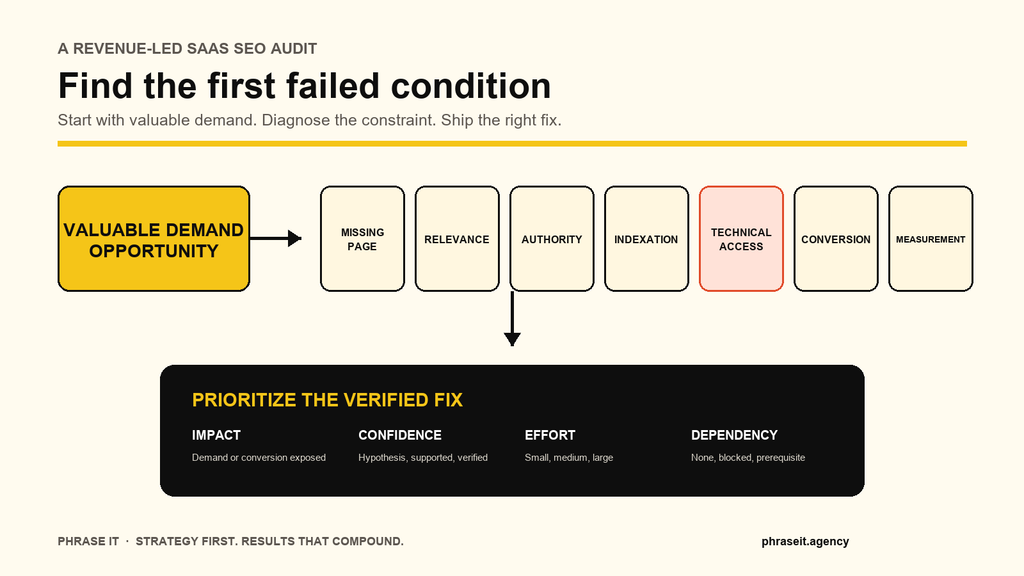
Figure 1. The SaaS SEO audit diagnostic system. Start with valuable demand, find the first failed condition, then prioritize the fix.
Start With Revenue-Relevant Demand, Not the Crawl
Start a SaaS SEO audit by listing the product questions and evaluation moments that could produce qualified trials, demos, pipeline, or revenue. Map each opportunity to an intended page and conversion path before opening a crawler. This makes every later finding answer a business question instead of merely increasing the audit’s issue count.
The input is not just a keyword export. I combine evidence from Google Search Console, paid-search terms, CRM stages, sales calls, support conversations, on-site search, product analytics, competitor pages, and AI prompts.
The attached 90-day B2B SaaS playbook describes these as money keywords and money prompts: specific category, use-case, competitor, integration, alternative, and job-to-be-done questions asked while a buyer is in market. I use the idea as an audit lens, not as permission to ignore earlier educational demand.
For each opportunity, record:
| Field | Audit Question | Example |
|---|---|---|
| Buyer | Who is searching or prompting? | RevOps lead at a 100-person SaaS |
| Need | What decision are they trying to make? | Connect attribution data to HubSpot |
| Demand | What query or prompt expresses it? | Best attribution software for HubSpot |
| Destination | Which URL should satisfy it? | Integration or use-case page |
| Next step | What action makes commercial sense? | Start trial or book demo |
| Evidence | What would prove success? | Qualified visits, trial starts, opportunities |
This demand inventory gives you the audit’s unit of analysis. You are no longer asking, “Does the site have duplicate titles?” You are asking, “Can the right page win this meaningful decision, and if not, what stops it?”
Free Download: The 100-Point SaaS SEO Audit Checklist
A crawler can flag hundreds of issues without telling you which one is costing you trials, demos, or revenue.
I turned this audit framework into a practical 33-page checklist covering 100 revenue-influencing SaaS SEO mistakes. Every check includes the revenue risk, the fix, and the evidence you should use to verify the work.
Use it to audit:
- Revenue-relevant demand and page architecture
- Search intent, content relevance, and product evidence
- Crawling, rendering, indexation, and canonicalization
- Internal links and external authority
- AI mentions, citations, and message accuracy
- Trial, demo, and signup paths
- Analytics, CRM attribution, and implementation priorities
This is not another list of technical warnings to clear indiscriminately. It helps you find the earliest failure in the path from buyer demand to revenue—and decide what deserves fixing first.
Diagnose Every Opportunity Against Seven Failure Classes
Every important opportunity should have one primary failure class: missing page, relevance, authority, indexation, technical access, conversion, or measurement. Several can coexist, but identifying the earliest decisive failure keeps the plan honest. A conversion rewrite cannot help a URL that is excluded from search, and backlinks cannot repair the wrong page intent.
| Failure Class | What It Means | Evidence to Check | Typical Owner |
|---|---|---|---|
| Missing page | No URL has the right job | Demand map, SERP type, site inventory | SEO, product marketing, content |
| Relevance | A page exists but answers the wrong intent or says too little | Query data, headings, copy, competitor coverage | SEO, content, product marketing |
| Authority | The page is relevant but lacks internal or external support | Internal links, backlinks, mentions, citations | SEO, content, PR |
| Indexation | Search systems discovered the URL but excluded or consolidated it | Search Console, Bing tools, canonicals, noindex | SEO, development |
| Technical access | Crawlers or browsers cannot reliably fetch, render, or interpret it | Status, robots, WAF, rendered HTML, logs | Development, infrastructure |
| Conversion | Qualified visitors arrive but cannot or will not take the next step | Analytics, recordings, forms, offer, message match | CRO, design, product marketing |
| Measurement | The outcome happens but reporting loses or misclassifies it | GA4, CRM, consent, source rules, event QA | Analytics, RevOps, development |
Use the earliest-failure rule. If a buyer prompt has no destination, that is a missing-page problem before it is an authority problem. If the intended page returns an empty JavaScript shell to a retrieval system, fix access before polishing the CTA.
This mirrors the request-pipeline method in my agentic browsing troubleshooting guide: test access before rendering, rendering before meaning, and meaning before interaction. The audit becomes shorter because you stop prescribing downstream work for a journey that already failed upstream.
If your crawler, content plan, and revenue report tell three different stories, Phrase It can turn them into one evidence-led audit and implementation sequence. You get the constraint, the owner, and the acceptance check—not a generic health score.
See the SEO audit scopeAudit the SaaS Page Architecture for Missing and Competing Destinations
A SaaS page architecture audit checks whether each distinct buyer intent has one clear destination and whether related pages support that destination without competing with it. Review product, feature, use-case, integration, industry, comparison, alternative, pricing, template, documentation, and educational pages as one connected system rather than separate content inventories.
I build a demand-to-URL map before judging individual pages. It exposes three costly patterns quickly:
1. A missing commercial destination. The blog ranks for a category or use-case term because no product-led page exists.
2. Several pages share one job. A feature page, old post, and campaign landing page all target the same query family, so rankings rotate or Google chooses the weakest URL.
3. One page is carrying incompatible jobs. A broad product page tries to rank for every industry, integration, feature, and competitor comparison, so none receives enough depth.
Cannibalization is not two URLs containing the same keyword. It is multiple URLs competing for the same search intent and weakening the site’s ability to present one authoritative answer. Check query-level URL changes in Search Console, ranking overlap, internal anchor patterns, canonicals, and the actual purpose of each page before merging anything.
The SaaS SEO strategy guide explains how to design the wider acquisition system. In this audit, the narrower question is diagnostic: does the architecture provide a stable home for every important decision, and does the site make that home obvious?
Test Relevance and Content Evidence, Not Word Count
A relevance audit determines whether the intended page satisfies the buyer’s actual question with accurate product facts, decision criteria, and evidence. Compare the page with the current search result and AI answer formats, but do not copy their length or headings blindly. The goal is to close the information gap that affects evaluation.
For a SaaS page, I look for explicit answers to practical questions:
- Who is this product, feature, integration, or plan for?
- What job does it complete, and what inputs or setup does it require?
- Which limitations, dependencies, and exclusions affect fit?
- How does it compare on criteria a buyer actually uses?
- What proof supports the promise?
- What should the visitor do next?
Evidence changes the audit from copy review to trust review. Product screenshots, methodology, implementation detail, customer language, original data, expert observations, documented limitations, and case-study results give a person or answer engine something concrete to use.
I have built hundreds of SEO content programs for individual SaaS brands and reviewed content selected for optimization across B2B software portfolios. For one SaaS client, the selected content later produced a 10x average increase in clicks. I do not treat that as a general refresh benchmark; it shows why selection and evidence matter more than an indiscriminate rewrite queue.
Google’s current guidance for generative Search says ordinary SEO foundations still apply and recommends unique, non-commodity, people-first content. It also warns against creating a separate thin page for every prompt variation. Audit for useful coverage and clear passages, not robotic chunking.
Separate Indexation Problems From Technical Access Problems
Indexation and technical access are related but different. Indexation asks whether a search engine selected the intended page for its index; technical access asks whether a crawler or browser can fetch, render, and interpret the required content reliably. Separating them prevents teams from treating every excluded URL as a content problem or every JavaScript site as broken.
Check Indexation and Canonical Selection
For the priority URL set, combine Search Console’s Page Indexing and URL Inspection evidence with sitemap status, internal links, canonicals, redirects, and server responses. Spot checks are not enough when one template creates hundreds of URLs.
Common SaaS patterns include:
- Campaign and product URLs canonicalizing inconsistently.
- Documentation parameters or faceted directories multiplying near-duplicates.
- Staging, localization, or legacy subdomains remaining crawlable.
- Expired feature pages returning 200 with an error message.
- Valuable integration pages remaining orphaned from crawlable navigation.
- Canonicals pointing to a broad parent that does not satisfy the same intent.
Google defines canonicalization as selecting a representative URL from a duplicate or very similar set. A canonical is a hint, not an instruction, so the signals should agree: redirects, internal links, sitemap inclusion, page content, and the canonical annotation should point toward the same preferred page.
Check Fetching, Rendering, and Machine Interpretation
Google documents three phases for JavaScript pages: crawling, rendering, and indexing. A 200 response can still deliver an app shell whose meaningful copy arrives late, fails behind an API call, or never appears in the rendered HTML.
Test priority templates with:
1. The raw HTTP response and status code.
2. View Source and rendered DOM comparison.
3. Search Console URL Inspection or an equivalent rendered snapshot.
4. JavaScript disabled, slowed, and with critical API calls blocked.
5. Robots rules, CDN/WAF logs, rate limits, and crawler-specific access.
6. Links and primary facts in the accessibility tree.
OpenAI’s publisher guidance says sites that want content eligible for ChatGPT summaries and citations should not block OAI-SearchBot. That does not mean allowing every claimed AI user-agent through a firewall. Verify crawler purpose and identity, keep private areas protected, and test the specific public pages you want discoverable.
Phrase It’s technical SEO service covers the implementation layer when the audit exposes crawl, render, indexing, duplicate, performance, or migration constraints. The handoff still needs affected templates, expected behavior, risk, and a verification method.
Found a crawl or rendering issue but cannot tell whether it affects revenue-relevant pages? Phrase It traces the failing mechanism, scopes the affected templates, and turns the fix into developer-ready requirements with launch QA.
Explore technical SEO supportAudit Traditional Search and AI-Assisted Discovery Together
Audit traditional and AI-assisted discovery from one shared demand map, then record their different outputs separately. Google and Bing visibility depend on pages and rankings; answer engines can also produce brand mentions, source citations, comparisons, and recommendations. The technical and evidence foundations overlap, but the measurement units and competing sources do not.
For 20-40 high-value buyer prompts, freeze the wording, market, platform, date, and retrieval setting. Record:
| Signal | Audit Question |
|---|---|
| Mention | Is the brand named in the answer? |
| Recommendation | Is it presented as a suitable option for the stated need? |
| Citation | Does the answer link or attribute evidence to the site? |
| Message accuracy | Are category, audience, features, and limitations described correctly? |
| Competing sources | Which review sites, media, communities, and vendor pages shape the answer? |
| Referral outcome | Do identifiable visits engage, start trials, book demos, or convert? |
Do not compress those signals into one mysterious visibility score. A brand can be mentioned without a citation, cited without being named, or visited without a measurable conversion.
My low-cost AI visibility audit workflow shows how I preserve prompts, answers, citations, and competitor evidence, then connect the sample to GA4 and Search Console. Phrase It’s AI SEO service is the implementation path when the gap spans technical access, content, entities, third-party authority, and ongoing reporting.
Test Authority as Corroboration, Not Just Link Volume
An authority audit asks whether credible owned and external evidence supports the page’s claim and the brand’s category fit. Backlinks remain useful, but SaaS evaluation also happens through reviews, comparison pages, expert coverage, documentation, communities, videos, and customer proof. Audit which sources influence the exact demand opportunity, not only domain-level totals.
For each priority page or prompt, review:
- Relevant internal links from authoritative pages on the same site.
- Editorial backlinks to the exact destination, not only the homepage.
- Unlinked brand mentions that accurately describe the product.
- Review-platform profiles and current customer evidence.
- Listicles and comparison pages already cited in AI answers.
- Product documentation, integrations, and original assets others can reference.
External corroboration matters most where your own claim is not enough. A product page can state that onboarding is fast. A transparent implementation guide, customer review, or third-party comparison can support the claim.
Phrase It’s 27-article case study shows what evidence-led coverage can produce: in a July 2026 DataForSEO review, all 27 pages had measurable organic visibility, including 134 first-page page-keyword records, 23 top-three records, and 63 Google AI Overview reference records. Those are page-keyword observations from a defined audit, not promises for every content program.
Audit the Conversion Path as Carefully as the Ranking Path
A SaaS SEO audit is incomplete until it tests what happens after a qualified visitor arrives. Review message match, proof, pricing clarity, CTA relevance, form function, signup continuity, mobile usability, and the handoff into product or sales. More visibility only compounds waste when the next step is confusing, broken, or inappropriate.
Trace at least one real journey for every commercial page type:
1. Search query or AI prompt sets an expectation.
2. Result title, snippet, or recommendation earns the visit.
3. Landing page confirms the product and use case.
4. Evidence reduces the next buyer objection.
5. CTA offers a proportionate next step.
6. Form, signup, or booking preserves context and completes.
7. Analytics and CRM record the outcome.
Test logged-out and mobile states. Check form validation, consent behavior, cross-domain redirects, thank-you pages, duplicate submissions, and whether a trial click differs from a completed trial.
My traffic-to-conversion diagnostic matrix separates low qualified demand from landing-page persuasion, funnel friction, and tracking failure. That distinction belongs inside the audit because “organic conversions are down” can originate before the click, on the page, or after the event fires.
One SaaS client saw sign-up conversions improve after work on content and key landing pages. The approved evidence does not support attaching a percentage or claiming causation from one change, so I use it as a practical reminder: page relevance and the conversion path must be reviewed together.
Prove the Measurement System Before Trusting the Dashboard
Measurement auditing proves whether search discovery can be followed into a meaningful SaaS outcome. Define the event, test it manually, confirm source and landing-page preservation, reconcile analytics with product or CRM records, and document attribution limits. Rankings, prompt mentions, sessions, trial clicks, completed trials, opportunities, and revenue are separate stages.
For product-led SaaS, trace signup, activation, free-to-paid conversion, and revenue where the data permits. For sales-led SaaS, trace form completion, lead qualification, opportunity creation, pipeline, and closed revenue. Hybrid businesses need both views.
I own reporting pipelines end to end, including API acquisition, Apps Script transformations, Google Sheets, Looker Studio, KPI definitions, and weekly decision support. That work has taught me to test the event before explaining the trend.
Phrase It’s AI-referral case study shows why. Across an exact 365-day reporting period, identifiable AI referral sessions increased 21.4% to 1,458, while key events increased 90.5% to 80 and completed free trials rose 117.6% from about 17 to 37. The data did not contain closed revenue, so the case study does not turn those trials into a revenue claim.
If your rankings, AI mentions, analytics events, and CRM outcomes do not reconcile, bring the current reports to a strategy call. I will help you identify which measurement break deserves attention before you invest in more acquisition work.
Book a 30-minute strategy callUse This Revenue-Led SaaS SEO Checklist
A useful SaaS SEO checklist verifies the full path from demand to revenue and attaches evidence to every check. Work through the list for priority opportunities first, not alphabetically across every URL. Mark pass, fail, unknown, or not applicable, then record the affected page, proof, owner, dependency, and acceptance test.
Demand and Architecture
- [ ] Priority categories, problems, features, use cases, integrations, industries, alternatives, and comparisons are mapped from real buyer evidence.
- [ ] Each distinct high-value intent has one intended page and one sensible conversion action.
- [ ] Missing commercial pages are separated from content-update opportunities.
- [ ] Cannibalization decisions use query and intent evidence, not keyword overlap alone.
- [ ] Internal links point people and authority toward the intended destination.
Relevance and Evidence
- [ ] The page type matches what searchers and answer engines reward for the question.
- [ ] The primary answer is explicit, accurate, current, and easy to find.
- [ ] Product, plan, pricing, integration, audience, and limitation facts agree across the site.
- [ ] Claims have usable proof: data, examples, screenshots, methodology, expert detail, or customer evidence.
- [ ] Content adds original value instead of repeating the same public summaries.
Indexation and Technical Access
- [ ] Priority pages return the intended status and are eligible for indexing.
- [ ] Canonicals, redirects, sitemaps, internal links, and page content support the same preferred URL.
- [ ] Robots, noindex, CDN, WAF, and rate-limit rules match the intended crawler policy.
- [ ] Meaningful content and links appear in rendered HTML and do not depend on fragile client state.
- [ ] Core templates work across mobile, slow networks, failed API calls, and logged-out states.
- [ ] Duplicate routes, parameters, documentation variants, staging hosts, and expired pages are controlled.
Authority and AI Discovery
- [ ] Priority pages receive relevant internal and external support.
- [ ] Brand positioning is consistent across owned pages, reviews, directories, and credible coverage.
- [ ] A frozen set of high-value AI prompts records mentions, recommendations, citations, accuracy, and competing sources.
- [ ] The site is not unintentionally blocking retrieval crawlers it wants to reach.
- [ ] Third-party source gaps are translated into legitimate editorial, review, research, or expert opportunities.
Conversion and Measurement
- [ ] Result promise, landing-page message, proof, and CTA form one coherent path.
- [ ] Trial, demo, contact, and signup flows work on mobile and logged-out sessions.
- [ ] Events distinguish CTA clicks from completed actions.
- [ ] Source, medium, landing page, consent, and cross-domain data survive the journey where permitted.
- [ ] Analytics outcomes reconcile with product, CRM, or revenue records closely enough for the intended decision.
- [ ] Reporting separates rankings, mentions, citations, visits, leads, trials, pipeline, and revenue.
Prioritize Findings by Impact, Confidence, Effort, and Dependency
Prioritize audit findings with four explicit dimensions: likely business impact, confidence in the diagnosis, implementation effort, and dependency order. Do not hide judgment inside one decimal score. Use the dimensions to compare work, then document why a high-impact item is urgent, uncertain, blocked, or intentionally deferred.
I use a simple decision table:
| Dimension | Question | Practical Scale |
|---|---|---|
| Impact | If fixed, how much valuable demand or conversion is exposed? | Low, medium, high |
| Confidence | How strong is the evidence that this is the constraint? | Hypothesis, supported, verified |
| Effort | How much coordinated work and risk does implementation require? | Small, medium, large |
| Dependency | Must another change happen first? | None, blocked, prerequisite |
A noindexed pricing page with qualified demand may be high impact, verified, small effort, and dependency-free. A sitewide frontend rebuild may be high impact but only a supported hypothesis, large effort, and blocked by platform work. Both matter. They do not belong in the same sprint.
Add risk when a change can damage existing performance. Merging pages, changing URLs, altering JavaScript rendering, or redesigning templates requires baselines, redirects, rollback criteria, and post-launch QA.
Turn the Audit Into a 90-Day Roadmap
A 90-day roadmap should sequence verified blockers, existing-page gains, missing commercial destinations, authority work, and measurement improvements around real team capacity. The audit supplies the evidence; the roadmap decides what ships now, next, and later. Every initiative needs an owner, dependency, acceptance check, and review date.
Days 1-30: Repair the Measurement and Access Foundation
- Freeze priority demand, URL, and AI-prompt baselines.
- Fix verified noindex, canonical, robots, status, rendering, WAF, and tracking failures on revenue-relevant pages.
- Resolve the highest-value cannibalization case only after protecting redirects and internal links.
- Confirm trial, demo, and CRM events before using them to judge later work.
Days 31-60: Improve Existing Demand Capture
- Refresh pages already showing qualified impressions, rankings, citations, or conversions.
- Align page type, product facts, evidence, comparison criteria, and CTA with the buyer’s question.
- Strengthen internal links to the intended destinations.
- Repair weak third-party profiles and pursue the most credible corroborating sources.
Days 61-90: Build the Highest-Value Missing Pieces
- Publish the missing product, feature, use-case, integration, alternative, or comparison pages the demand map justifies.
- Create original evidence or tools that strengthen both owned pages and outreach.
- Re-run the frozen AI prompt set and compare cited sources.
- Review qualified visits, trials, demos, opportunities, and revenue where tracking allows.
The playbook’s 90-day concept is useful because it forces sequence and speed. The audit improves it by refusing to prescribe the same first month to every SaaS. A site with blocked product pages needs different work from a site that ranks well but loses every trial in a broken cross-domain signup.
Write Developer and Content Tickets That Can Be Verified
An audit finding becomes executable when the ticket states the observed evidence, affected scope, intended behavior, implementation constraints, owner, acceptance criteria, and post-launch measurement. “Fix canonicals” or “improve the content” transfers interpretation to the assignee. A useful ticket makes the decision explicit while leaving implementation detail to the right expert.
Developer Ticket Example
Title: Render unique integration-page copy and canonical in the initial HTML
Evidence: Twelve priority integration URLs return 200, but View Source contains the same app shell and canonical. Rendered copy arrives after a client API call; two tested crawlers did not receive it.
Business impact: The affected pages map to qualified integration demand and two assisted demo paths.
Required behavior: Each URL returns a self-referencing canonical, unique H1, core description, and crawlable related-integration links in server-rendered or statically generated HTML.
Acceptance criteria: Raw response contains the required elements; rendered DOM matches; status and canonical pass for all twelve URLs; no regression on signup; Search Console validation submitted.
Content Ticket Example
Title: Rebuild the competitor comparison around verified switch criteria
Evidence: The page ranks on page two, receives qualified impressions, and appears in two AI citation sets, but it lacks pricing basis, integration limits, ideal-customer criteria, and current screenshots.
Business impact: The query appears in sales-call evaluations and has a direct demo path.
Required behavior: Add a fair comparison using the same criteria for every option, cite sources, state who each product suits, show the product workflow, and answer the three follow-up questions from sales calls.
Acceptance criteria: Product marketing verifies facts; legal reviews claims if required; page includes the mapped CTA and internal links; rankings, qualified visits, and demo assists are reviewed after reindexing.
This is how I work across technical, content, and reporting initiatives: the audit ends when the team knows what to ship and how to prove it, not when the PDF reaches 80 pages.
Make the Audit Earn Its Implementation
A useful SaaS SEO audit proves which valuable demand opportunity is failing, where the path breaks, who owns the fix, what depends on it, and how the team will verify progress. It does not need to catalogue every imperfection. It needs to convert reliable evidence into the next defensible implementation decision.
That is the difference between an audit that becomes a backlog and one that becomes a 90-day operating plan.
If you want a SaaS SEO audit your developers, content team, and leadership can use, share your site and the outcome that is stuck. Phrase It will identify the real constraint and give you a prioritized path from evidence to implementation.
Discuss your SaaS SEO auditFrequently Asked Questions About SaaS SEO Audits
SaaS SEO audit questions usually concern scope, timing, tools, and prioritization. The useful answer depends on the business model, site architecture, and available evidence, but every audit should connect valuable demand to a page, test its discovery and conversion path, identify the primary failure class, and produce verifiable work.
What Should a SaaS SEO Audit Include?
A SaaS SEO audit should include demand and competitor research, product and content architecture, cannibalization, crawlability, rendering, indexation, on-page relevance, authority, AI-search visibility, conversion paths, and analytics-to-CRM measurement. It should finish with prioritized findings, owners, dependencies, acceptance criteria, and a 90-day implementation roadmap.
How Often Should a SaaS Company Run an SEO Audit?
Run a focused audit when performance changes, before and after a migration or redesign, when the product architecture shifts, or when content and pipeline stop moving together. A broad annual review can help, but continuous monitoring and quarterly priority reviews usually catch implementation and measurement drift earlier.
Which Tools Do You Need for a SaaS SEO Audit?
Use tools that answer specific questions: Screaming Frog or another crawler for URL evidence, Google Search Console for Google discovery and indexation, GA4 plus product or CRM data for outcomes, PageSpeed Insights and Chrome DevTools for performance and rendering, and an SEO platform for rankings and links. Tools collect evidence; they do not set business priority.
How Do You Prioritize SaaS SEO Audit Findings?
Prioritize each finding by likely business impact, confidence in the diagnosis, implementation effort, and dependency order. Fix verified blockers on high-value pages first, then improve existing assets showing demand, build missing commercial pages, strengthen authority, and expand measurement. Preserve baselines and rollback plans for changes that can affect current performance.
Is a SaaS SEO Checklist Enough?
A checklist is enough for repeatable QA when the team already understands the site’s demand, architecture, and risks. It is not enough when several plausible causes compete or when the site needs strategic tradeoffs. In those cases, use the checklist to collect evidence and an audit to decide which constraint matters.